Get Full Government Meeting Transcripts, Videos, & Alerts Forever!
Get email alerts on the Housing Rent Relief topic
No spam. Unsubscribe anytime.
Committee advances $20.1M Prop I supplemental to fund rent relief and housing stability, continues item to March 23
Summary
The Budget & Appropriations Committee approved amendments and moved a supplemental ordinance that would allocate $20.1 million (split roughly $10M to rent relief and $10M to a housing stability fund) for further consideration at a special March 23 meeting. Supervisors pressed for data tracking and oversight board appointments before funds are deployed.
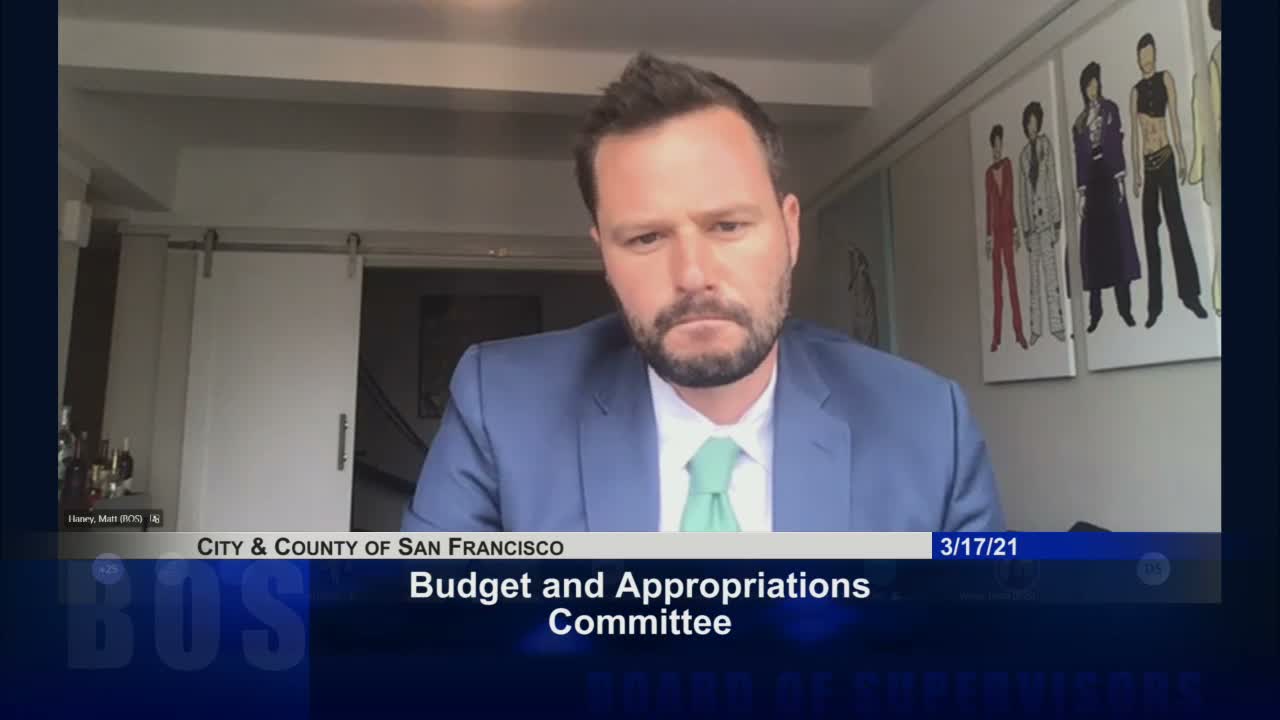
The Budget & Appropriations Committee on March 17 advanced an ordinance to appropriate roughly $20.1 million in one-time funds tied to Prop I revenue for rent relief and a new housing stability fund, approving an amendment to change the revenue source and continuing final action to a special committee meeting on March 23.
Supervisor Dean Preston, who introduced the measure, told the committee the ordinance implements voter intent from Prop I, which raised the transfer tax on high-end real estate to fund rent relief and permanently affordable housing. He said recent controller projections increased Prop I revenue "to $26,100,000 in the current fiscal year, or $20,100,000 after baselines," and urged the committee to use the updated estimates to begin issuing assistance to tenants and small property owners left out of state and federal programs.
Preston described two program streams in the ordinance: a COVID-19 Rent Resolution Relief Fund and a Housing Stability Fund, each receiving initial allocations of about $10 million under the proposal. He also offered — and the committee accepted — a controller-informed amendment to allocate property-tax-derived revenue rather than tapping the General Reserve as originally written.
The office of the Budget Legislative Analyst (Nick Menard) recommended approval of the ordinance but asked the board to request a report from the Mayor's Office of Housing and Community Development on the final implementation rules. Menard noted MOHCD is still developing program rules and recommended a report back regarding the rent-relief design.
Members pressed for program safeguards and transparency. Vice Chair Supervisor Safaie highlighted BLA estimates that needs could range from $90 million to $180 million and asked whether landlord cost-sharing (previously discussed around 50% debt forgiveness) would be required; Preston said MOHCD is developing criteria and that the Prop I funds are intended to fill the gaps for applicants who do not qualify for higher levels of state or federal reimbursement. Preston also asked MOHCD to track demographic data on tenants served, amounts disbursed, landlords receiving funds, and a breakdown of units and arrears, with a report back no later than June.
Public commenters — tenants, tenant advocates and community groups — overwhelmingly urged the board to split Prop I funds between immediate rent relief and social housing, to prioritize undocumented tenants and to seat a diverse oversight board quickly so funds can move out the door.
On procedural votes, the committee approved the Preston amendment changing the revenue source (moved by Supervisor Safaie; seconded by President Walton) on a roll-call vote (Safaie, Marr, Ronan, Walton, Haney — 5 ayes). The committee then voted to continue the item to the special Budget & Appropriations Committee meeting on March 23 as amended (moved by Supervisor Marr; seconded by Supervisor Ronan), with the same 5–0 roll-call outcome.
Next steps: the ordinance will return to the committee on March 23 for further action and then to the full Board of Supervisors. The committee directed MOHCD to supply implementation rules and demographic reporting to guide allocation decisions before large-scale disbursement.