Get Full Government Meeting Transcripts, Videos, & Alerts Forever!
Get email alerts on the Municipal Revenue And Forecast topic
No spam. Unsubscribe anytime.
Controller reports $125M projected general‑fund improvement; warns of fragile, shifting revenue picture
Summary
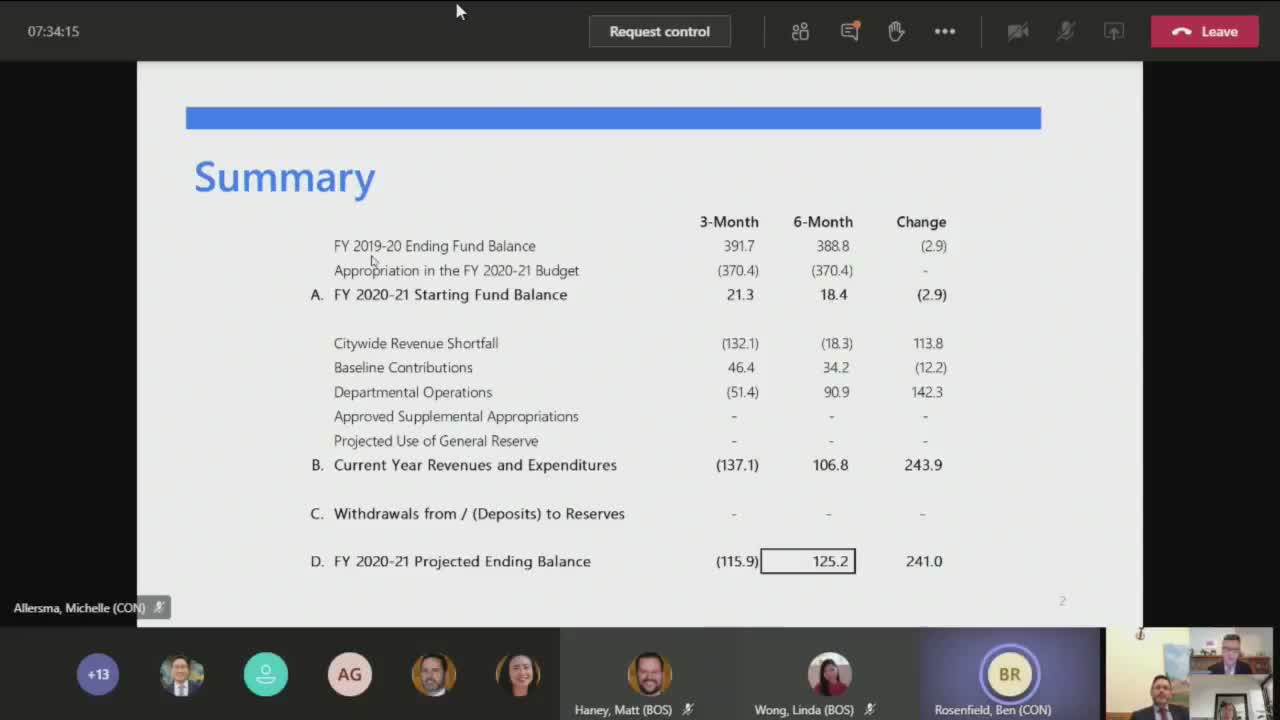
Controller Ben Rosenfield's six‑month status report showed a projected $125 million general‑fund ending balance driven mainly by a handful of state and federal actions (excess ERAF guidance, redevelopment distributions, DPH federal revenue extension and behavioral health reconciliation) and stronger transfer‑tax receipts; Rosenfield cautioned that hotel, sales and business taxes remain weak and federal stimulus and state actions are key uncertainties.
Controller Ben Rosenfield told the Budget and Appropriations Committee that the city's six‑month budget status report projects a roughly $125 million general fund ending balance in the current fiscal year, an improvement from the three‑month outlook.
Rosenfield said much of the positive movement stems from a few material items: final guidance from the State Controller on excess ERAF calculations (net benefit to the city of about $50 million in the current year); state rulings on successor‑agency/redevelopment distributions that freed roughly $20–30 million in property tax for the city this year; an extension of disproportionate‑share and related hospital revenue in federal legislation that yields about $50 million for the Department of Public Health; and accelerated state reconciliation of prior behavioral‑health claims that produced around $30 million in one‑time current‑year benefit.
Rosenfield and Michelle Allersma (Budget Analysis) also reported stronger‑than‑expected property transfer tax receipts in Q4 2020—likely influenced by high‑value transactions and timing around Prop I—offsetting continued weakness in hotel, sales and business taxes. He cautioned that transfer tax is volatile and could decline if construction and commercial sales slow or if tax‑avoidance strategies increase after the Prop I rate change.
On COVID response spending, Rosenfield said new FEMA guidance increasing certain reimbursements from 75% to 100% retroactive to the emergency start improved the city's COVID project picture and produced a projected $77 million general‑fund surplus in the COVID continuing‑appropriation account; because that account is a continuing appropriation, balances roll forward unless the Board chooses to reappropriate them into current‑year general fund uses.
Rosenfield emphasized uncertainties that could materially alter forecasts: final Congressional action on federal stimulus (city estimates under current draft language could provide up to approximately $600 million to San Francisco for state/local aid), possible state legislative changes to ERAF calculations, and additional FEMA guidance expanding eligibility or reimbursement. He said the controller's office will update the five‑year forecast in March and current‑year projections again in the nine‑month report in May.
Committee members asked how much of the COVID continuing‑appropriation savings could be used for programs such as learning‑loss recovery; Rosenfield said board action could reappropriate funds but that baseline projections for next year currently assume some COVID spending will continue and that updated FEMA and federal news will change next year's needs.
The committee filed the six‑month report for the record and discussed convening a focused hearing to set priorities for any available current‑year balance.