Get Full Government Meeting Transcripts, Videos, & Alerts Forever!
Get email alerts on the Municipal Budget topic
No spam. Unsubscribe anytime.
Budget committee clears path to suspend one‑time‑revenue rule and advances spending priorities
Summary
At a remote Aug. 26 Budget & Appropriations Committee meeting, members signaled support to suspend the city—s one‑time revenue policy to bridge a $332 million one‑time/recurring use gap, accepted Fire Department alternative overtime reductions, and discussed funding for Mental Health SF, Black maternal health and testing for community learning hubs.
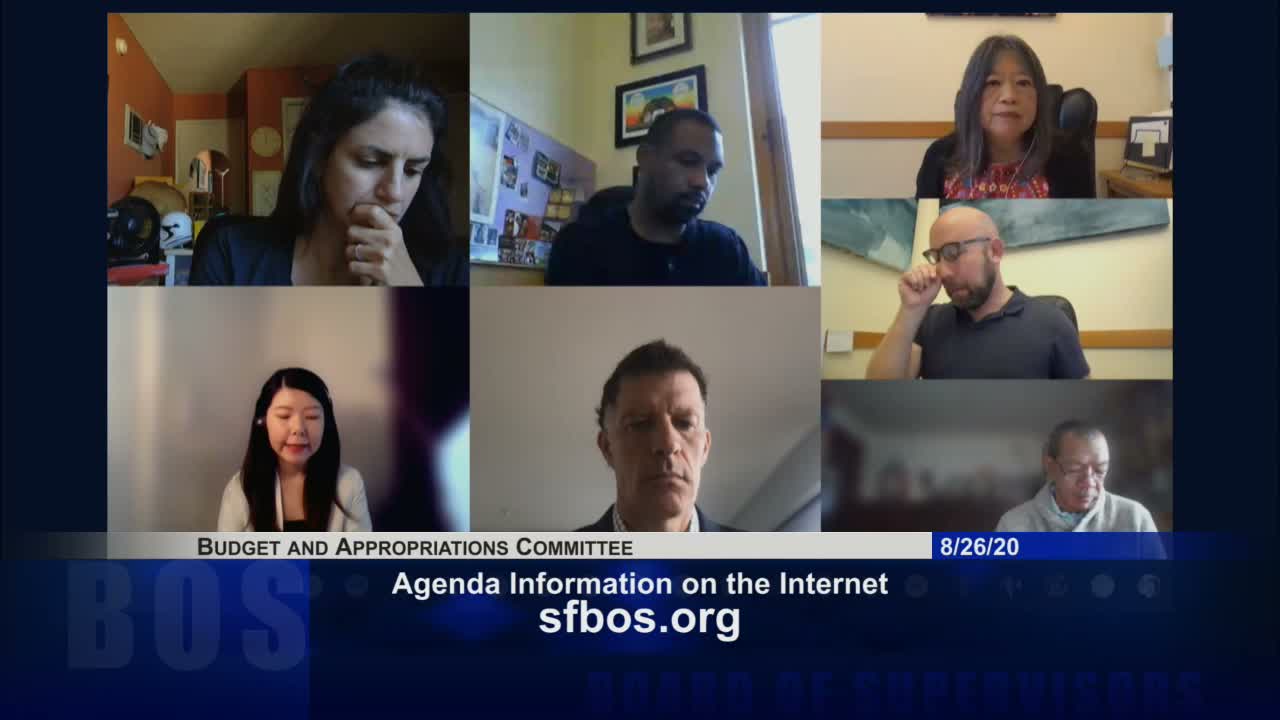
The San Francisco Board of Supervisors' Budget & Appropriations Committee met remotely on Aug. 26, 2020, and moved to allow the use of one‑time revenues for ongoing expenditures by indicating support for a resolution to suspend the city's long‑standing policy that matches one‑time revenues with one‑time uses.
Chair Sandra Lee Feurer opened the session and outlined a revised two‑year spending plan totaling about $42 million that focuses on restoring services cut from the mayor's proposal, expanding rental subsidies for low‑income households, funding targeted investments in Black communities and bolstering community‑based COVID‑19 response and food security programs.
Controller staff told the committee the budget before it includes about $332 million in one‑time revenues but only roughly $89 million in one‑time uses, creating an imbalance that requires the Board to formally suspend Administrative Code 10.6 to lawfully proceed. The committee discussed the tradeoffs that suspension entails and heard from DPH and other departments on how identified one‑time dollars would be applied.
On department adjustments, the committee rejected the Board Legislative Analyst's recommendation to cut funding for a Fire Department ladder truck and command vehicles after the department proposed alternative reductions. The department identified about $650,000 in two‑year savings, primarily by trimming overtime ($310,000 in year one, $305,000 in year two) and eliminating travel in the first year; the controller confirmed the reductions would leave a smaller but continuing overtime budget. President Norman Yee pressed staff to ensure mutual‑aid obligations would still be met.
The committee received a presentation from DPH on Mental Health SF and related capital and staffing costs. DPH said it can cover some capital work in the first year using one‑time revenue tied to a business tax measure and expand joint EMS/DPH crisis teams to six teams (providing 24/7 coverage) and add staffing for a mental health service center, but noted an estimated $11.4 million unfunded gap in a later third year that would require additional revenues.
Supervisors discussed targeted investments for Black maternal and infant health. DPH described roughly $600,000 in new local funding: $200,000 for a doula access program, about $200,000 for the Abundant Birth Project, and roughly $187,000 to staff an Office of Health Equity position to coordinate existing programs that address perinatal disparities.
Supervisor Ronan proposed an outline for proactive testing in community learning hubs to protect children and staff: testing half of hub children in each two‑week period (so each child is tested monthly) and testing adults twice monthly. He estimated the approach at about $7 million a year, with $3.5 million as the local ask if half is reimbursable. DPH said testing cadence guidance is still evolving, supports targeted approaches and broader partnerships with UCSF subject‑matter experts, and said additional resources could allow expansion but could not endorse a fixed cadence without further technical review.
The committee asked the controller and budget analyst to complete an attrition savings analysis for major general‑fund departments and recessed until 3 p.m. The items acted on in committee will be scheduled for the full Board agenda on Sept. 15 unless otherwise noted.
Next steps: committee staff will finalize the ordinance language for the financial‑policy suspension and circulate financial analyses and the attrition report. No formal roll‑call votes on the ordinance were recorded at the Aug. 26 session; the committee signaled agreement on the department reductions and spending direction but left final adoption to the Board process.