Get Full Government Meeting Transcripts, Videos, & Alerts Forever!
Get email alerts on the Racial Equity topic
No spam. Unsubscribe anytime.
Office of Racial Equity presents budget-equity framework; public urges no cuts to CBOs and calls for targeted Black investments
Summary
The Office of Racial Equity presented a racial-equity framework and previewed a budget-equity tool to be released in December; directors reported departmental progress, gaps in investment for Black, Pacific Islander and Indigenous communities, and urged disaggregated data and dedicated equity line items. Dozens of public commenters demanded that community-based organizations be protected from cuts and that the city make targeted investments in Black communities.
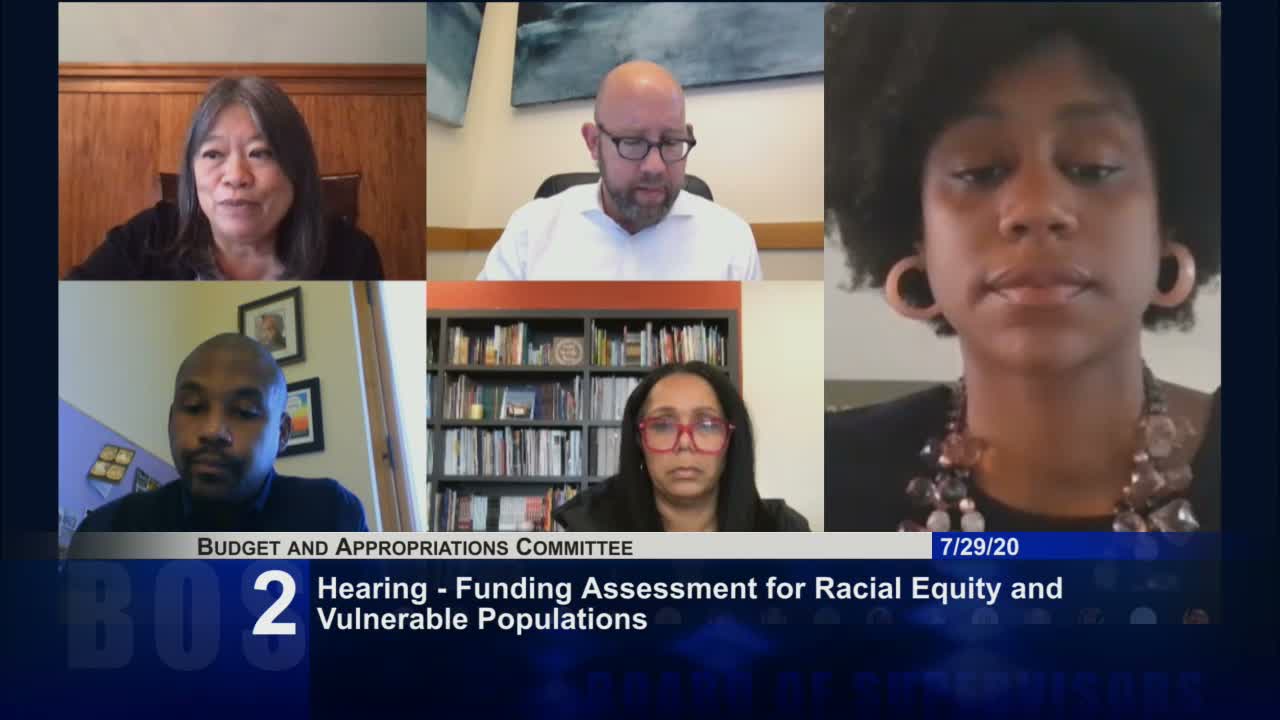
At the July 29 Budget & Appropriations Committee hearing, Director Shakira Simley of the Office of Racial Equity (ORE) described the office’s racial-equity framework and an imminent budget-equity tool the office plans to release in December. Chair Sandra Lee Feuer introduced Item 2 and thanked ORE and Director Cheryl Evans Davis of the Human Rights Commission for participating.
Simley said the ORE’s work is a response to long-standing disparities that COVID-19 has intensified. She told the committee the office surveyed departments and has been working with communities and the mayor’s budget office to create a consistent approach for identifying disparities, prioritizing programs that reduce them and setting measurable outcomes. “We know that San Francisco is facing a $1,500,000,000 deficit over the next 2 fiscal years,” Simley said, framing the urgency of the work.
Key themes Simley described included shifting power to people closest to the pain, disaggregating racial and ethnic data, creating dedicated equity line items, improving transparency and aligning budget plans with citywide racial equity priorities. She said 43 departments have designated racial-equity leaders and that the ORE continues to engage the remaining departments to meet the ordinance’s expectations.
Supervisors pressed Simley and Director Davis on staffing and capacity; Simley and Davis said that the office has limited staffing and needs additional resources to meet pandemic-related demands and ongoing mandates. Director Davis highlighted successful community engagement efforts the Human Rights Commission and ORE have supported in neighborhoods such as the Tenderloin, Sunnydale and Bayview.
Public comment was extensive. Dozens of callers representing immigrant-, Latino- and Black-led community-based organizations urged the board not to cut CBO funding during the pandemic, described rapidly rising demand for services and asked that investments be targeted to neighborhoods with historical disinvestment. Supervisor Shimon Walton cited a past $42 million RFP in which he said about 2% of awards reached Black-led organizations; he urged ORE to review procurement and selection processes. Director Simley and Director Davis described coordination with departments and an intent to use the office’s data and tools to inform future procurement and equity action plans.
Near the close of the meeting Chair Feuer moved to continue Item 2 to the call of the chair for further guidance; the committee voted to continue the item and also voted to excuse President Yi from the remainder of the meeting. The committee adjourned after completing the scheduled business.
Next steps identified in the hearing included continued ORE analysis during August departmental hearings, the release of the budget-equity tool in December and ORE’s offer to work with the mayor’s budget office and departments to apply the tool to budget proposals.