Get Full Government Meeting Transcripts, Videos, & Alerts Forever!
Get email alerts on the Municipal Budget topic
No spam. Unsubscribe anytime.
Supervisors told to prepare 10%–15% cuts as San Francisco faces $1.7 billion COVID shortfall
Summary
The mayor—s budget office told the Board of Supervisors— Budget and Appropriations Committee that the city faces a $1.7 billion shortfall and is asking all general fund departments to propose 10% reductions for FY2021 (rising to 15% in FY2022), plus a 5% contingency for the first year.
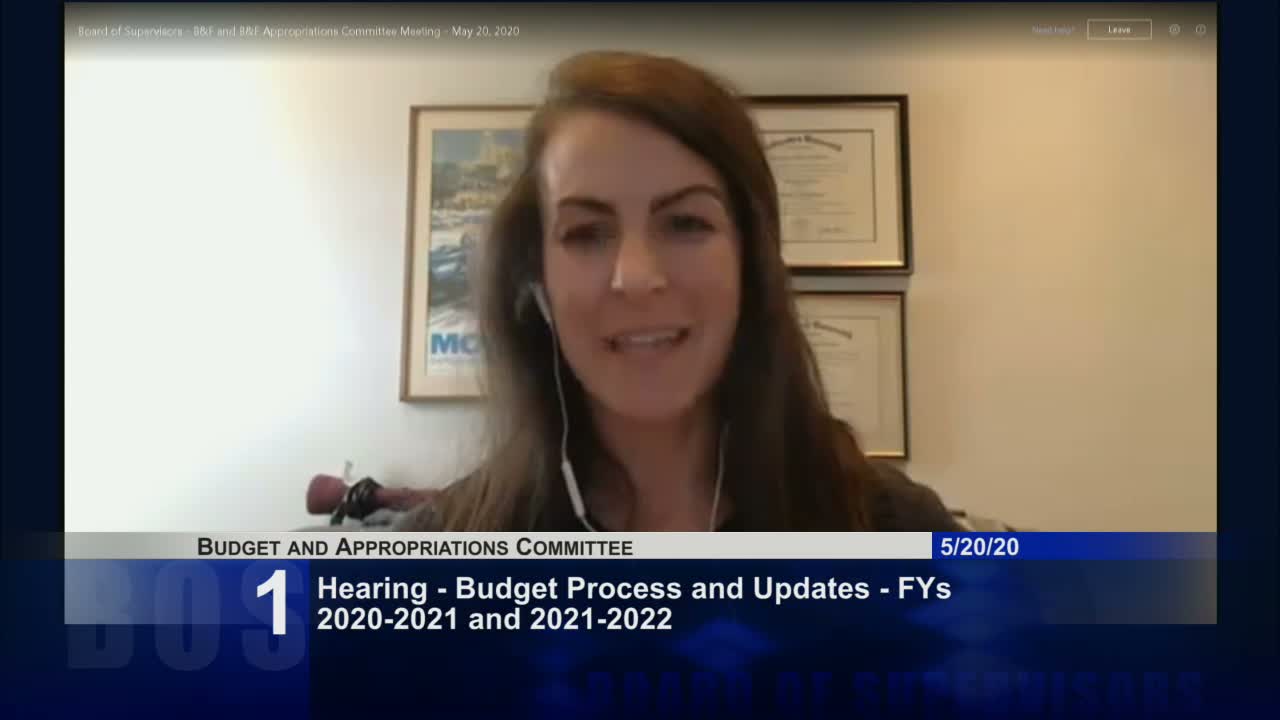
San Francisco—s mayor—s budget office told the Board of Supervisors— Budget and Appropriations Committee on May 20 that the city is "facing a $1,700,000,000 shortfall" tied to the economic impact of the COVID-19 emergency and must prepare immediate, deep spending reductions.
"All general fund departments must propose 10% reductions and adjusted general fund support in fiscal year 21 that grows to 15% in fiscal year 22," Ashley Grafenberger, deputy budget director in the mayor's budget office, said during the committee meeting. She added that the mayor's office is asking departments to identify an additional 5% contingency for FY2021 that could be used if the fiscal picture worsens.
The administration said the $1.7 billion gap consists of roughly $250 million in the current year and $1.5 billion in the upcoming budget years. Grafenberger told supervisors the revised instructions were necessary because the shortfalls materialized late in the budget process and because the duration of the public-health emergency, the pace of economic recovery and state and federal revenues remain uncertain.
Budget staff outlined several tools departments may use to meet targets: contract savings, reductions in personnel costs including elimination of vacant positions and continued hiring freezes, suspending projects, streamlining operations, and seeking outside revenue sources. The mayor's office also said cash-funded general-fund-supported capital projects that are not legally or safety-essential should be paused and coordinated with capital planning and public works.
To maintain city operations while the final budget is prepared, the administration plans to introduce an interim budget on June 1 that would allow baseline appropriations to continue from July until the final budget is adopted. Grafenberger said the interim budget will include a wage delay triggered by an earlier March joint report and that the mayor's proposed budget is scheduled for August 1.
Supervisors pressed budget staff on priorities amid the cuts. "How do we sort of balance that knowing that on the one hand cut or don't expand and don't start new programs knowing that we know this is such a big need?" President Norman Yee asked, citing ongoing support for mental-health services. Grafenberger and Kelly Kirkpatrick, who is assisting the mayor's office, replied that the city will need to rethink service delivery and prioritize core services while protecting vulnerable and underserved residents.
Several supervisors emphasized behavioral health funding during the discussion. Supervisor Rafael Mandaman urged the mayor's office and the Department of Public Health to consider placements and alternatives to simply retrenching services, saying past reductions in psychiatric beds had lasting consequences. Supervisor Ronan asked whether departments were being asked to perform 0-based budgeting; staff said departments should identify core functions and prioritize but not necessarily rebuild budgets from scratch.
Public participation was available by phone and email, and the clerk reported no callers for public comment on Item 1. The committee voted to continue the item to the call of the chair.
Votes at a glance: Chair Sandra Lee Feurer moved to continue Item 1 to the call of the chair, Supervisor Ronan seconded. The clerk recorded a roll-call vote with five ayes and the motion passed as recorded.