Get Full Government Meeting Transcripts, Videos, & Alerts Forever!
Get email alerts on the Covid Finances topic
No spam. Unsubscribe anytime.
Committee hears update on COVID-19 spending, FEMA reimbursements and Give2SF donations
Summary
City staff told supervisors on April 29 that the city has tracked tens of millions in COVID-19 spending, submitted expedited FEMA public assistance requests that have been obligated, and is using CARES Act and Give2SF donations to cover non‑FEMA costs. Officials cautioned much depends on eligibility and documentation.
San Francisco’s Budget and Finance Committee on April 29 received an update on the city’s COVID-19 spending, how much can be recovered from FEMA and other sources, and how private donations are being used.
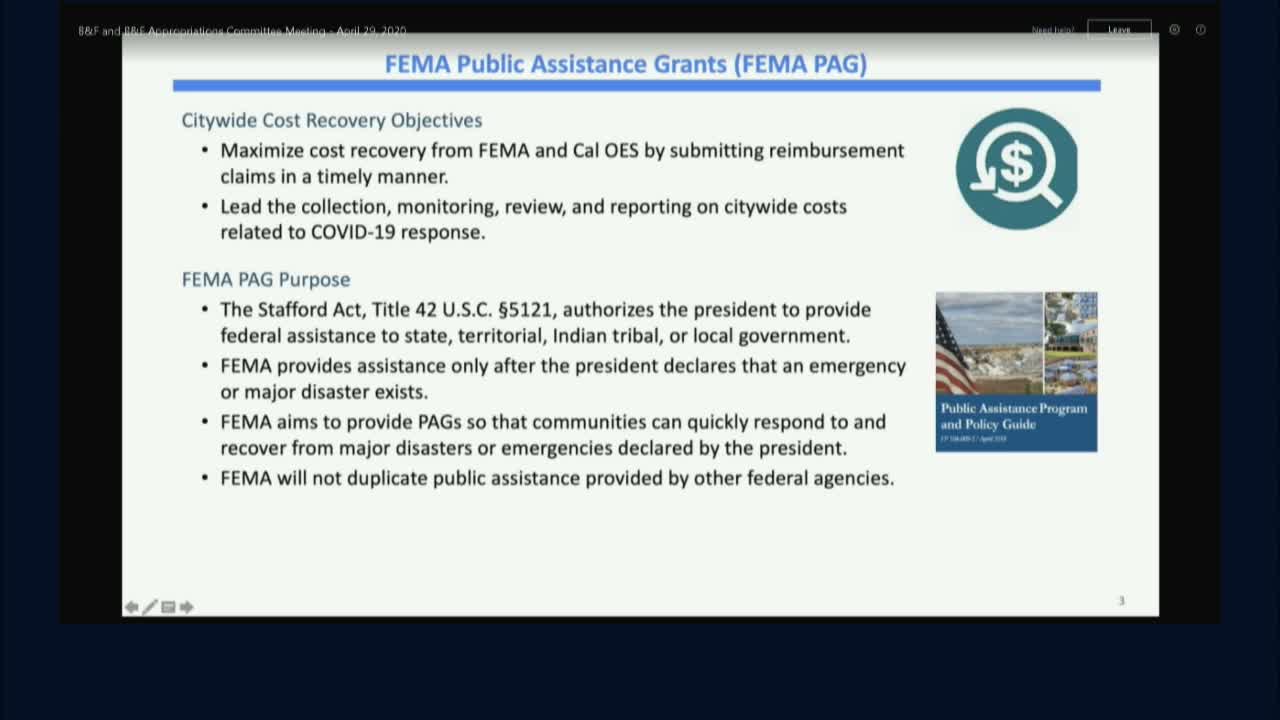
Acting audits director Mark De La Rosa of the Controller’s Office told the committee the city has tracked several cost categories that FEMA’s public assistance grant program may cover, including emergency operations center management, non‑congregate medical sheltering, PPE and supplies, alternate care sites, food and water, and overtime tied to protective measures. De La Rosa said FEMA generally reimburses 75 percent of eligible costs, Cal OES covers 18.75 percent, and the local share is 6.25 percent; he stressed that accurate documentation is vital to avoid duplicate federal payments.
De La Rosa said the city submitted three expedited funding requests in April covering emergency protective measures, non‑congregate sheltering and emergency medical care. He told supervisors those expedited requests had been reviewed and obligated by FEMA and were being routed through Cal OES, the state grantee, to the city as part of the public assistance process. He added that future biweekly submittals will include actual expenditures with backup documentation.
City staff also presented broad spending figures as of April 28: roughly $60 million in expenditures already recorded (about half attributed to salary and benefit costs), including $15 million on health‑related staffing and medical transportation. The presentation showed approximately $40.4 million in FEMA‑eligible amounts submitted as part of expedited requests; a CARES Act installment and other federal/state allocations were also noted.
Kelly Kirkpatrick of the Mayor’s Budget Office and Controller Ben Rosenfield cautioned supervisors the numbers on the slides mix estimates and actuals. Rosenfield said the chart presented was an incomplete snapshot because some contracts and orders have not yet been captured; the city expects to present a fuller projection through June 30 in an upcoming May report that will reconcile projected expenditures with the various federal and state funding sources.
Supervisors pressed staff on whether FEMA and CARES Act funds together would cover the “vast majority” of COVID‑related expenses. De La Rosa and Rosenfield responded that FEMA will only reimburse costs that meet its eligibility rules and that CARES Act guidance as to whether CARES funds must be spent before seeking FEMA reimbursement remains uncertain; the city is working to clarify sequencing and eligibility.
Officials also described Give2SF, a private fundraising effort: the city has received about $9.5 million in donations and dispersed roughly $5 million for small business and worker support, food security and housing assistance, with an administration and oversight committee managing priorities.
Chair Sandra Lee Fewer and other supervisors asked staff to return with more detail in the next projection report. Public comment was taken and, amid procedural housekeeping, the committee voted to continue the budget overview item to the call of the chair for further analysis.
The committee did not take final budget action at this meeting; staff indicated more detailed reports and reconciliations will come in mid‑May.