Get Full Government Meeting Transcripts, Videos, & Alerts Forever!
Get email alerts on the Youth Budget Priorities topic
No spam. Unsubscribe anytime.
San Francisco Youth Commission urges funding for Vote16, youth housing and civics education
Summary
At a Feb. 26, 2020 Budget and Appropriations Committee hearing, the San Francisco Youth Commission pressed for more Department of Elections funding and classroom civics ahead of a planned Vote16 ballot effort, expanded transitional-age youth housing (a 400-unit goal), and funding for Know Your Rights outreach and transit for students.
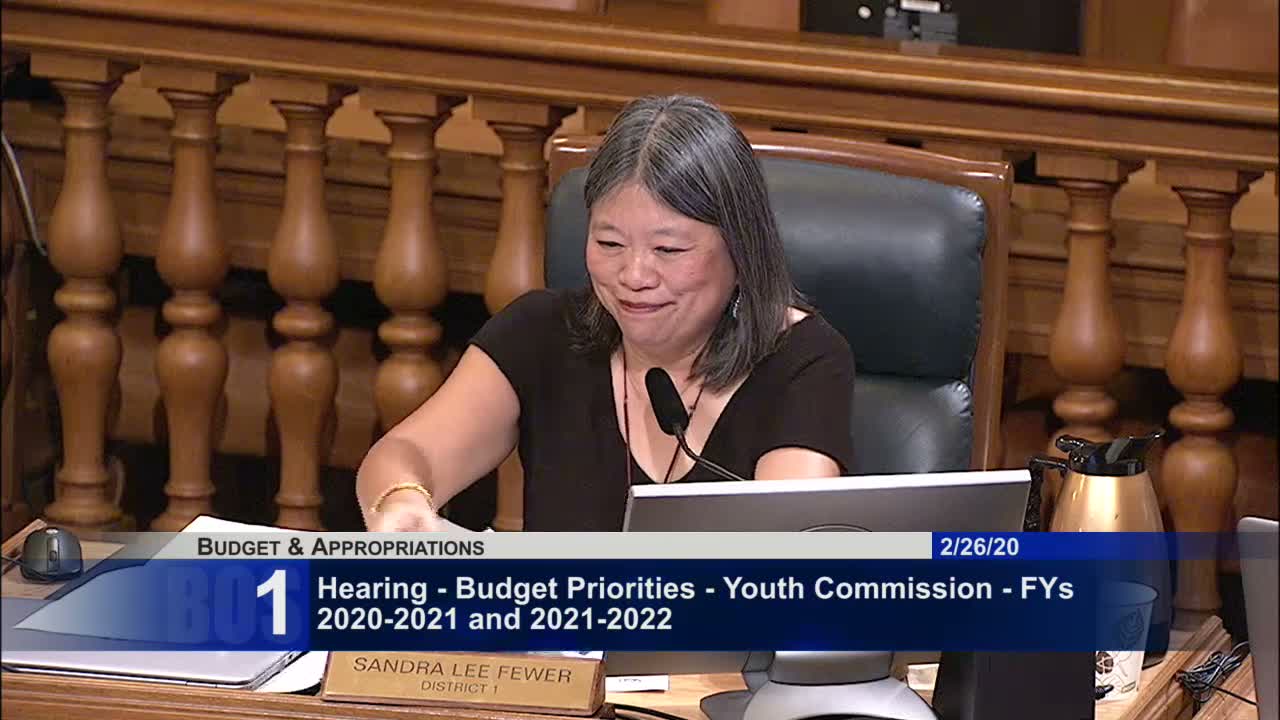
On Feb. 26, 2020 the San Francisco Budget and Appropriations Committee heard a presentation from the San Francisco Youth Commission laying out preliminary budget and policy priorities for fiscal years 2020–21 and 2021–22.
"It is a central duty of the Youth Commission to report on the unmet needs of youth in San Francisco every year," Calvin Quick, the commission's legislative affairs officer and District 5 representative, told the committee as he opened the commission's presentation.
Commissioners presented three committee-level priorities: civic engagement (including the Vote16 campaign), transformative justice (including Know Your Rights outreach and expanded young adult court capacity), and housing and land use (focused on transitional-age youth, or TAY). Ariana Nasiri, chair of the civic engagement committee, said Vote16 seeks to allow 16- and 17-year-olds to vote in local elections and that the campaign’s success “depends solely on the fortification of education infrastructure” so newly enfranchised youth will be prepared to vote.
Nasiri told supervisors the commission is working with President Yi’s office and plans to bring Vote16 to the Board of Supervisors in May; the commission intends to seek financial support before any November ballot placement and emphasized that commissioners cannot run a ballot campaign while acting in their official commission roles.
The transformative justice committee, led by Josephine Kearton, urged maintaining and expanding the young adult court and called for accountability measures for community-based organizations that receive city funds. Kearton also corrected an earlier phrasing while speaking: she requested a minimum of 100 units of permanent supportive housing for girls, saying the change from "100 shelter beds" to "100 units of permanent supportive housing" reflected the committee’s intent.
Katav Elmeri, vice chair of the housing and land use committee, said the commission supports a goal of 400 units of transitional-age permanent supportive housing and estimated roughly 200 units exist today. Elmeri also asked the Department of Homelessness and Supportive Housing to increase funding for mental-health counseling, substance-use treatment and drop-in centers for TAY, and urged SFMTA to expand the free muni-for-youth enrollment and pursue service improvements on the 29 bus corridor to reduce overcrowding and missed stops.
Rocky Versace recommended gender-specific and LGBTQ-inclusive programming with juvenile probation, mandatory youth-focused SFPD training that incorporates youth brain development and a trauma-informed equity lens, and more consistent implementation of community-oriented plans. The commission also asked the Public Defender’s Office to explore funding for immigration relief, bail reform and reentry case management.
Supervisors pressed commissioners for detail and numbers. President Yi asked if the commission had ranked higher- versus lower-priority items; Quick replied the commission’s charter role is to report unmet needs rather than set a ranked order but acknowledged some issues were further along toward concrete goals. Supervisor Feuer urged the commission to attach dollar figures and program-size estimates to each ask to assist the committee’s funding decisions; commissioners said they are working with the controller’s office and departmental finance contacts to provide cost estimates in the full May budget and policy priorities report.
Ariana Nasiri said the commission has already seen progress on preregistration: she reported receiving an email that, "as of January 30, 2020, San Francisco has seen a record high of 16- and 17-year-olds who are preregistered to vote," and supervisors encouraged the commission to coordinate with SFUSD and the Student Advisory Council to build school-based preregistration and civics instruction.
The committee took a procedural motion to file the item and accepted it without objection. Chair Sandra Lee Fuerich moved to file the report; the clerk recommended filing and the meeting was adjourned.
The Youth Commission will submit a final BPP report in May with more detailed cost estimates and implementation suggestions for the priorities it outlined to the Budget and Appropriations Committee.