Get Full Government Meeting Transcripts, Videos, & Alerts Forever!
Get email alerts on the Worker Justice Fund topic
No spam. Unsubscribe anytime.
Budget committee amends and advances Worker Justice Fund after hours of testimony from affected workers
Summary
After hours of public testimony, the Budget and Finance Committee amended an ordinance to create a Worker Justice Fund that would pay workers when employers cannot, narrowed eligibility to primarily minimum-wage violations, reduced the redirected OLSE penalty share to 50%, and continued the item one week to Nov. 20 for final language. The fund drew wide support from worker centers and legal aid groups.
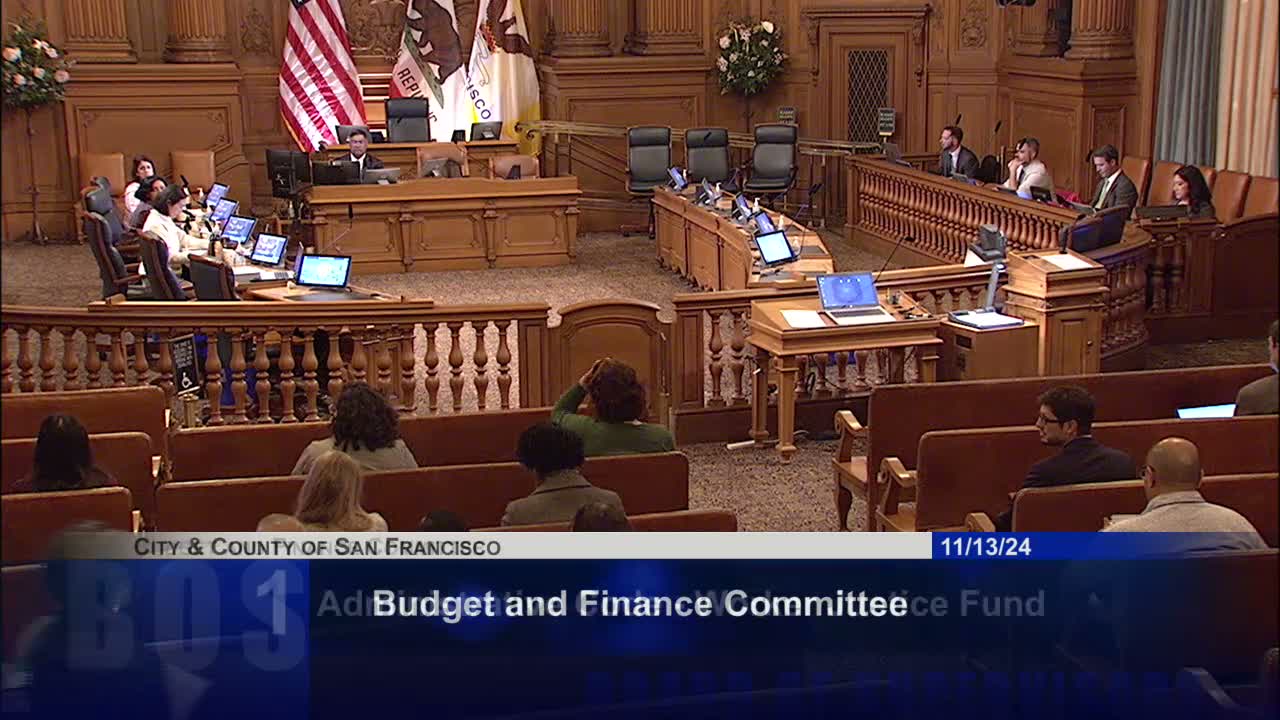
Supervisor Hillary Ronan’s proposed Worker Justice Fund, intended to provide timely restitution when employers cannot pay court-ordered wages, moved forward in the San Francisco Budget and Finance Committee on Nov. 13 after extensive public testimony and a committee amendment.
Ronan described the measure as a targeted safety net for low-wage workers whose employers have absconded, closed, or lack assets to satisfy wage judgments. She told the committee she would introduce amendments to narrow eligibility and to phase aspects of the program in. "This is one of the first of its kind in the country," Ronan said in opening remarks.
The Budget and Legislative Analyst (BLA) presented fiscal estimates that shaped the changes. BLA staff said Office of Labor Standards Enforcement (OLSE) penalty revenues average about $1.4 million a year; the sponsor’s amendment to redirect 50% of those revenues would provide roughly $700,000 annually to the Worker Justice Fund. Based on OLSE case data and the narrower focus on minimum-wage violations, BLA estimated payouts from the fund would range roughly from $100,000 to $300,000 annually. OLSE told the committee it may need up to four positions to administer the fund, at an estimated cost of about $800,000 a year if backfilled through the general fund.
Ronan’s amendments the committee adopted limited eligibility largely to minimum-wage violations (with one grandfather exception related to a Burger King healthcare-security case), reduced the share of OLSE penalty revenues directed to the fund from 100% to 50%, and added a clause giving OLSE up to three years to pursue and escheat unclaimed settlement funds. The committee voted to amend the ordinance as described and to continue the item one week to Nov. 20 so the final text may be circulated.
The public comment period featured more than three hours of testimony from workers, organizers and lawyers. Community advocates described repeated examples of wage theft and its consequences: long delays to recover money, employers filing bankruptcy or disappearing, and families pushed into debt. Mimi Chan of the Asian Law Caucus told the committee, "The Worker Justice Fund puts wages earned by workers back into workers' hands." Alex Campbell, senior staff attorney at Legal Aid at Work, called the proposal "smart" and said it is intended to ensure that workers who prevail in enforcement proceedings can actually receive restitution when employers have no assets.
Several workers gave first-person accounts. One caregiver, Lorena, said she and her husband were awarded roughly $32,000 but received only a single payment before their employer’s care home closed; another recorded witness, a former Paramount Superstar restaurant worker, said the owner disappeared and left him owed about $10,000. Advocates argued those examples show why an enforcement victory without a remedy can chill future claims and weaken enforcement efforts overall.
Some committee members and members of the public raised concerns that diverting OLSE penalty revenue could diminish enforcement capacity. Winnie Gao of the Asian Law Caucus responded that the fund is narrow in scope and would strengthen enforcement by ensuring victims receive restitution, not by absolving employers: "When workers muster the courage to come forward … and end up with nothing, it undermines the impact of our enforcement work," she said.
The committee’s formal action amended the ordinance as described and voted to continue the item to the Nov. 20 Budget and Finance meeting so the exact amended ordinance language can be entered into the record. Roll call on the motion showed Member Melgar—Aye; Chair Chan—Aye; Vice Chair Mandelmann—excused.
What’s next: The item was amended and continued to the committee’s Nov. 20 meeting; the clerk and sponsor will circulate the revised ordinance text to supervisors and to the clerk’s office prior to that date. The committee did not adopt a final implementation plan for staffing; the BLA recommended any request for positions be addressed through the budget process next year.