Get Full Government Meeting Transcripts, Videos, & Alerts Forever!
Get email alerts on the Behavioral Health Beds topic
No spam. Unsubscribe anytime.
Supervisors press DPH on whether San Francisco’s bed expansion is producing usable treatment capacity
Summary
At a Feb. 21 Budget & Finance Committee hearing, city health officials said DPH has opened nearly 400 behavioral health beds since 2020 but still estimates a gap — especially 55–95 locked subacute beds — citing workforce, procurement and counting challenges; the committee continued the item for follow-up.
San Francisco — City health officials told the Board of Supervisors’ Budget & Finance Committee on Feb. 21 that the Department of Public Health (DPH) has added nearly 400 residential behavioral health beds since 2020 but still faces notable shortfalls and operational challenges.
Vice Chair Rafael Mendelmann, sponsor of the hearing, framed the session around the city’s effort to reach a 400-bed expansion announced in 2021 and the broader effects of a statewide retreat from institutional mental health care that has shifted demand to local systems. "DPH has identified a gap of between 55 and 95 locked sub acute treatment beds," Mendelmann said during opening remarks.
Dr. Hillary Kennans, the DPH presenter, told the committee that DPH’s current inventory estimate is roughly 2,550 residential beds, a figure that combines fixed, contracted beds and a set of variable “as-needed” beds that fluctuate by demand and inter-county availability. DPH said it has about 44 beds left to open to reach the 400-bed goal conceived under Mental Health SF, and that updated modeling (including a 2022 RAND triangulation) recommends an additional 50 general mental-health residential beds, 55–95 locked subacute (LSAT) beds, 20–40 behaviorally complex RCFE/elder care beds, and 20–30 more substance-use disorder (SUD) step-down beds.
DPH and supervisors flagged three constraints that complicate whether added beds translate into more San Franciscans actually receiving appropriate placements: workforce shortages, procurement and contracting delays, and the opaque status of "as-needed" out-of-county beds.
"Vacancies can sometimes reduce the effective behavioral health residential capacity by 15 to 20 percent," Dr. Kennans said, describing workforce churn and a forthcoming controller’s wage-and-staffing analysis aimed at identifying retention and pay strategies. She also described procurement hurdles that can keep new or out-of-county providers from contracting quickly with the city. DPH said it is seeking a competitive-solicitation waiver to speed contracting and has convened an executive steering committee to operationalize SB 43 implementation.
Kelly Dearman, executive director of the Department of Disability and Aging Services, presented a complementary snapshot of assisted-living capacity. Using state licensing data, Dearman said there are about 2,700 residential care facility for the elderly (RCFE) beds in the city; DOS reported a net loss of small board-and-care facilities but net growth in total RCFE beds driven by larger facilities. Dearman also described DOS subsidy programs (the Community Living Fund, HomeSafe pilot) and warned that some state funding for pilots expires in mid-2025.
Supervisors pressed DPH on how it counts beds on the public dashboard and whether contracted or acquired beds translate into placements of San Franciscans. Mendelmann cited a discrepancy in one chart that lists 76 contracted RCFE beds from a provider while internal breakdowns accounted for 58; he called for reconciliation and better provenance of counts. Supervisor Hillary Ronan asked for clearer methodology and more visible wait-time data, noting that estimates alone do not show whether people with severe needs are being placed more often than five years ago.
Tanya Mara, representing jail health coordination, described logistical obstacles to moving justice-involved people into residential placements — inter-county warrants, court scheduling, required medical clearances — and offered recent case examples that delayed placement by weeks despite active coordination.
Public commenters included Adrian Maldonado, director of Harbor Light Center, who said his program expanded from 30 to more than 100 clients since June 2023 and urged the city to make fuller use of community recovery models and available Salvation Army beds; Adam Francis of the San Francisco Marin Medical Society urged immediate workforce incentives to reduce the 15–20 percent of beds that are unstaffed; and neighborhood representatives described improved outreach but persistent unmet needs.
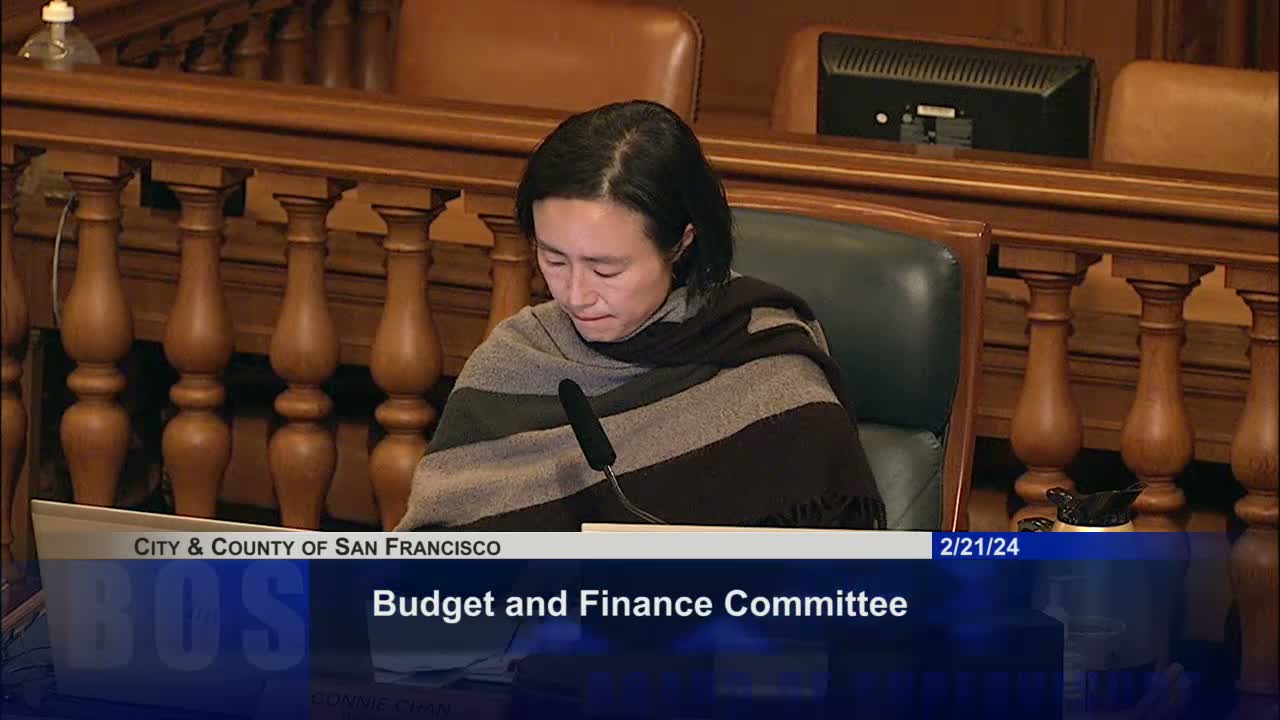
The committee voted to continue the item to the call of the chair so supervisors and staff can reconcile public-dashboard discrepancies, provide data on how many San Franciscans are actually placed in each bed type over time, and return with a clearer strategic and funding plan. The motion, made by Vice Chair Rafael Mendelmann, passed on a 3–0 roll call (Mendelmann aye; Melgar aye; Chan aye).
What’s next: DPH and DOS were asked to provide reconciled bed counts by contract/location, citywide wait-time data for key bed types, a list of out-of-county bed contracts and counties involved, and a projection of the expected effect of procurement-waiver authority and forthcoming controller wage/staffing analysis. The committee signaled that Prop. 1 capital funding and SB 43 implementation will be central to longer-term infrastructure planning.