Get Full Government Meeting Transcripts, Videos, & Alerts Forever!
Get email alerts on the Harm Reduction topic
No spam. Unsubscribe anytime.
Supervisors pause approval of $6.5M amendment to syringe‑access contract, ask DPH for status report
Summary
The Budget & Finance Committee continued a vote on a proposed $6.5 million amendment to the Department of Public Health contract with the San Francisco AIDS Foundation after supervisors requested a report on implementation of recently approved fentanyl response funding and service‑level monitoring.
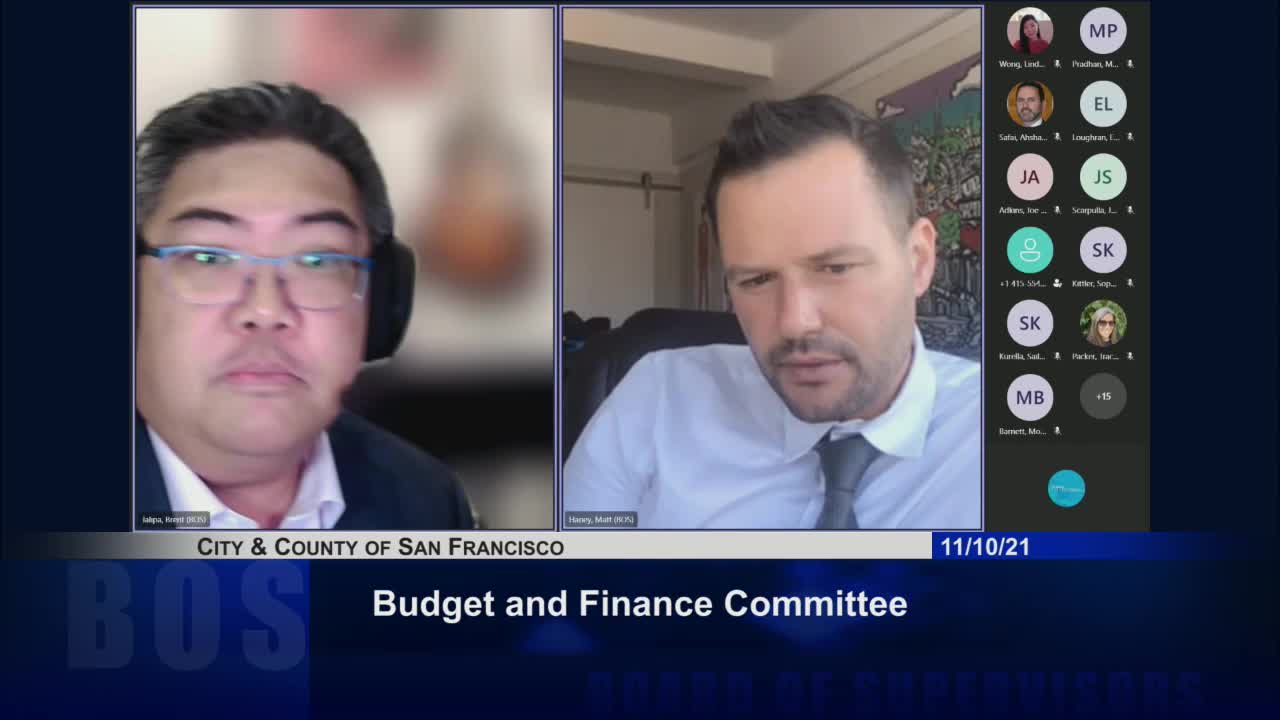
Chair Matt Haney on Wednesday continued debate on a requested third amendment to the Department of Public Health’s contract with the San Francisco AIDS Foundation, saying the committee needed more information on how recent fentanyl‑focused funding has been implemented before approving an additional $6.5 million.
The amendment would add roughly $6,500,000 to the existing syringe access and disposal agreement, increasing the contract’s not‑to‑exceed amount to about $42,100,000 with no change to the contract term, DPH presenters said. DPH described the contract as a continuation of existing services that include syringe distribution and disposal, overdose prevention, health education, harm‑reduction support, counseling, low‑barrier substance‑use treatment and HIV and hepatitis C testing and linkage.
Nick Bernard of the Budget and Legislative Analyst’s office said the BLA supports the proposed amendment but asked DPH to provide monitoring data from fiscal year 2020–21 once that evaluation is complete; the most recent monitoring data BLA had been able to review were from FY 2019–20.
Supervisor Asha Safaie pressed DPH staff on program details, asking whether sites hand out fentanyl test strips (they do) and which neighborhoods are prioritized. Eileen (CHEP representative) said fentanyl‑test‑strip distribution and training are offered at syringe sites and that ‘‘hot spots’’ for disposal and enhanced outreach are identified through supervisor input, constituent reports and the Syringe Access Collaborative. She also described a Bayview pilot that added contingency‑management outreach and a medical doctor on Mondays to provide targeted fentanyl outreach.
Both Safaie and Haney asked how the city measures success, including whether the program tracks transitions from harm reduction to abstinence‑based treatment. Staff said partners do not collect individual names to preserve low‑barrier access, which complicates measuring long‑term abstinence, but they do track connections to buprenorphine and other treatment services. DPH staff said they are working with Behavioral Health and community partners to improve tracking and to report results from recent contingency‑management work.
Haney said the committee had approved roughly $1 million earlier in the year for fentanyl response actions and asked whether that funding had been deployed; DPH said those surplus‑funded pieces are being implemented through other contracts, not this amendment, and said they could prepare a status report on rollouts and people reached so far.
After discussion, Haney moved to continue the item for one week to allow DPH to provide the requested updates. The committee approved the continuance by roll call (Vice Chair Safaie, Member Marr and Chair Haney: 3 ayes).
The committee emphasized support for the AIDS Foundation’s work while asking for a clearer accounting of how the recent overdose‑response funding has been spent and what measureable outcomes have been achieved.
What’s next: The item was continued to the Budget & Finance Committee meeting scheduled for Nov. 17, 2021.