Get Full Government Meeting Transcripts, Videos, & Alerts Forever!
Get email alerts on the Housing Transfer Tax topic
No spam. Unsubscribe anytime.
Supervisors’ committee backs transfer-tax exemption to help deed-restricted affordable rentals
Summary
The Budget & Finance Committee voted to forward an ordinance that would exempt deed-restricted rental properties from higher Prop I transfer-tax rates when values meet statutory thresholds, aiming to ease small-sites and preservation acquisitions while carving out an estimated <2% of Prop I revenue.
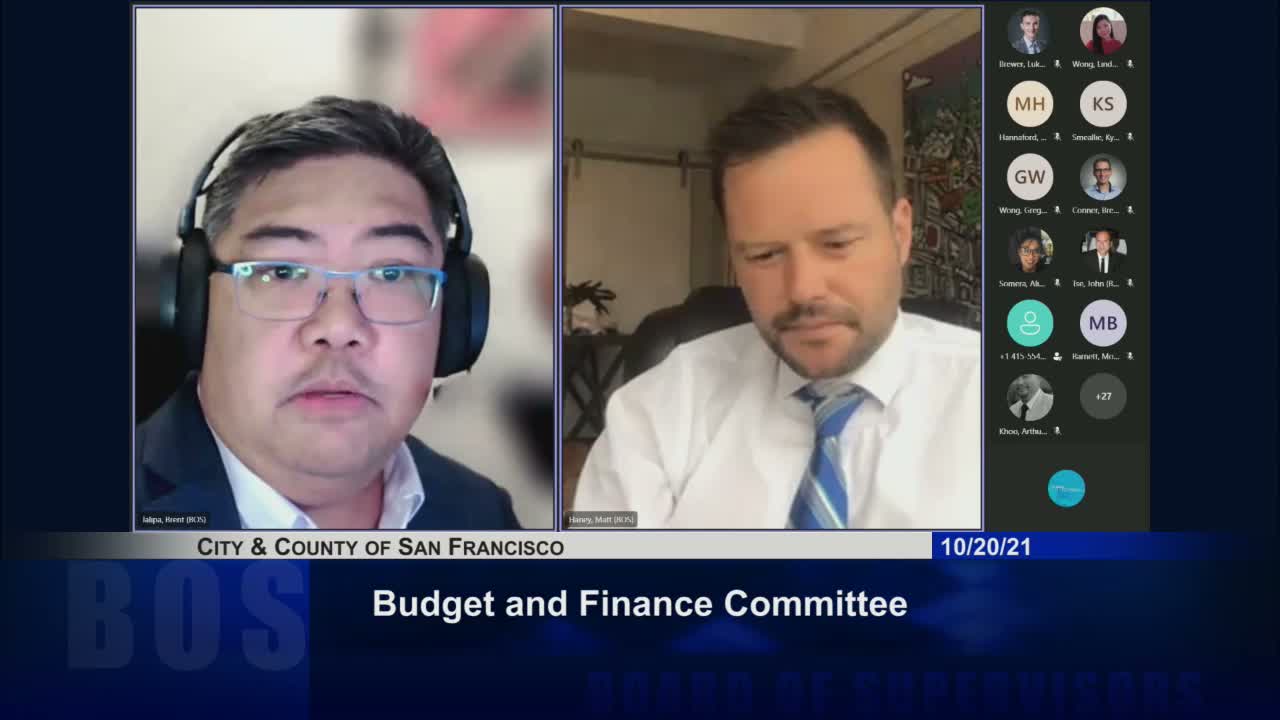
Supervisor Rafael Mandelman (presented as Supervisor Preston in the transcript), before the Budget & Finance Committee on Oct. 20, introduced an ordinance to exempt transfers of deed-restricted residential rental properties from higher transfer-tax rates approved by recent ballot measures. The exemption would apply to transfers on or after Jan. 1, 2021, where the sales consideration meets or exceeds $5,000,000 and the property meets a set of affordability criteria.
The ordinance defines eligible projects as those restricted to households earning up to 120% of area median income, with the average maximum unit income at or below 80% of AMI at initial occupancy, rents limited to no more than 30% of household income, affordability restrictions recorded for at least 55 years, monitoring by a government agency, and either vacant status before sale or qualification for the welfare exemption under section 214 of the California Revenue and Taxation Code. The mayor’s Office of Housing and Community Development (MOHCD) would certify eligible properties.
The Budget Legislative Analyst, Nick Menard, told the committee the change would reduce general-fund transfer-tax revenues by an estimated $8.1 million for the period Jan. 2021 through June 2024 and noted a drafting error in the report to be ignored. Supervisor Preston said the exemption would carve out less than 2% of the Prop I revenue stream while clarifying a flat 0.75% transfer-tax rate would apply to qualifying affordable projects under the ordinance.
Supervisors sought implementation clarifications. Supervisor Asha Safaie asked whether the small-sites acquisition program would benefit; Lydia Ealy of MOHCD answered that small-sites purchases over $5 million would qualify and that many small-sites developers already qualify as COPA QMPs and are therefore already exempt. Supervisor Gordon Mar asked why two projects with similar purchase prices had substantially different estimated tax savings; the BLA explained San Francisco’s transfer-tax is not marginal but applied to the full value and that higher-tier rates apply once a price exceeds $10 million, producing the observed discrepancy.
The public-comment period drew multiple housing advocates and nonprofit developers who urged approval. Charlie Shumas (Council of Community Housing Organizations), Saki Bailey (San Francisco Community Land Trust), Anastasia Yovanopoulos (San Francisco Tenants Union), Caroline Fang (Mission Economic Development Agency), Peter Cohen (CCHO), Fernando Marti (CCHO), Rebecca Foster (Housing Accelerator Fund), Chris Cummings (Tenderloin Neighborhood Development Corporation), David Sobel (SF Housing Development Corporation) and others described the exemption as an important tool to preserve and acquire affordable homes and noted Prop I has brought new revenue that can scale small-sites and preservation work.
Chair Matt Haney moved the ordinance forward with a positive recommendation to the full Board. The clerk recorded a roll-call vote with Vice Chair Asha Safaie, Member Gordon Mar and Chair Matt Haney voting “Aye” and the committee forwarded the item to the full Board with a positive recommendation.
What’s next: The ordinance will be heard by the full Board of Supervisors on Oct. 26 unless otherwise scheduled.