Get Full Government Meeting Transcripts, Videos, & Alerts Forever!
Get email alerts on the Housing Finance And Grants topic
No spam. Unsubscribe anytime.
Budget and Finance Committee advances housing bonds and several grants, asks for Sunnydale cost breakdown
Summary
The committee recommended multiple housing bond and grant actions to the Board of Supervisors, including Mission Bay Block 9 and a Sunnydale Block 6 bond; it also advanced public-health and education grants and continued two items for additional information, including a detailed cost-per-unit report for Sunnydale.
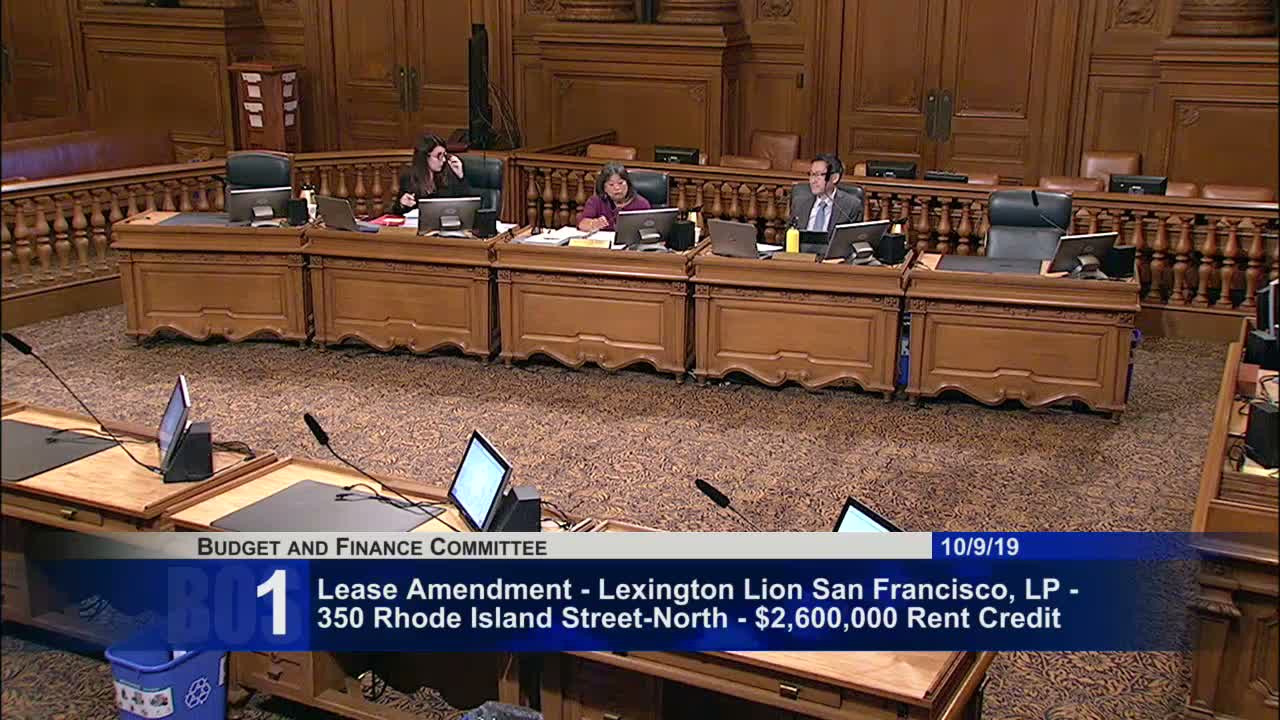
The Budget and Finance Committee met Oct. 9, 2019, and recommended several housing finance actions and grant agreements to the full Board of Supervisors while asking staff for additional cost detail on a large Sunnydale housing project.
The committee recommended that the Board consider a bond application for Mission Bay South Block 9, a 141-unit development for formerly homeless households, and moved multiple funding items forward with positive recommendations. It also approved moving to the Board a retroactive, three-year intergovernmental agreement with the State Department of Health Care Services for Drug Medi-Cal substance use disorder services totaling $171,700,000 (07/01/2019–06/30/2022). Jim Stillwell of the Department of Public Health told the committee the contract is retroactive because the city received the agreement late and noted the agreement establishes Drug Medi-Cal billing rules. Severn Campbell of the Budget Analyst's Office (BLA) summarized the grant as reimbursable spending and recommended approval while cautioning that year-two and year-three amounts could change with state budgeting.
The committee also recommended that the Board accept $962,000 from the California Student Aid Commission to continue the Kindergarten to College outreach and incentive program. Eric Mankey of the Treasurer———s Office said the city automatically opens accounts for SFUSD kindergartners, that families have saved about $4.6 million in those accounts since the program began, and that total balances including city and private funds are about $7.3 million.
The Department of Public Health asked the committee to accept and expend a $2.3 million grant from the California Department of State Hospitals to support a pretrial felony mental health diversion program that will fund intensive case management through UCSF, stabilization rooms and evaluation teams via Hatchell Tabernick and Associates, and a behavioral health clinician for jail evaluations and treatment referrals. The committee moved that item to the Board with a positive recommendation.
On housing finance, Christina Moon (Mayor——s Office of Housing and Community Development) presented Mission Bay South Block 9, a conduit financing transaction that would not obligate the city's general fund. The Block 9 project sponsor team (Mission Bay 9 LP, Bridge Housing and Community Housing Partnership) plans 141 studio units with on-site supportive services and a community garden. The committee recommended the Tefra/bond application proceed to the Board.
The committee also considered multifamily housing revenue bonds for the acquisition and rehabilitation of a 67-unit affordable rental project at 385 Eddy Street. The agenda lists the bond amount "not to exceed $26,900,000," but presenter Amy Chan referred to $28,900,000 during her remarks; the committee moved the item to the Board with a positive recommendation and did not resolve the discrepancy in-session.
For Sunnydale Block 6 (242 Hahn Street), MOHCD staff described a financing package that includes a bond (Item 7) and a gap loan (Item 8). The BLA reported that the Block 6 project would receive approximately $18.6 million in gap financing from the city and that the total project cost is about $148.7 million. The BLA flagged a per-unit development cost of roughly $890,000 and recommended the mayor——s office report back on the drivers of these housing costs by Dec. 9, 2019. In committee questioning, MOHCD attributed higher costs to difficult site topography and grading, relocation requirements, parking and infrastructure, and stability work (pile-driving) for higher-density construction. The committee moved Item 7 (bond authorization) to the Board with a positive recommendation and continued Item 8 (gap loan) to the next meeting to allow MOHCD to provide the requested cost breakdown.
Votes at a glance: the committee took items forward by unanimous voice consent where noted as "if I can take that without objection" (items advanced included Items 2, 3, 4, 5, 6, and 7). Item 1 was continued to Oct. 16; Item 8 was continued for additional cost detail. The meeting adjourned after no further business.
What happens next: most items will appear on the Board of Supervisors agenda on Oct. 22 unless otherwise stated; MOHCD was asked to return with a chart comparing Parcel Q and Block 6 cost drivers and to deliver a report back by Dec. 9, 2019, on housing cost drivers as requested by the BLA.