Get Full Government Meeting Transcripts, Videos, & Alerts Forever!
Get email alerts on the Electronic Monitoring topic
No spam. Unsubscribe anytime.
San Francisco supervisors press for data, changes after full hearing on electronic monitoring
Summary
Supervisors, public defenders and community groups debated the city nd county gencies' use of electronic monitoring, raising concerns about equity, legal authority for searches and device-related re-arrests; the committee agreed to continue the Sheriff's EM rules to allow departments to craft revised language and pursue additional study.
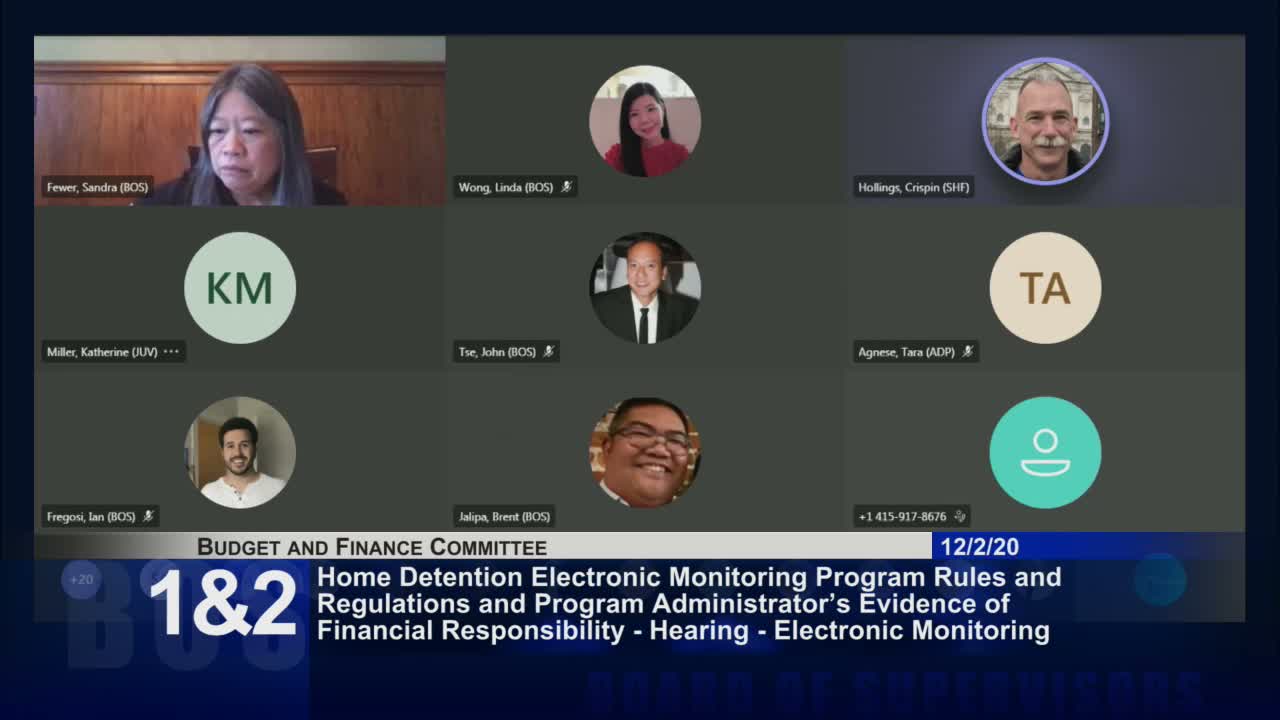
San Francisco—oard of Supervisors Budget and Finance Committee Chair Sandra Lee Feuer brought the committee to a close Dec. 2 after a four-hour hearing that focused on the city nd county gencies' use of electronic monitoring (EM).
The hearing combined a staff presentation from the Sheriff's Office, reports from juvenile and adult probation, the superior court's perspective, and testimony from Pretrial Services. Crispin Hollings, the Sheriff's Office chief financial officer, told the committee that EM placements are ordered by judges and that the county—M population "during this time grew threefold," a shift he said was one factor in reducing the jail population. Hollings said the Sheriff's Office is partnering with the California Policy Lab on a study expected in about a year to evaluate EM's effectiveness.
Deputy Public Defender Matt Sotorosin argued that EM often "is not an alternative to incarceration. It's kind of another form of incarceration," and urged the board to adopt immediate rule changes. He proposed three changes: require reasonable attempts to contact support people before seeking arrest for technical violations, remove contract language that purports to require participants to sign away Fourth Amendment protections unless a judge orders it, and prohibit non-court uses or broad sharing of GPS data citing the California Electronic Communications Privacy Act.
Chief Karen Fletcher of Adult Probation defended a cautious, service-linked approach to EM. She said adult probation currently supervises about 51 clients on EM (less than 1% of its ~6,300 caseload), with an average time on EM of roughly 180 days and an overall noncompliance rate near 20 percent. Fletcher said the department treats EM as a graduated sanction and uses it in coordination with casework, counseling and housing supports.
Chief Katie Miller of Juvenile Probation said the juvenile program uses EM only with a court order and for limited purposes (pre-adjudication release, some post-adjudication supervision) and that juvenile EM is not live-monitored but reviewed daily by a probation officer. Miller reported 17 youth on EM as of mid-November and emphasized the need to include EM in a broader conversation about juvenile justice.
Public comment was strongly critical of EM. Speakers representing Glide, the SF Jail Coalition, the Youth Law Center and other community groups urged the board to disapprove the Sheriff's proposed rules and to adopt harm-reduction measures such as caps on time in program, presumptive allowances for family visits, limits on searches absent court orders, and prioritized funding for community supports shown to improve court appearance rates.
After extended discussion about differing provider arrangements (the sheriff, adult probation and juvenile probation use different vendors), legal questions on search and data-sharing provisions, and gaps in outcome data, the committee reached procedural agreement. Chair Feuer said "there is not enough data" and moved to continue Item 1 (the Sheriff's EM rules) to the call of the chair while filing Item 2 (the hearing record). The motion passed on a 3–0 roll call (Supervisors Walton, Mandelmann and Chair Feuer voting aye).
What happens next: the Sheriff's Office agreed to work with the Public Defender's Office to revise consent forms and rule language (including clarifying that searches are conducted only if ordered by a judge). Multiple departments and the court signaled interest in working with the California Policy Lab and the Public Safety Assessment Working Group to provide more granular data on how EM interacts with housing status, service referrals and other release conditions.
The committee recorded at least one clear consensus: departments should formalize procedures to contact a defendant's support person or attorney before seeking an arrest warrant for a technical device violation. The broader questions about EM's causal effect on court appearance and public safety will be addressed through promised data analysis rather than immediate policy changes.
The hearing is expected to return to the committee after the chairs and departments negotiate revised language and the Policy Lab produces initial findings.