Get Full Government Meeting Transcripts, Videos, & Alerts Forever!
Get email alerts on the Housing Inventory topic
No spam. Unsubscribe anytime.
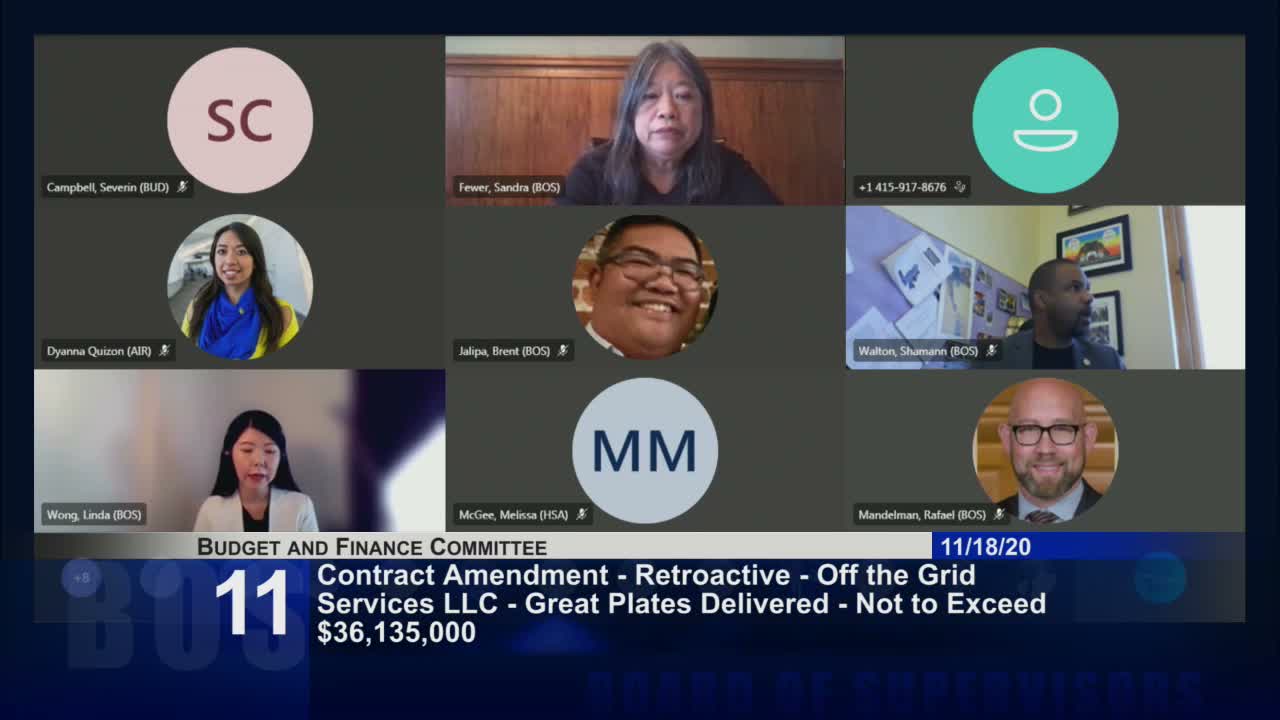
Budget committee advances San Francisco housing-inventory ordinance after heated public comment
Summary
The Budget & Finance Committee voted 3–0 on Nov. 18, 2020 to forward an ordinance creating a citywide housing inventory to the full Board, after BLA cost estimates and nearly four hours of public comment that ranged from strong support to fierce opposition over privacy and cost concerns.
The San Francisco Board of Supervisors’ Budget & Finance Committee voted 3–0 on Nov. 18 to advance an ordinance directing the Rent Board to collect an annual inventory of the city’s rental housing stock, moving the measure to the full Board with a positive recommendation.
The ordinance would require owners to report unit-level information — including mailing address, owner or manager contact, unit square footage and bedroom count, occupancy status and dates, and a base rent reported in $250 increments — beginning July 1, 2022 for larger buildings and phased in for smaller owners. Supervisor Sandra Lee Feuer, who sponsored the measure, said the inventory is designed to be “not a rental registry” and that collected information would be limited to housing units, not tenants.
Why it matters: BLA estimates provided to the committee put year-one implementation costs between $1.4 million and $3.2 million, and ongoing annual costs between $1.2 million and $2.8 million. That translates to an estimated $5–$14 per unit in year one and $5–$12 per unit annually thereafter; the ordinance proposes the cost be covered by a modest increase folded into the existing Rent Board fee and split 50/50 between landlords and tenants.
BLA and Rent Board: Fred Broussard and Emily Fergens of the Budget and Legislative Analyst’s office presented the report, which drew on other California cities’ registries and staffing models. Rent Board Director Robert Collins told the committee the board plans to run an online portal for submissions and to provide phased support for small owners.
Public reaction and concerns: The item produced an unusually large public-comment docket — dozens of callers — reflecting a stark divide. Tenant advocates and housing groups urged the committee to adopt the measure, saying up-to-date unit and vacancy data is essential for planning, emergency use, habitability enforcement and equitable policy. Julie of the Housing Rights Committee told the committee the inventory “will provide another layer of protection for tenants” and help the city identify vacant units that could be used in emergencies.
Opponents, including many small landlords and property managers, criticized the proposal as an invasion of privacy and an added cost in the middle of the COVID-19 economic downturn. Callers repeatedly urged delay, more outreach and either narrowing or exempting small owners; concerns included “rent animosity” among tenants if rents became visible and uncertainty about the Rent Board’s capacity to run the new program.
Sponsor amendments and implementation timeline: In response to those concerns and at the Rent Board’s request, Supervisor Feuer offered amendments that the committee approved. The changes include (1) clarifying that owner-occupied units only require an owner-occupied flag rather than full reporting, (2) phasing reporting by building size (≥10 units by July 1, 2022; smaller buildings by March 1, 2023), (3) allowing any additional data points only after a duly noticed public Rent Board meeting, and (4) folding the inventory fee into the existing Rent Board fee rather than creating a separate surcharge.
Quote: “This inventory is only collecting information about housing units, not about the people who live in them,” Chair Sandra Lee Feuer said during the committee’s response to public comment.
What happens next: With the committee’s 3–0 vote to approve the amendments and forward the ordinance, the measure goes to the full Board of Supervisors for consideration. The Rent Board and sponsor offices said staff will continue outreach and refine the online filing process before implementation deadlines.