Get Full Government Meeting Transcripts, Videos, & Alerts Forever!
Get email alerts on the Hsoc Budget topic
No spam. Unsubscribe anytime.
Supervisors press city on HSOC staffing, data and outcomes amid $4M budget request
Summary
City officials outlined HSOC operational results and a staffing proposal; supervisors repeatedly pressed for clearer metrics on outcomes for high-need individuals, org charts and total FTE counts before approving additional HSOC funding.
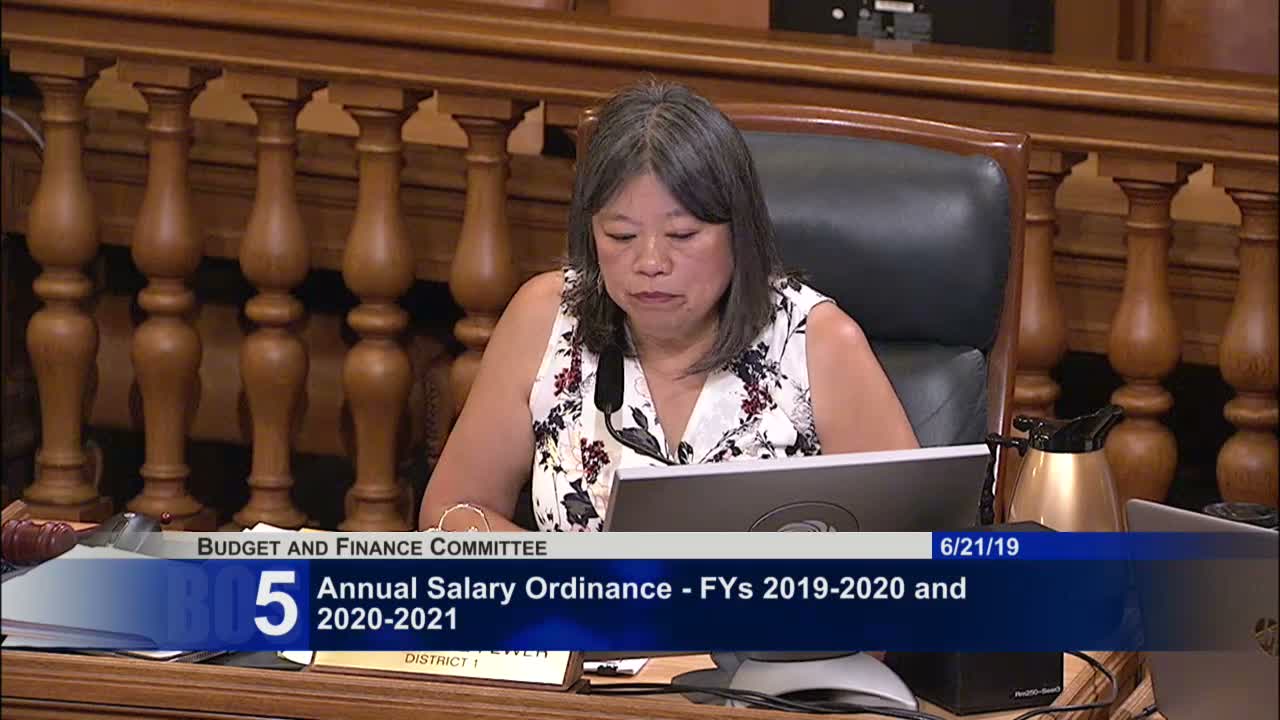
The Budget and Finance Committee spent a substantial portion of its June 21 hearing probing the Healthy Streets Operations Center (HSOC) — a multi-agency coordination hub launched in January 2018 to respond to unsheltered homelessness and unhealthy street behaviors. Department of Emergency Management director Mary Ellen Carroll and Department of Homelessness and Supportive Housing director Jeff Kositsky described the program’s roles and recent operational data.
Carroll listed several performance figures for 2018–19: homeless-related service requests were down about 33% year-over-year; average call response time fell from 123 minutes to about 90; citywide tent counts declined 40% from July 2018 to January; sites with six or more tents dropped from 17 to 6 (a 65% reduction); and HSOC-linked resolutions led to 365 individuals linked to shelter or navigation centers. Carroll also outlined a budget package that includes new positions (five new FTEs and several reassignments), expansion of sobering-center resources and funding to expand a Community Assessment Service Center’s after-hours access.
Supervisors pressed for more outcome-oriented measures. "I think the data that I would like to see is how many high-need individuals have you assisted and what has been the outcome for these high-need individuals," Chair Sandra Lee Feurer said, asking whether HSOC tracks people through shelter and into housing. Jeff Kositsky said HSOC and participating departments are collecting 311 and 911 call data and performing weekly case conferencing; he acknowledged that HSH and DPH had struggled to compile consistent outcome data because HSOC historically operated using repurposed staff rather than dedicated positions.
DPH’s Navina Baba told the committee the sobering center model must be upgraded to treat rising opioid and methamphetamine use, including changes to monitoring, medical equipment and pharmaceutical needs. Supervisors also questioned whether HSOC’s operational results—such as needle-collection totals—reflected the city’s contracted partners (e.g., the AIDS Foundation) and asked staff to clarify which activities were HSOC-managed versus contractor-delivered.
The controller’s office and the budget legislative analyst agreed to work with departments to identify and report the specific metrics requested by supervisors, and Kositsky said the office could deliver a report within about three months identifying what would be collected to evaluate HSOC’s effects on very high-need individuals.
Next steps: Supervisors requested an org chart, total FTE counts, and clear outcome metrics (for example, number of high-need individuals sheltered or housed as a result of HSOC interventions). Departments agreed to provide a data package and follow-up briefing to the committee.