Get Full Government Meeting Transcripts, Videos, & Alerts Forever!
Get email alerts on the Airport Healthcare topic
No spam. Unsubscribe anytime.
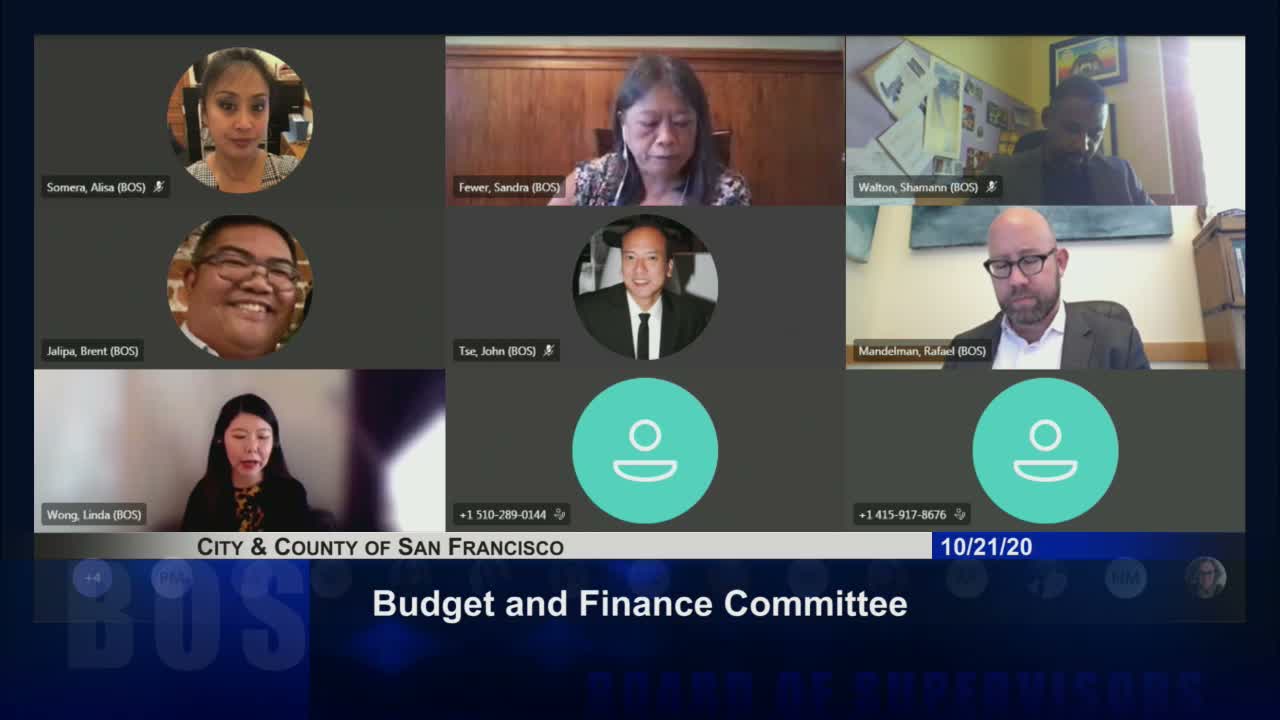
San Francisco committee advances amended "Healthy Airport" ordinance after hours of testimony from workers and airlines
Summary
The Budget & Finance Committee continued an amended ordinance that would require family, platinum-level health coverage or higher employer contributions for airport service workers; supporters said it would protect low-wage workers and families during COVID-19, while airlines warned of job losses and higher fares. The committee approved an amendment tightening waiver documentation and continued the item as amended to a later meeting.
Supervisor Rafael Mandeman introduced a measure on Oct. 21 proposing to amend the city's Healthcare Accountability Ordinance (HCAO) to require Quality Standards Program employers at San Francisco International Airport to provide family, platinum-level health insurance at no cost to employees or to make a contribution of $9.50 an hour to the city option in lieu of offering family coverage. The proposal would also eliminate the current 20-hours-per-week threshold so the requirement applies regardless of hours worked.
Mandeman said the change is aimed at low-wage airport service workers and subcontracted employees who "cannot afford family coverage" and who face elevated COVID-19 exposure on the job. "For far too many workers, the cost of health insurance is out of reach," he said, arguing the measure would protect workers, their families and the traveling public.
The committee heard an extended public-comment period that split sharply along industry and labor lines. Dozens of airport service workers and union representatives — including SEIU and Local 2 members — described unaffordable premiums and large deductibles, medical debt from delayed care, and workplace COVID exposures. "We need the Healthy Airport Ordinance because our health care is unaffordable," said Melanie Cruz, a catering worker for LSG Sky Chefs, who described paying $150 a month in premiums but facing $5,000 in medical debt. Multiple callers recounted workplace COVID-19 infections and the risk of transmitting illness to family members.
Labor advocates and organizers warned the ordinance would close a gap that leaves many subcontracted workers without dependents' coverage and urged protections against widespread voluntary opt-outs. Jane Martin of SEIU said the measure was drafted to include both directly hired airline employees and subcontracted workers such as cabin cleaners and catering staff, and to prevent abusive waiver practices.
Airport officials and major carriers strongly opposed the ordinance. Representatives from Hawaiian, Delta, JetBlue, Alaska and United Airlines, as well as trade groups, said the proposal would add substantial costs to airlines and contractors already weakened by the pandemic, potentially reducing air service at SFO and risking job losses. "Proposals such as the HWO will only further exacerbate the already devastating financial impacts of COVID-19," said Blaine Bien Sato for Hawaiian Airlines. Industry speakers cited internal estimates of higher operating costs and offered alternative assessments of passenger-ticket impacts.
The city Budget Analyst (BLA) summarized fiscal scenarios and estimated that increasing the HCAO contribution to $9.50 per hour could raise employer costs across the airport system by millions of dollars per year (BLA's scenarios ranged from roughly $8.4 million to $33 million depending on implementation choices). The BLA's analysis also included an illustrative passenger-cost figure of about $1.83 per ticket based on 18.4 million annual passengers; analysts emphasized those are model-based estimates and characterized the ordinance as a policy matter for the full Board.
Sponsor Rafael Mandeman offered a substantive amendment to the ordinance's waiver provision to reduce potential abuse. Under the amendment employees who voluntarily decline the employer's offered coverage must provide proof of existing health insurance (for SFO service employees, proof must include dependent coverage where relevant); employers would be required to use an OLSC-approved waiver form, retain waivers and proof of coverage for three years, and produce them on request.
The committee adopted the amendment by roll call (3 ayes) and then moved to continue the ordinance as amended to the next Budget & Finance Committee meeting to allow time for further review and for the amendment to be incorporated. The continuation passed by roll call (3 ayes). The committee did not take a final vote on the ordinance itself; the matter will return to committee with the amendment in place.
What happens next: The ordinance, as amended, will be scheduled for further consideration at the next Budget & Finance Committee meeting; if again forwarded it will go to the full Board of Supervisors for final action.