Get Full Government Meeting Transcripts, Videos, & Alerts Forever!
Get email alerts on the Public Safety topic
No spam. Unsubscribe anytime.
Sheriff's electronic monitoring rules continued after public outcry and requests for data
Summary
After extended questioning and multiple public callers urging rejection, the Budget & Finance Committee continued the Sheriff's Office electronic monitoring (EM) rules and financial-responsibility evidence to Sept. 16 so staff can supply program, demographic and effectiveness data requested by supervisors and commenters.
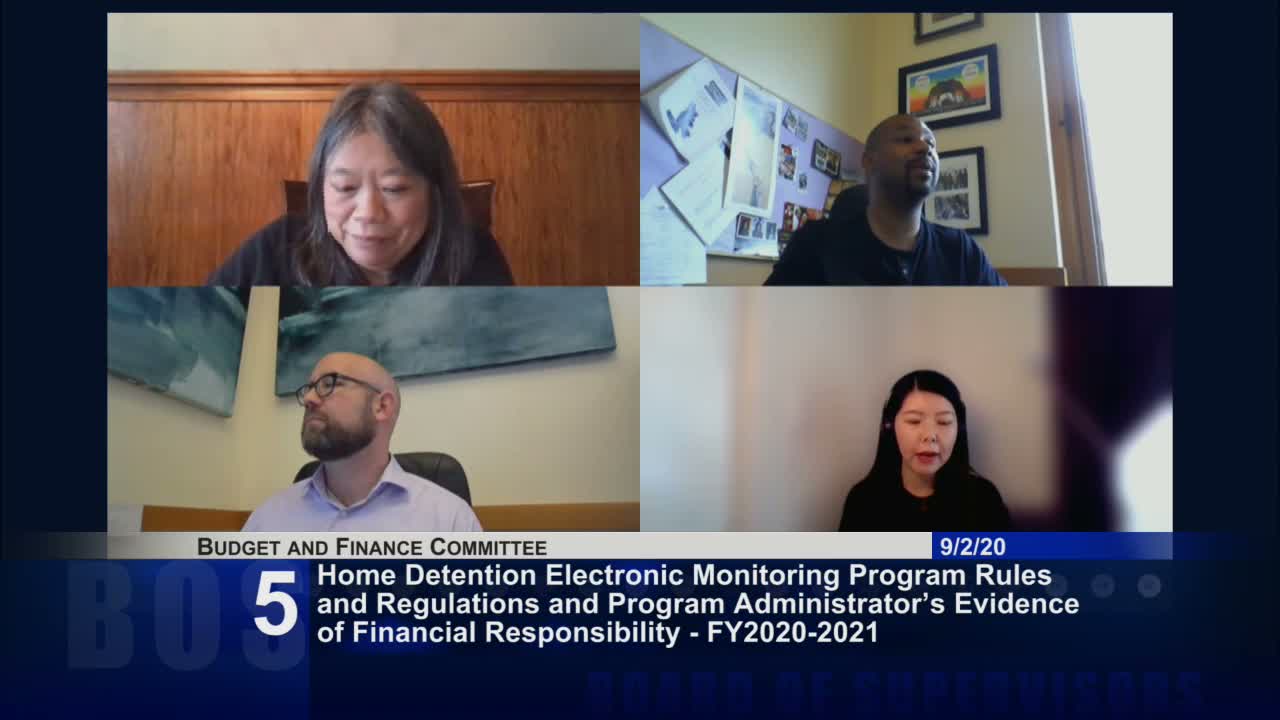
The Budget & Finance Committee on Sept. 2 voted to continue consideration of a resolution approving the Sheriff's Office home detention and electronic monitoring program rules and evidence of financial responsibility until Sept. 16 to allow the department to provide additional data and to invite Pretrial to the discussion.
Crispin Hollings, chief financial officer for the Sheriff's Office, told the committee the program was established as an alternative to incarceration, the current contract (awarded to Sentinel in 2019) has not changed since approval last year, and the Sheriff's Office provides evidence of liability insurance as required. He said the contract cost is about $1.1 million annually and that roughly 18—9 staff in Community Programs administer alternatives to custody.
Supervisors pressed for more programmatic details. Supervisor Shamon Walton asked for recidivism and demographic data and whether the program is being adjusted amid systemwide criminal-justice reforms; Hollings said some data exist but were not available at the hearing and agreed staff could return with detailed metrics. Supervisor Rafael Mandelman asked how often monitors are cut off; Sheriff's staff said strap removal occurs with some frequency and that staff attempt field responses when devices are disabled.
Public comment was strongly skeptical. Carolyn Goosen, Policy Director for the Public Defender's Office, said private contractors have financial incentives that can conflict with reform goals and asked for audit-quality data showing whether the contract advances public safety or keeps people shackled longer. Other callers, including representatives of No New SF Jail Coalition and ACLU volunteers, said EM expands surveillance, disproportionately harms Black, Indigenous and Latino communities and causes practical harms (charging difficulties for unhoused people, medical pain from ankle devices and employment impacts).
Several callers asked how many people are returned to custody on technical violations such as missed device charging. Zach Dillon of the Public Defender's law enforcement integrity unit observed that the per-person device costs implied by July caseloads appeared far lower than the $1.1 million budget and asked for a clearer breakdown of what drives the total cost.
After public comment and questions, Chair Sandra Lee Fewer moved to continue the item to the Sept. 16 committee meeting to allow the Sheriff's Office to return with requested data and to invite Pretrial; the motion passed on a 3-0 roll-call vote.