Get Full Government Meeting Transcripts, Videos, & Alerts Forever!
Get email alerts on the Clean Power Sf topic
No spam. Unsubscribe anytime.
SFPUC seeks authority to sign long-term renewable contracts; supervisors press for mandatory community benefits
Summary
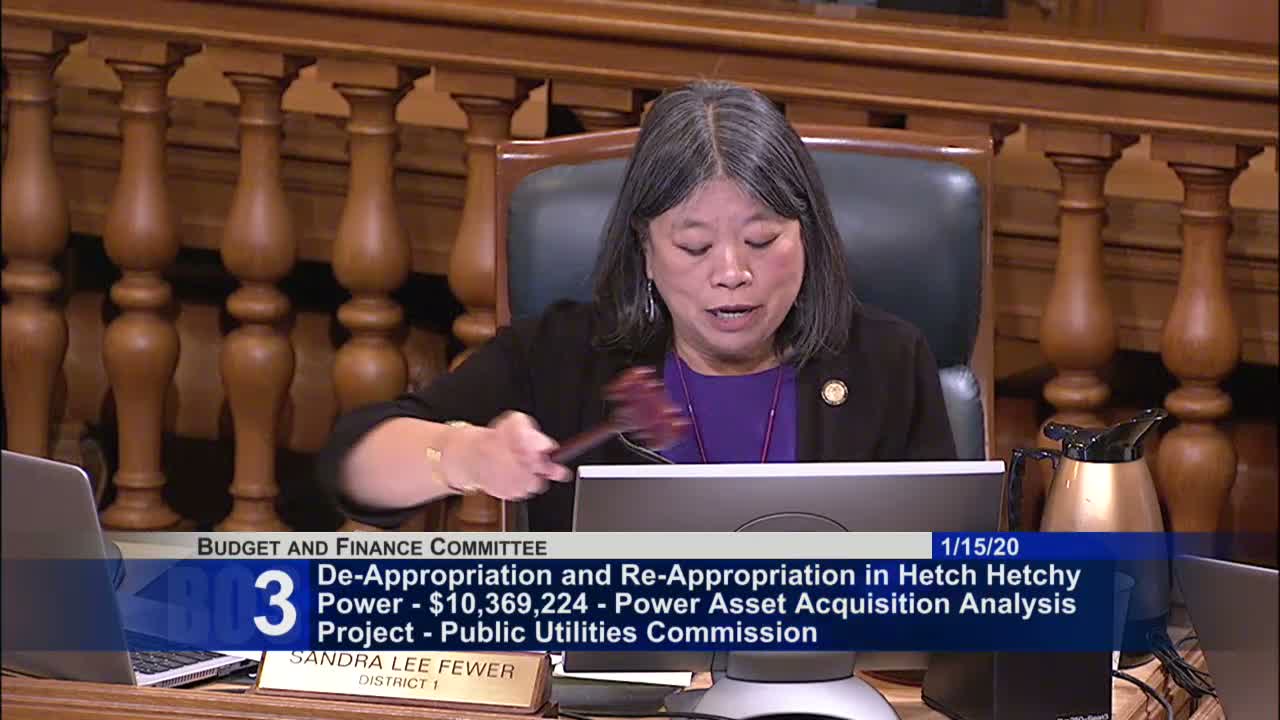
The committee advanced an ordinance letting the SFPUC general manager execute up to 25‑year renewable-energy contracts from a shortlisted RFO pool, with supervisors urging stronger community-benefits requirements; the Budget Analyst’s Office recommended clarifying amendments and the committee forwarded the item to the full Board.
Michael Hines, director of Clean Power SF at the San Francisco Public Utilities Commission, told the Budget and Finance Committee that the SFPUC seeks authorization to execute renewable-energy contracts from a pool of shortlisted projects identified in a 2019 request for offers. Hines said the contracts would supply part of Clean Power SF’s customer demand and could span up to 25 years, with deliveries starting as early as January 2021 and no later than December 2024.
Hines said the RFO produced 43 unique bids from 13 companies and that the PUC shortlisted 10 project offers from nine suppliers; bids were evaluated on viability, cost, how energy fits demand profiles and an optional community benefits component. Hines described Clean Power SF as serving more than 379,000 customers and said the program is on track to meet a mayoral goal of 50% RPS-eligible renewable energy for the default product by 2020.
Supervisor Shimon Walton asked why community benefits were optional in the RFO rather than required. John Scarpulla of the SFPUC said the PUC’s long-standing practice is to treat community benefits as voluntary but award additional points to offers that include them; Scarpulla and Hines said PUC staff are drafting broader, SFPUC‑wide language to memorialize community-benefits requirements on certain contracts.
The ordinance would authorize the SFPUC general manager to use industry-standard and city pro forma power contracts; waive some city contracting provisions that are uncommon in energy deals only when the general manager documents that waivers are reasonable and in the public interest; and permit contracts exceeding 10 years or $10 million subject to conditions (limited to shortlisted resources, paid solely from Clean Power SF revenues, capped contract value per year and annual reporting to the Board). The Budget Analyst recommended clarifying amendments—including language that extensions be included in the 25‑year term cap—and those clarifications were accepted as non‑substantive by the deputy city attorney.
The committee took the amendment and agreed to move the legislation to the full Board with a positive recommendation. Supervisors signaled interest in making community benefits mandatory for some contract types and PUC staff said they are drafting related legislation and would work with supervisors’ offices.