Get Full Government Meeting Transcripts, Videos, & Alerts Forever!
Get email alerts on the Vacancy Tax Ballot topic
No spam. Unsubscribe anytime.
Budget and Finance Committee sends vacancy excise tax ordinance to March 3, 2020 ballot
Summary
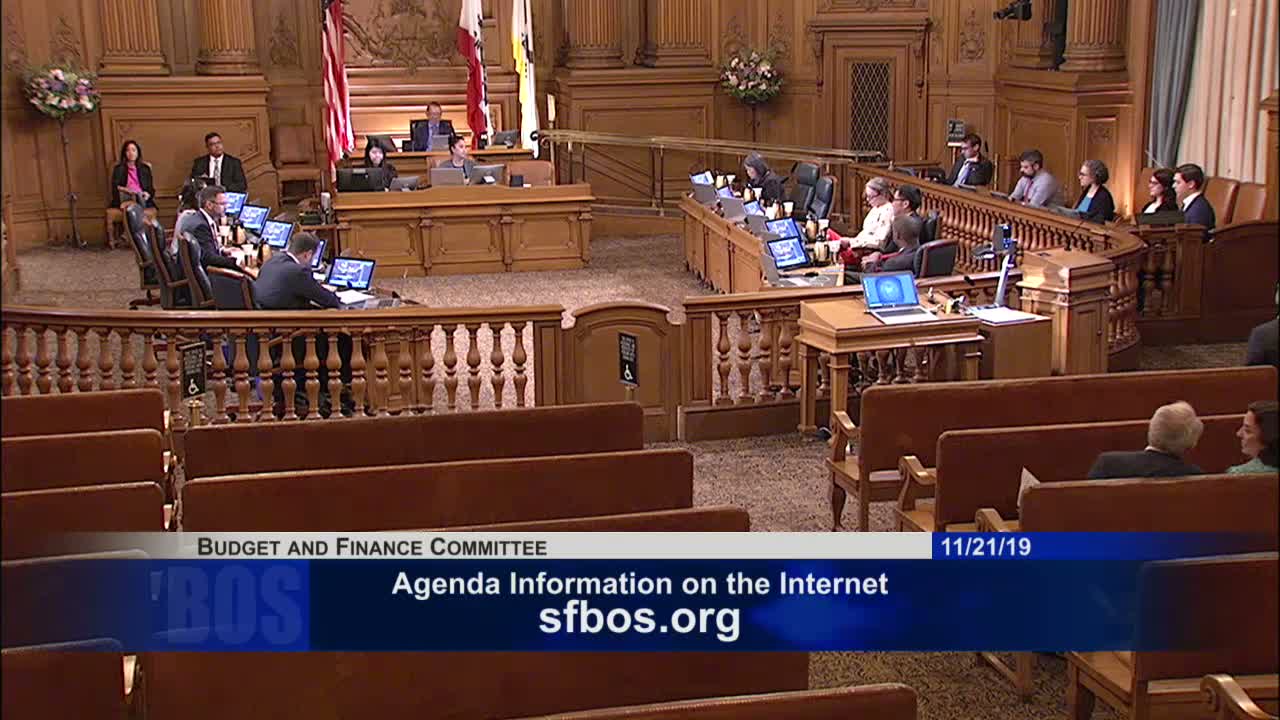
On Nov. 21, 2019 the San Francisco Budget and Finance Committee voted to send an ordinance to the full Board to place an excise tax on ground-floor commercial vacancies on the March 3, 2020 ballot; the measure includes exemptions for active permitting and aims to fund small-business assistance.
SAN FRANCISCO — The Budget and Finance Committee on Nov. 21, 2019 voted to send to the full Board of Supervisors an ordinance to place an excise tax on ground-floor commercial vacancies on the March 3, 2020 ballot, a measure backers say is designed to encourage landlords to fill empty storefronts and to fund small-business assistance.
Lee Hepner, presenting for the measure’s sponsor, summarized a package of amendments intended to limit the tax’s reach. He said the proposal would not assess the excise while a Department of Building Inspection permit application is pending and for one year after permit issuance, would exempt properties while Planning considers a conditional-use authorization if a decision is not reached within six months, and would prevent assessment against a space for the unexpired remainder of a tenant’s lease if the tenant goes out of business early. "Short of something like commercial rent control, which requires an amendment to state law, I truly believe that this is the most powerful and effective tool that we have to stabilize rents for existing small businesses," Hepner said.
Supervisor Safaie raised technical and equity concerns and asked for further trailing legislation. He urged that the linear-footage calculation not include ingress or egress unrelated to the business and asked that the permit/construction protection period be extended from 12 to 18 months to reflect real-world delays in tenant improvements and capitalization. "My request would be for the sponsor of the legislation to consider at least an 18 month period," Safaie said.
Several other supervisors echoed the need for complementary work on permitting and fees. Supervisor Haney said vacancy is a public-safety and quality-of-life issue in some corridors; Supervisor Brown urged attention to differences in retail-space size and local liquor-license moratoria; and Supervisor Walton described a working group with Chair Fewer to engage small businesses on permitting streamlining.
Public commenters included Henry Kanelowitz of the San Francisco Council of District Merchant Associations, who advocated a "carrot and stick" approach, and Hans Hansen of Starboard Commercial Real Estate, who urged better data before imposing a tax. Hansen cited CoStar data showing "148 buildings that are actually vacant, with 323 spaces available in the NC zone," and said leasing from availability to occupancy often takes about 14 months.
Ben Blyman, president of the Entertainment Commission, said he was cautiously optimistic the measure could compel "bad actor" landlords to act but urged careful vetting of unintended consequences.
After public comment and brief committee discussion, a motion was made to send the ordinance as a committee report to the Nov. 21 Board meeting; the chair asked if the item could be taken "without objection," and it was approved without objection. The committee adjourned.
What’s next: sending the measure as a committee report moves it to the full Board of Supervisors; additional technical and implementation amendments were discussed as trailing legislation but were not adopted at this meeting.