Get Full Government Meeting Transcripts, Videos, & Alerts Forever!
Get email alerts on the Vacancy Tax topic
No spam. Unsubscribe anytime.
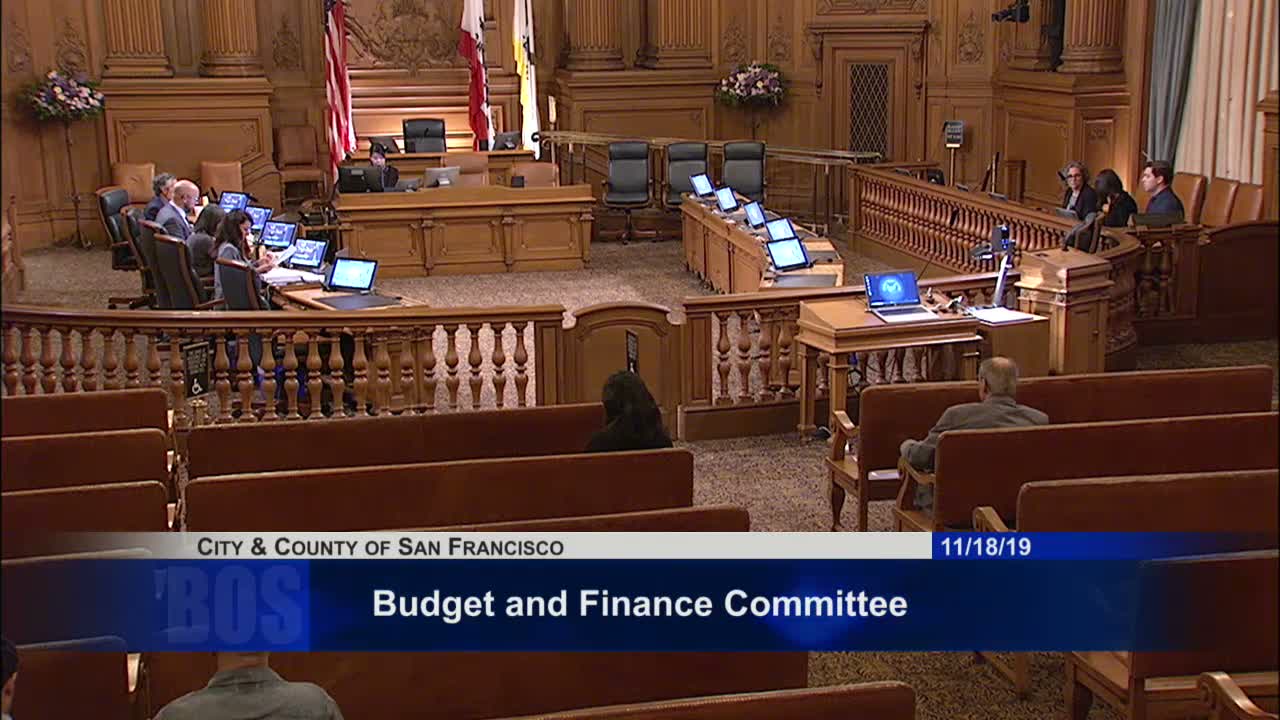
Committee advances vacancy-tax amendment, continues item to Nov. 21 while sending measure toward March ballot
Summary
The Budget and Finance Committee approved an amendment clarifying that lessees who operated for at least six months and then went out of business would not be liable for a proposed ground‑floor vacancy tax; the committee approved the amendment and continued the item to the full Board on Nov. 21 and the measure is slated for the March 3, 2020 ballot if advanced.
The San Francisco Budget and Finance Committee on Nov. 18 advanced an amendment to a proposed ordinance that would place an excise tax on certain vacant ground‑floor commercial spaces before voters on March 3, 2020.
Sponsor Siva Repaskin proposed adding language to Section 2905D to protect legitimate lessees: if a business has operated for at least six months and then goes out of business with time remaining on its lease, the lessee would not be liable for the vacancy tax for the remainder of the lease or sublease interest. "If a business has been open for at least 6 months ... and then goes out of business ... they shall not be liable for the vacancy tax the remainder of that lease or sublease hold interest," the sponsor told the committee.
The amendment was offered after public comment that raised concerns about the ordinance’s impacts. Mark Borsuk, a retail leasing broker and real property attorney, urged caution, saying online shopping and restrictive formula‑retail rules have reduced demand for storefronts and warning the tax could unintentionally increase bankruptcies or entrench vacancies. "Retail leasing is a troubled business," Borsuk said, recounting a recent tenant bankruptcy at a Chestnut Street property.
Business groups and housing advocates reflected mixed reactions. Dady Workman of the San Francisco Chamber of Commerce said the amendments moved the legislation in the right direction but expressed concern about inadvertently punishing owners and tenants who cannot find tenants through no fault of their own. Corey Smith of the San Francisco Housing Action Coalition urged the city to pursue incentives for productive ground‑floor uses, such as childcare and nonprofit office space, alongside regulatory changes.
Property owner Ron Miguel told supervisors that many neighborhood commercial districts were not informed about the proposal and described the excise as a "band aid" that does not address structural change in retail demand. An additional public commenter with a research background asked the committee to provide empirical evidence that an excise tax would improve retail outcomes.
Committee Chair Sandra Lee Feuer and colleagues framed the amendment as a way to target "bad actors" who hold properties off the market while protecting legitimate tenants and noted other city efforts to support storefront activation, including fee relief and zoning changes. Staff from the Treasurer‑Tax Collector’s office (identified in the record as Miss Fried) said that if voters approve the measure it would not take effect until Jan. 1, 2021 and that the office would do outreach to affected property owners.
Chair Feuer moved to approve the amendment and continue the item to the Board meeting on Nov. 21 for further consideration; the motion was taken without objection. The committee did not adopt a final ordinance at the Nov. 18 session; the measure remains subject to further action by the full Board and, if placed on the ballot and approved by voters, would become effective Jan. 1, 2021.
Next steps: the item was continued to the full Board on Nov. 21 for further consideration and potential placement on the March 3, 2020 ballot.