Get Full Government Meeting Transcripts, Videos, & Alerts Forever!
Get email alerts on the Public Health Naloxone topic
No spam. Unsubscribe anytime.
Budget committee backs retroactive acceptance of 768 naloxone units for police
Summary
The committee unanimously moved to forward a resolution authorizing the Police Department to accept 768 naloxone units (valued at $57,600) from a SAMHSA-funded distribution project; the department said units will be distributed citywide to district stations and specialized units to help reverse opioid overdoses.
Sandra Lee Feuer, Chair of the Budget and Finance Committee, moved the committee to forward a resolution authorizing the San Francisco Police Department to accept and expand an in-kind gift of 768 naloxone units valued at $57,600, which the committee took to the full Board with a positive recommendation.
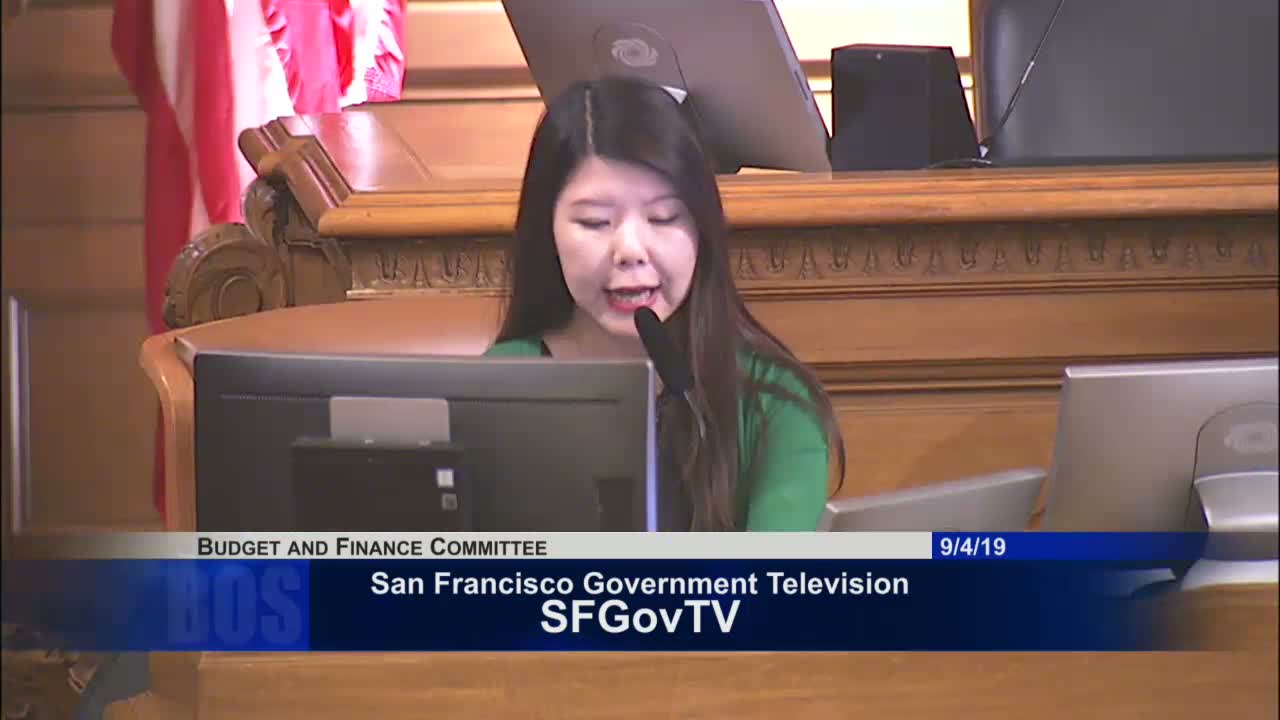
Patrick Leung, identified in the transcript as chief financial officer for the San Francisco Police Department, said the department applied earlier in the year to receive 768 units through a naloxone distribution project administered by the California Department of Health Care Services and funded by the Substance Abuse and Mental Health Services Administration. "Naloxone is an antidote used to try to help individuals recover from an opiate overdose," Leung said, noting recent overdose deaths: "In 2018, DPH reported that 89 deaths occurred. And in 2017, 36 deaths occurred, related to fentanyl." He described fentanyl's potency as "100 times more potent than morphine, and it's 50 times more potent than heroin."
Leung said the department intends to distribute received naloxone to all district stations and to specialized units, including officers assigned to the Healthy Streets Operations Center, and encouraged eligible first responders, emergency medical services, law enforcement, schools and hospitals to apply for the program. The presenter described the application process as "fast and easy" and said it "will help save lives."
The committee recorded no objections and moved the item to the full Board with a positive recommendation. No formal vote tally was recorded in the committee transcript.
The resolution, as read into the record by the clerk, covers the period 02/01/2019 through 05/30/2019 and is retroactive to the distribution project period. The transcript does not record distribution logistics beyond the departments noted or any additional conditions tied to the acceptance of the gift. The Board will consider the resolution at its next meeting.