Get Full Government Meeting Transcripts, Videos, & Alerts Forever!
Get email alerts on the Police Budget topic
No spam. Unsubscribe anytime.
Supervisors Debate $62M Police Budget Increase as BLA Seeks Overtime, Taser Cuts
Summary
The San Francisco Budget & Finance Committee spent hours debating SFPD’s FY2020 proposal — including a $62 million overall increase, a contested $2.37M overtime add, $1M TASER reserve and a Union Square ambassador pilot — with the Budget & Legislative Analyst (BLA) urging tighter overtime controls and the deletion of TASER funding.
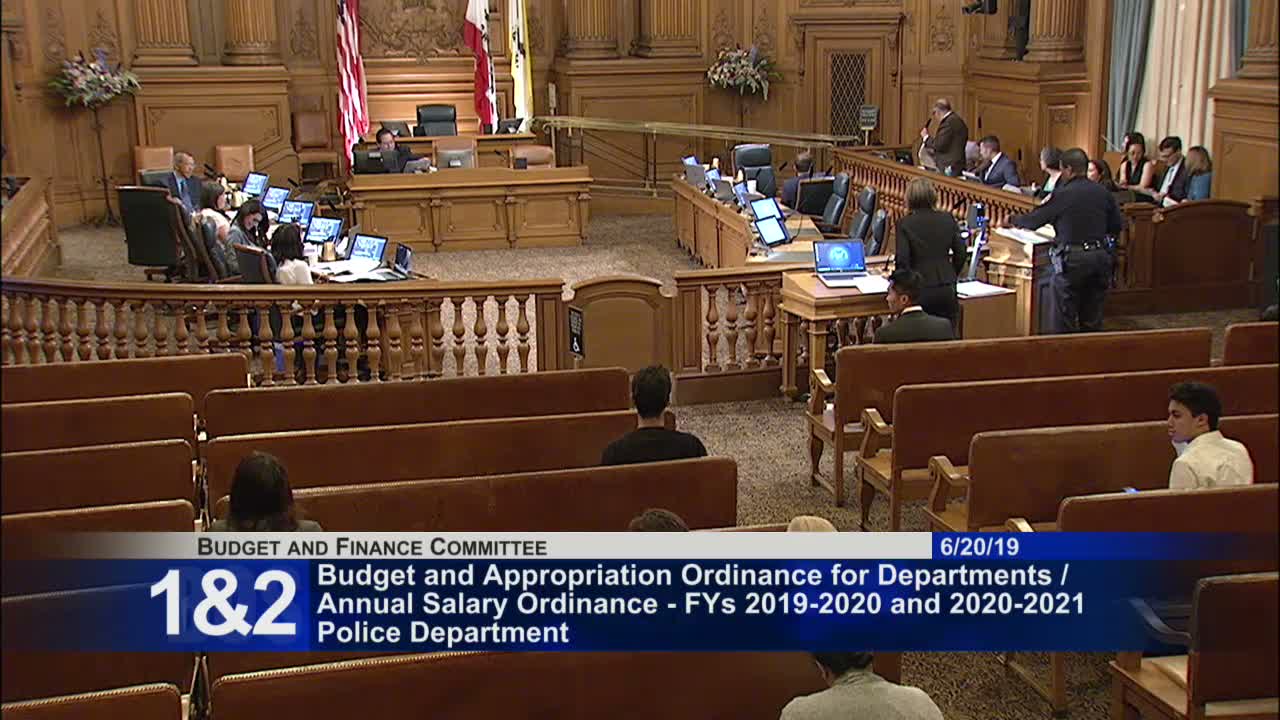
The Budget & Finance Committee on June 20 wrestled through one of the meeting’s longest debates: how to fund the San Francisco Police Department’s proposed increases while reining in overtime and controversial program spending. The committee heard a detailed Budget & Legislative Analyst (BLA) report, a presentation from Police Chief William Scott and extensive public testimony.
The BLA recommended $3.12 million in reductions to the department’s FY2020 proposal, including $2.37 million to delete a proposed overtime increase; a $1 million deletion of reserve funds for electronic-control weapons (TASERs) as a policy recommendation; and a package to accelerate civilianization with offsets. The BLA told supervisors that overtime is concentrated: roughly 26% of sworn officers earned half of their pay or more in overtime, and several officers receive overtime equal to or exceeding their base pay.
Chief Scott defended the department’s requests as operationally necessary to sustain foot beats, cover transit hubs and maintain proactive patrols citywide. Scott said some overtime would be funded by internal salary savings and that the requested hours would sustain new, city-prioritized patrol deployments and training. He disputed some BLA conclusions and said removing the overtime increase would reduce planned proactive coverage in high-need corridors such as Mid‑Market and Civic Center.
TASER funding quickly became a focal point. The BLA asked supervisors to delete a $1 million TASER line; multiple supervisors and public commenters urged deletion, citing national evidence on TASER harms and a preference for further investments in behavioral health and de‑escalation training. Business and tourism representatives, and some supervisors, argued for new investments such as a Union Square ambassador pilot (a lower-cost public-safety presence using trained civilian or retired-officer staff) to protect high‑traffic commercial areas.
After hours of questions and public testimony that ranged from homelessness advocates urging housing investment to hotel and merchant groups seeking more visible safety presence downtown, the committee reached partial consensus: to delete $1 million in TASER reserves and to accept several BLA recommendations where departments agreed. Members requested additional BLA and Controller analysis on the overtime proposal and civilianization effects and scheduled follow-ups for a final decision on the remaining contested items (including the Union Square ambassador pilot). The committee asked that several SFPD position proposals be considered as limited‑term (two‑year) appointments to preserve flexibility.
What’s next: The committee requested numerical scenarios from the BLA/Controller and scheduled further budget deliberations on the contested SFPD elements at the next committee meeting. The Board will consider the final budget and any ordinance actions at the July meeting cycle.