Get Full Government Meeting Transcripts, Videos, & Alerts Forever!
Get email alerts on the Small Business Support topic
No spam. Unsubscribe anytime.
OEWD outlines neighborhood‑targeted programs, storefront vacancy study and small‑business portal
Summary
The Office of Economic and Workforce Development (OEWD) told the committee it serves nearly 100,000 registered small businesses, prioritizes neighborhood commercial districts with grants and technical assistance, is implementing a storefront vacancy initiative and operates a multilingual small‑business portal with ~25,000 unique users annually.
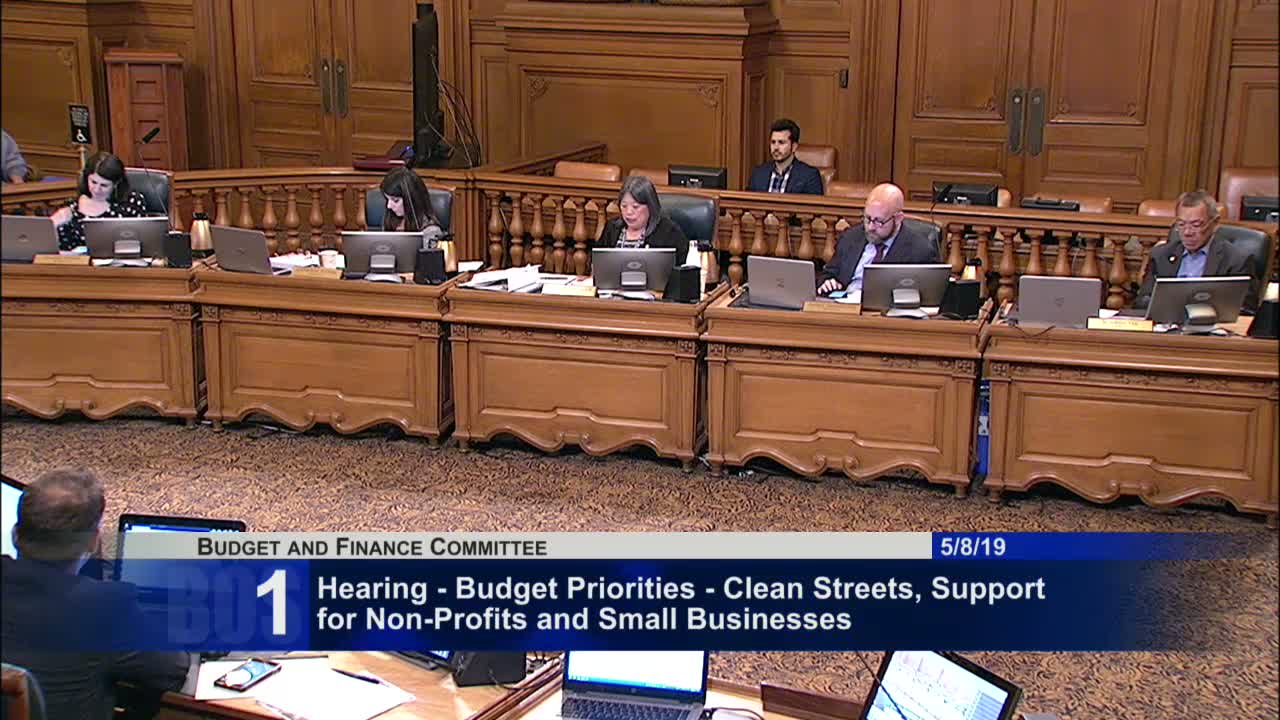
Lisa Pagan, representing the Office of Economic and Workforce Development, briefed the Budget and Finance Committee on OEWD’s small‑business strategy on May 15. She said the city had 99,434 registered small businesses in 2018 and that OEWD’s approach emphasizes neighborhood commercial district preservation, plaintiff‑oriented technical assistance, and merchant association capacity building.
Pagan outlined OEWD programs that cover neighborhood services (53% of the small‑business budget), business attraction and retention, financial assistance (loan and credit‑building programs), and workforce services that aim to connect employers with local residents. She described a storefront vacancy initiative and a neighborhood impact report currently in progress to guide deployment of grants and district marketing.
Regina Dickendresi, director of the Office of Small Business, answered questions about the legacy business grant program. She said grant awards were prorated based on the department’s FTEs this year, leading to smaller per‑award amounts, and that 181 businesses were on the legacy registry with 300 nomination slots per year. OEWD staff pledged to provide supervisors with fuller projections of the funding required to meet the program’s goals.
Supervisors asked for data on OEWD’s bilingual staffing and language capacity; OEWD said the department has multilingual staff but did not provide detailed counts at the hearing and agreed to follow up. On permitting and regulatory streamlining, Dickendresi said the small‑business portal is active and supports translated interfaces and some online permitting; she said about 25,000 unique users access the portal annually and that additional online application capabilities are being developed.
Supervisors requested clarification on the share of brick‑and‑mortar businesses among registered firms and the rate of small‑business closures; OEWD said some of those metrics exist in retail studies and registry data and pledged to provide more granular breakdowns to inform policy decisions. The committee took no final funding votes on OEWD items and continued budget deliberations.