Get Full Government Meeting Transcripts, Videos, & Alerts Forever!
Get email alerts on the Public Works Cleaning topic
No spam. Unsubscribe anytime.
Public Works details rising street-cleaning demand, pilots sensors and pit stops
Summary
Public Works told the Budget and Finance Committee it has expanded pit stops to 25 sites and hired apprentices and nonprofit partners, but service orders, needle pickups and illegal dumping are increasing; staff described sensor pilots for trash cans and budget priorities including tree establishment and nighttime median crews.
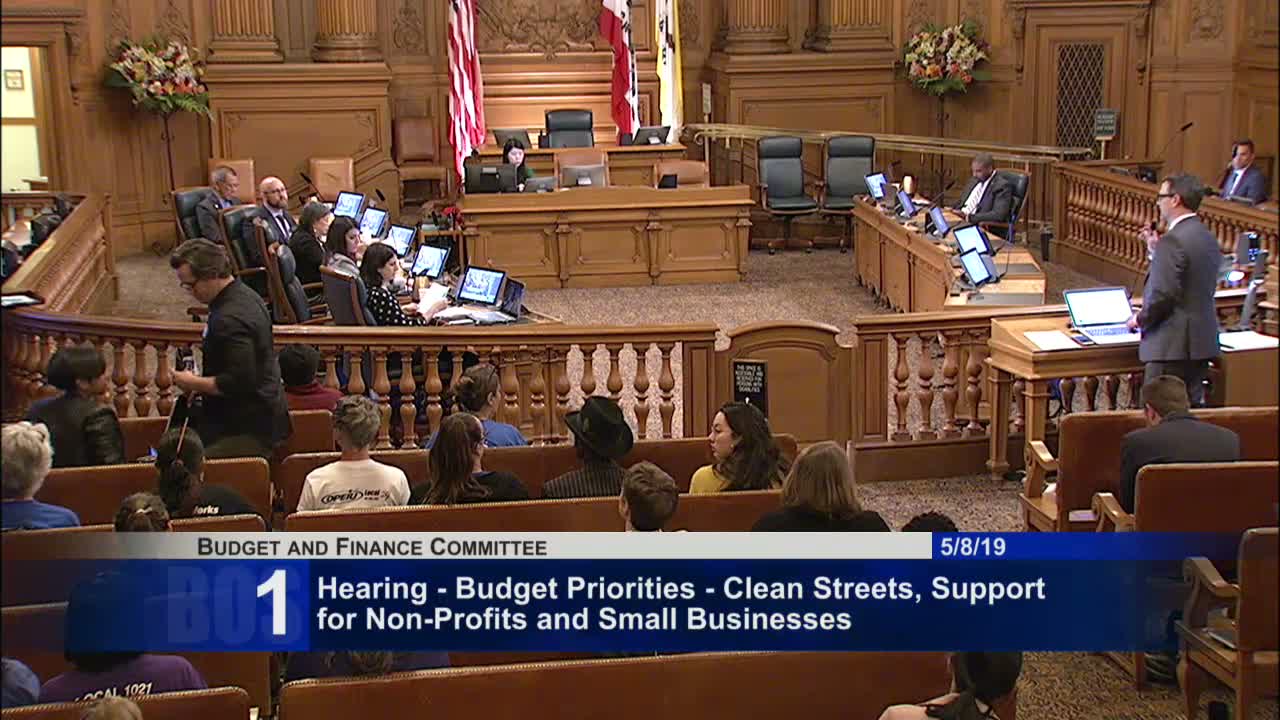
Bruce Robertson, finance manager for San Francisco Public Works, told the Budget and Finance Committee on May 15 that the city is handling a growing volume of street‑cleaning requests even as it expands programs aimed at reducing blight. "We're up to 25" pit stop locations, Robertson said, and the city logged more than 45,000 monthly uses for pit stops in the first half of the fiscal year.
Robertson presented historical data showing service orders rising toward a projected 147,000–148,000 for the fiscal year and a corresponding uptick in tonnage collected (from about 26,000 tons last year to a projected 28,000). He said litter patrol is the largest category of calls and that steamer requests for feces and urine have increased in several districts, with District 6 notably higher than others.
Public Works described pilot and partnership strategies intended to manage demand. Robertson said the department has 111 pre‑apprentice and apprenticeship positions and has increased nonprofit partnership hours by more than 39,000, focusing resources in Tenderloin, SoMa and other high‑volume corridors. On trash cans, Deputy Larry Stringer said the city is installing roughly 1,000 sensors that notify Recology when a can reaches 80 percent capacity; Stringer reported the pilot had a 97 percent success rate at prompting pickup before overflow.
On pit stops and public restrooms, Julie Dawson, Public Works CFO, said a pending contract with JCDecaux would replace the 25 existing toilets and include an option to buy up to 15 more units; any additional units without advertising revenue would require separate city funding because the voter‑approved cap on advertising kiosks (Prop E, 2009) limits kiosk revenue to the existing inventory.
Robertson also reviewed urban forestry funding and constraints. He described the voter‑established tree maintenance fund (about $19 million) and warned that the fund cannot pay for the first three years of establishment costs; "tree establishment costs about $2,000 per tree," he said, noting that mortality has left about 6,500 trees prioritized for removal and replacement. Median maintenance was flagged as an unfunded but safety‑critical work area; Robertson advocated for initiatives such as nighttime median crews to reduce risk to crews.
Supervisors pressed staff for follow‑up information: supervisors asked for cost comparisons of sensor installs versus compacting (Big Belly) cans and for Recology tonnage data (Public Works said the department's tonnage figures do not include Recology's collections, which are maintained separately). Staff committed to providing more detailed cost analyses and to coordinating with community benefit districts (CBDs) and the Department of Public Health on needle‑cleanup and sanitation strategies.
The committee did not take a vote on funding during the hearing; the item was continued to the call of the chair for further budget deliberation.