Get Full Government Meeting Transcripts, Videos, & Alerts Forever!
Get email alerts on the Five Year Financial Plan topic
No spam. Unsubscribe anytime.
Budget committee hears five‑year plan showing persistent deficits and rising costs
Summary
The committee reviewed a five‑year financial plan projecting a $270 million shortfall over the next two years and a much larger out‑year gap driven by pension growth, healthcare inflation and an IHSS cost shift; officials said March updates and the May state "May revise" will clarify options.
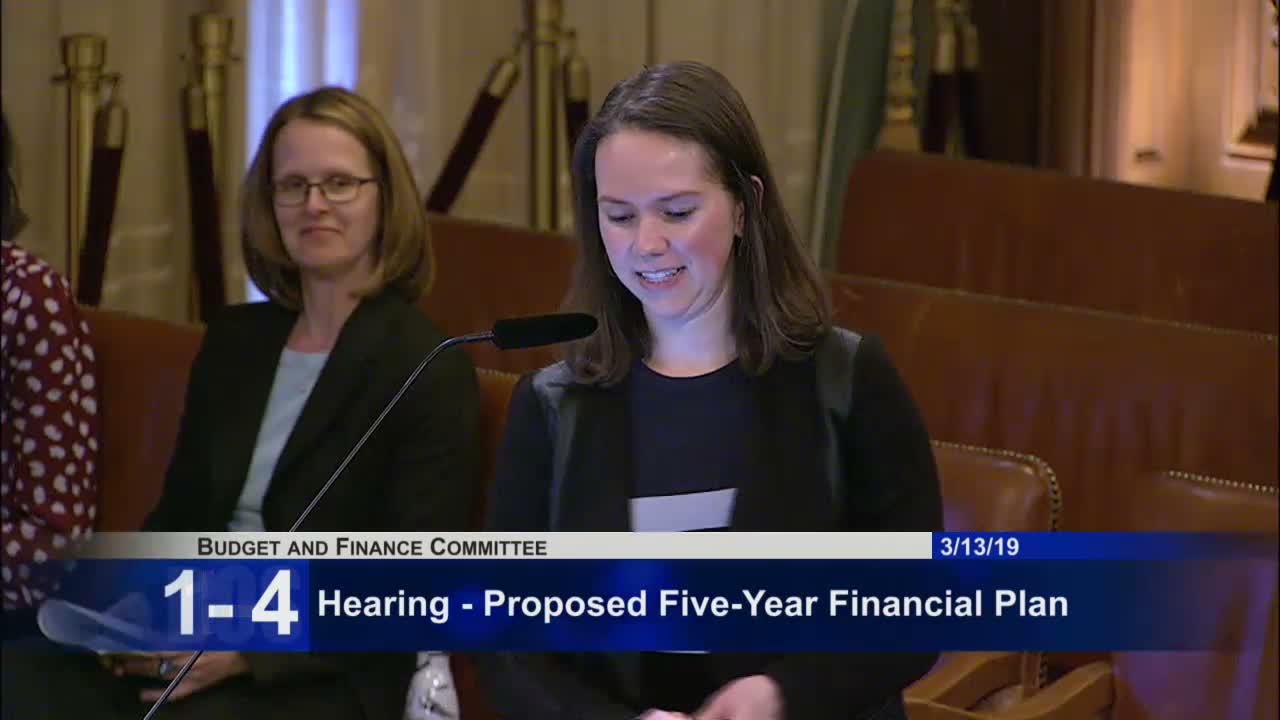
San Francisco—s expanded Budget and Finance Committee heard a joint presentation March 13 on the mayor—s five‑year financial plan that warns of growing structural deficits driven by pension and health‑care costs, an in‑home support services (IHSS) cost shift from the state and labor obligations.
Chair Sandra Lee Feuer convened the first meeting of the five‑member committee and introduced analysts from the Budget & Legislative Analyst (BLA), the Mayor—s Budget Office and the Controller—s Office. Kelly Kirkpatrick, the mayor—s budget director, said the January projection shows a two‑year shortfall of $270,000,000 for fiscal years 2019–20 and 2020–21 and a much larger projected fifth‑year gap absent policy changes.
"The shortfall is the two year shortfall for fiscal year 19‑20 and 20‑21 ... is $270,000,000, as of the January projection," Kirkpatrick told the committee. She said the plan assumes health care costs will grow about 6 percent annually and uses a roughly 3 percent CPI assumption for other inflation, and that the report does not assume a recession.
Michelle from the Controller—s Office explained that a substantial portion of long‑term cost growth is pension related, including actuarial adjustments and a lowered assumed return (noted in the presentation as 7.4 percent). The presentation also flagged the IHSS cost shift, which added roughly $100,000,000 in projected costs by the fifth year under current law.
Dan Goncher of the BLA summarized the office—s role in compiling performance measures, historical spending and audit findings to inform the board—s priority hearings. He said the BLA will issue in‑depth reports in April on public safety (April 10), homelessness and housing (April 17), and mental health and substance‑use services (April 24).
Committee members pressed staff on how one‑time state and federal actions might change the outlook. Kirkpatrick noted uncertainty around the Educational Revenue Augmentation Fund (ERAF) and said the mayor—s office and controller are preparing a March update to the five‑year plan and will incorporate any May state actions in the May revise that appears on May 15.
"We are still working through the mayor's budget. We—ll have a better sense in May as to what state action may or may not occur," Kirkpatrick said. Separately, controller staff indicated in a forthcoming March update they expected a smaller programmable ERAF amount (an estimate cited in the hearing was about $140,000,000 after baselines, to be refined).
Officials repeatedly warned that labor negotiations (more than two dozen memoranda of understanding coming due) and possible economic slowdown would materially affect projections. The presenters recommended departments propose targeted reductions and one‑time investments that do not carry ongoing costs to help balance the general fund, which was described in the presentation as roughly $5.5 billion of the city—s roughly $11 billion total budget.
The committee set an April schedule of priority hearings and expected to revisit the March update and the mayor—s May 31 budget submission after the state May revise and receipt of labor agreements.
Next steps: staff will publish the updated five‑year financial plan in March and present the April priority reports; the committee will use those materials during June add‑back deliberations ahead of final board action in July.