Get Full Government Meeting Transcripts, Videos, & Alerts Forever!
Get email alerts on the Eraf Allocation topic
No spam. Unsubscribe anytime.
Budget Committee backs compromise to split ERAF windfall across homelessness, schools and early childhood
Summary
After hours of public comment, the Board of Supervisors Budget & Finance Committee accepted amendments to two ordinances allocating excess educational property-tax revenue (ERAF). The package keeps a large homelessness/housing allocation while creating a $52 million educator reserve to protect teacher and early‑childhood raises and continues final action to a special Feb. 11 meeting.
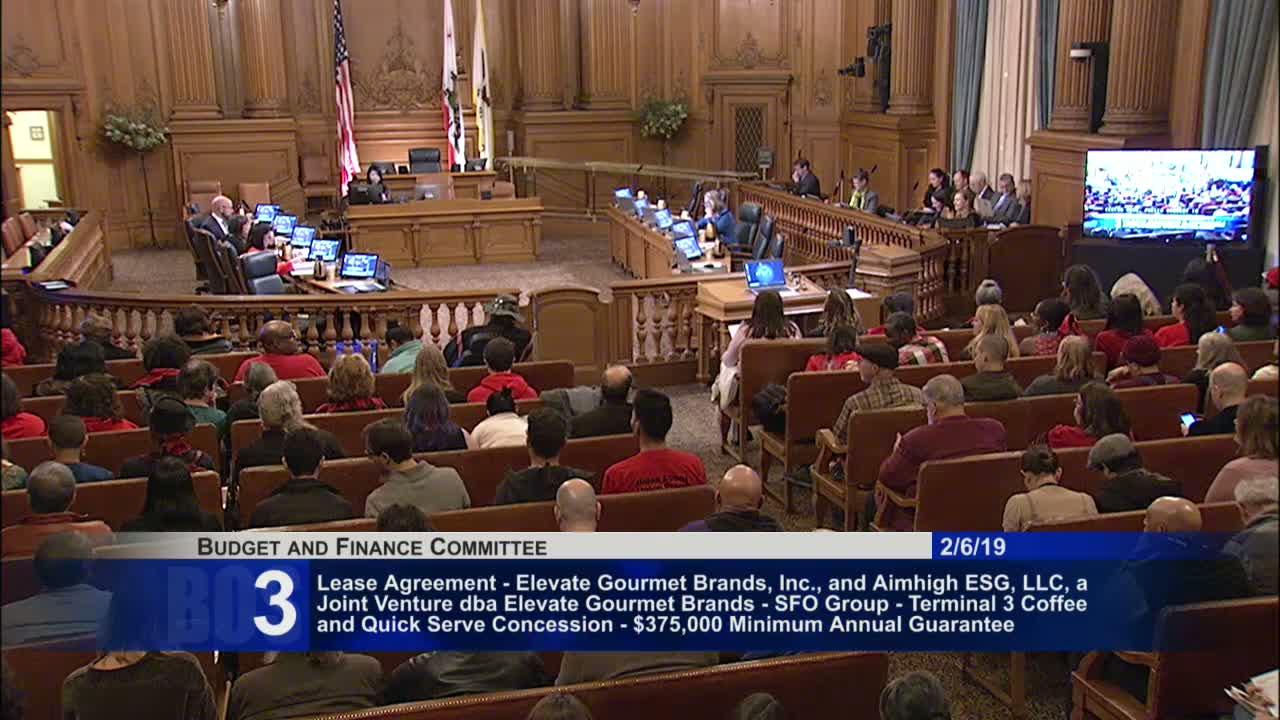
The Board of Supervisors Budget & Finance Committee on an extended hearing accepted amendments to competing ordinances that would spend a multihundred‑million dollar ERAF (excess educational revenue augmentation fund) windfall on homelessness, housing, early‑childhood education and K–12 teacher pay.
Chair Sandra Lee Feuer opened the hearing after the committee and the mayor's office circulated competing proposals. The two substitute ordinances seek to split discretionary ERAF money after mandatory baselines and charter‑required allocations; the balance available for discretionary spending was described repeatedly at the hearing as roughly $185 million.
After more than three hours of public comment from hundreds of speakers — including teachers, early‑childhood educators, parents and homelessness advocates — the committee adopted a package of amendments that the city controller summarized as the balanced approach. The amendments create a teacher and early‑childhood educator reserve funded with $52 million of one‑time ERAF/rainy‑day money. The ordinance language makes the reserve a limited, "last‑resort" source for wage gap funding in fiscal year 2020–21 if other city or district revenues do not materialize; any appropriations from the reserve will require a later board action.
Sevin Campbell of the Budget and Legislative Analyst (BLA) told the committee the reserve closes an estimated funding gap of about $40 million for SFUSD and about $10 million for early childhood educators, subject to future board appropriation. The BLA also reviewed the broader package's allocations, noting mandatory baseline passthroughs (library, children's and other charter baselines) of about $35 million and discretionary balances as described above.
Homelessness and housing funding remained the largest single share in the amended package. Department presenters described a set of housing and service uses: roughly 300 leased or short‑term shelter beds and navigation capacity (including an expanded safe center), a $40 million small‑sites acquisition and loan program, capital contributions for the Seventh and Mission supportive‑housing project and interim repairs for Hope SF public‑housing sites (Sunnydale and Potrero). Jeff Kositsky, director of the Department of Homelessness and Supportive Housing, told the committee many of those programs could be stood up within months.
Department of Public Health and provider representatives described funded behavioral‑health components including 14 community care beds at the Saint Mary's healing facility and 72 step‑down residential beds intended to reduce recidivism after residential treatment. The mayor's office of housing and community development described $42.5 million targeted to new homeless housing (Seventh & Mission) and $14 million for site acquisition tied to transit‑oriented development.
Public testimony focused on two repeated themes: the urgency of expanding shelter and housing now for people living on the streets, and the urgency of maintaining Prop G salary gains for teachers and Prop baby C commitments for early‑childhood educators. Speakers repeatedly used the phrase "grow the pot," urging supervisors to expand revenue rather than choose one group over another. Multiple nonprofits and unions asked the board to preserve the voters' will and fund both homelessness solutions and educator wages.
Committee members praised the compromise language as a rare example of cross‑coalition solidarity. Supervisor Gordon Mar (coauthor) framed the $52 million reserve as a bridge to preserve educator raises in 2020–21 and repay the city if the pending litigation on the November measures is resolved in the city's favor. President Norman Yee and other supervisors emphasized the package is a first step and that additional revenue and future ERAF distributions could add capacity.
The committee accepted the controller's and mayoral amendments and continued final votes to a special Budget & Finance meeting set for Feb. 11 to give departments time to return with line‑item details and to finalize ordinance language.
The committee adopted a process provision that the controller shall transfer funds from the reserve only after an annual appropriation adopted no later than Aug. 15 of each year and only after other legally available revenue sources were considered, consistent with the "last‑resort" design of the reserve.
What's next: Committee members said departments (Homelessness & Supportive Housing; Public Health; Mayor's Office of Housing & Community Development) will return with finer budget detail, and the committee will act on Feb. 11. If litigation over the November ballot measures is resolved for the city, language in the ordinance contemplates reimbursement of any bridge funding spent from the reserve.