Get Full Government Meeting Transcripts, Videos, & Alerts Forever!
Get email alerts on the Zero Waste Ordinance topic
No spam. Unsubscribe anytime.
Committee delays vote on zero‑waste ordinance after lengthy debate over audits, fines and exemptions
Summary
Supervisors heard detailed testimony on an ordinance to require triennial audits of large refuse generators and to authorize orders to hire zero‑waste facilitators after failed audits; the committee continued the item to November 29 after sponsor amendments and stakeholder concerns.
The Budget & Finance Committee continued consideration of a proposed ordinance that would require audits every three years for the City’s largest refuse generators and establish enforcement measures, including the ability for the Director of the Department of Environment to order hiring of a 0‑waste facilitator after a failed audit.
Sponsor Supervisor Safaie said the requirement for a facilitator is intended to be an entry‑level, cost‑effective position that can drive diversion improvements and pay for itself. "This is about an entry level minimum wage job to help preserve money...and ultimately save our environment," he said. Director Debbie Raffel (Department of Environment) told the committee that a small share of large generators—now roughly 419 accounts after the threshold was adjusted—accounts for an outsized share of material sent to landfill and that targeted audits and facilitators have shown measurable diversion gains.
Jack Macy, the Department of Environment’s zero‑waste program lead, presented audits and case studies: Recology handles roughly 900,000 tons of material, and DOE’s audits showed that among audited compactors 77% had over half their material divertable as recycling or composting. Macy provided examples in which a facilitator produced net annual savings (for example, a net savings of $28,000 a year for a high‑rise apartment after hiring a facilitator).
Business groups and some industry representatives urged a more graduated enforcement process, citing the risk that one failed audit could force substantial operational changes. The San Francisco Chamber of Commerce, Biocom and building‑owner representatives asked for additional chances or phased enforcement; others, including unions and waste‑industry workers, urged stronger action to achieve long‑standing zero‑waste goals.
Recology’s representative described the company’s audit‑and‑outreach process and said contamination charges are intended as a last resort; she said charges remain on an account for at least two billing cycles and that Recology aims to help customers come into compliance.
Committee members debated several substantive changes: sponsors reported narrowing the regulated universe (raising the compacting/roll‑off threshold from a prior figure to 40 cubic yards) and proposed delayed implementation for nonprofit food providers and 100% subsidized affordable housing projects (a two‑year implementation delay for those categories). The Port and public‑can issues will be addressed with a non‑substantive city‑attorney amendment to exempt certain publicly accessible receptacles in Port/BCDC areas.
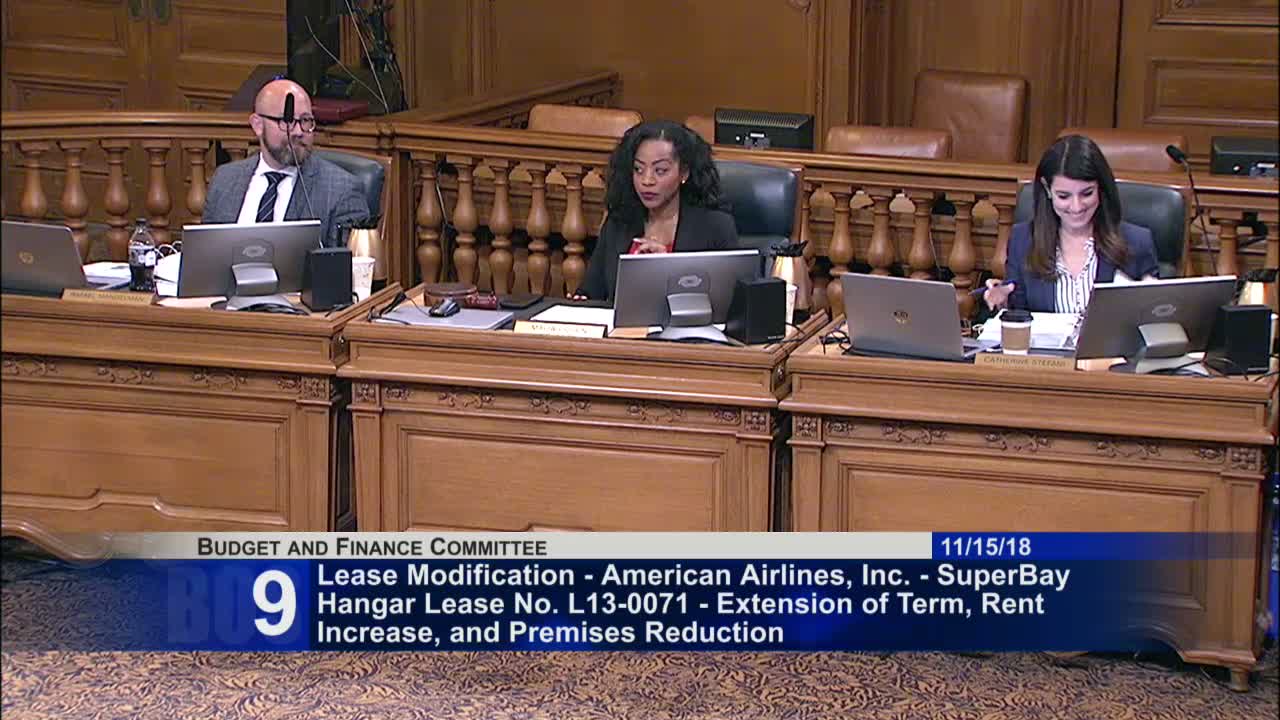
After extended discussion and public comment, Chair Malia Cohen moved to continue the item to the committee’s November 29 meeting so the city attorney can finalize amendment language and the sponsors can circulate the draft changes. The motion passed by roll call, 2 ayes to 1 no (Supervisor Rafael Mandelmann and Chair Cohen voted yes; Supervisor Catherine Stephanie voted no).
The committee record shows the DOE will provide updated audit schedules and lists of covered accounts to committee members prior to the next hearing and that the sponsors will circulate finalized amendment language.