Get Full Government Meeting Transcripts, Videos, & Alerts Forever!
Get email alerts on the Substance Use Treatment topic
No spam. Unsubscribe anytime.
Committee forwards 'Cash Not Drugs' pilot to Board, citing evidence for contingency management
Summary
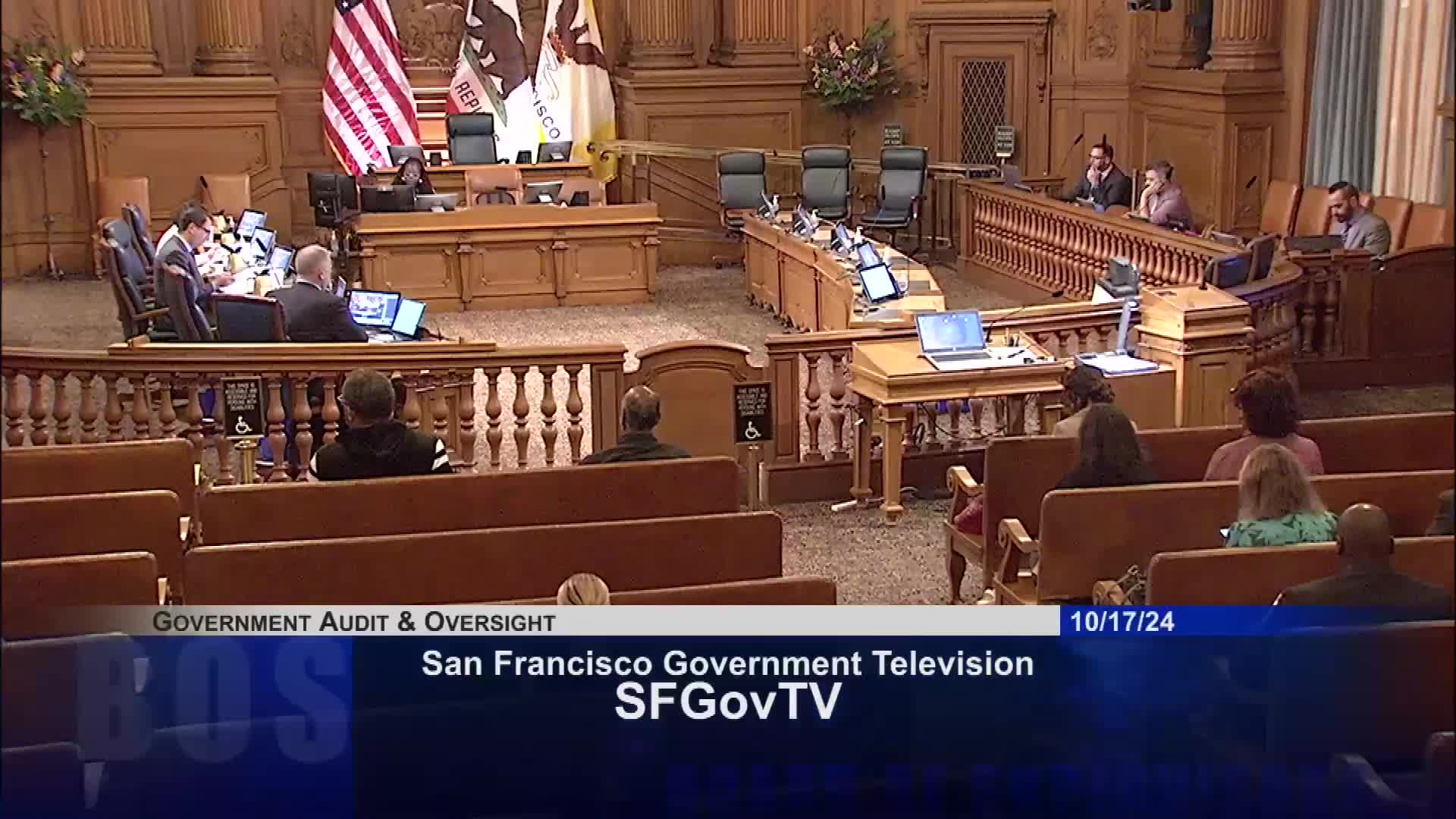
The Government Audit & Oversight Committee voted Oct. 17 to send Supervisor Matt Dorsey’s three‑year Cash Not Drugs pilot to the full Board with a positive recommendation. The voluntary program would offer up to $100 per week to eligible CAP recipients who test negative for illicit drugs, with a six‑month planning period and external evaluation.
San Francisco — The Government Audit & Oversight Committee on Oct. 17 voted to forward to the full Board of Supervisors an ordinance that would authorize a three‑year pilot program called Cash Not Drugs, which would let a human services agency, in coordination with the Department of Public Health, offer weekly financial incentives to some recipients of the county adult assistance program (CAP).
Sponsor Supervisor Matt Dorsey, who introduced the legislation, said the program would add a contingency‑management option to treatment pathways created under March 2024’s Proposition F. “Contingency management is one of the most effective behavioral interventions for initiating and maintaining abstinence,” Dorsey said, summarizing evidence cited in the bill and in recent clinical literature. The ordinance would exempt incentive payments from CAP eligibility calculations and require a six‑month implementation and plan‑design period before the program becomes operational.
Dorsey and Human Services Agency officials said the pilot is intended to be flexible so health professionals can design the model. Susie Smith, Deputy Director for Policy, Planning and Public Affairs at HSA, explained how Cash Not Drugs would fit into CAP intake and referral pathways and stressed that the departments will use the six‑month planning window to determine eligibility criteria and contracting: “HSA would do the intake, orientation and approval to confirm someone is eligible for CAP ... and then refer for an initial assessment to figure out the most appropriate pathway,” she said.
The Budget Legislative Analyst offered cost scenarios that vary with program size and duration. “You’ll see costs range from about $220,000 per year to $1,200,000 per year,” Nick Menard said, based on models serving 50 to 150 people per year for program durations between 12 and 24 weeks. Menard noted possible funding sources including the general fund, Prop C mental‑health funds and partial Medi‑Cal reimbursement, but warned that Medi‑Cal reimbursement would require the program to conform to state rules.
Department of Public Health staff said existing local contingency‑management programs structure incentives in different ways and that a $100‑per‑week cap fits within some local models. “Of the various contingency‑management programs that we operate currently in the city, they all range in the amount of incentives that are available,” Emily Ragnold of DPH said, noting variations in cycle length and total payouts.
Several recovery providers and people with lived experience urged adoption during public comment. Billy Lemon, executive director of the Castro Country Club, described contingency management as “life altering” in his recovery and urged the committee to approve the pilot. Other speakers praised the evidence base but asked the Board to ensure culturally appropriate outreach and participation by Black and other historically underserved communities.
The ordinance requires an external evaluator and leaves detailed design decisions to HSA and DPH during the six‑month planning period. The committee forwarded the item to the full Board with a positive recommendation; it is expected to appear on the Board’s Oct. 29, 2024 agenda unless otherwise stated in the legislative file.
The full Board will consider funding pathways after plan design and the six‑month implementation period; preliminary budget scenarios range from roughly $220,000 to $1.2 million annually depending on scale and duration. The Budget Legislative Analyst and city departments said they will return with more detailed cost estimates as part of the implementation plan.