Get Full Government Meeting Transcripts, Videos, & Alerts Forever!
Get email alerts on the Faircloth To Rad topic
No spam. Unsubscribe anytime.
Supervisors press housing officials as city moves to reserve 3,667 Faircloth-to-RAD units by Sept. 30
Summary
Housing Authority and MOHCD briefed the committee on the HUD Faircloth-to-RAD program; the authority committed to reserving its full 3,667-unit Faircloth allocation and to submit placeholder NARS applications by Sept. 30, 2024, while advancing an initial pilot cohort of about 750 units to test rent-augmentation implementation.
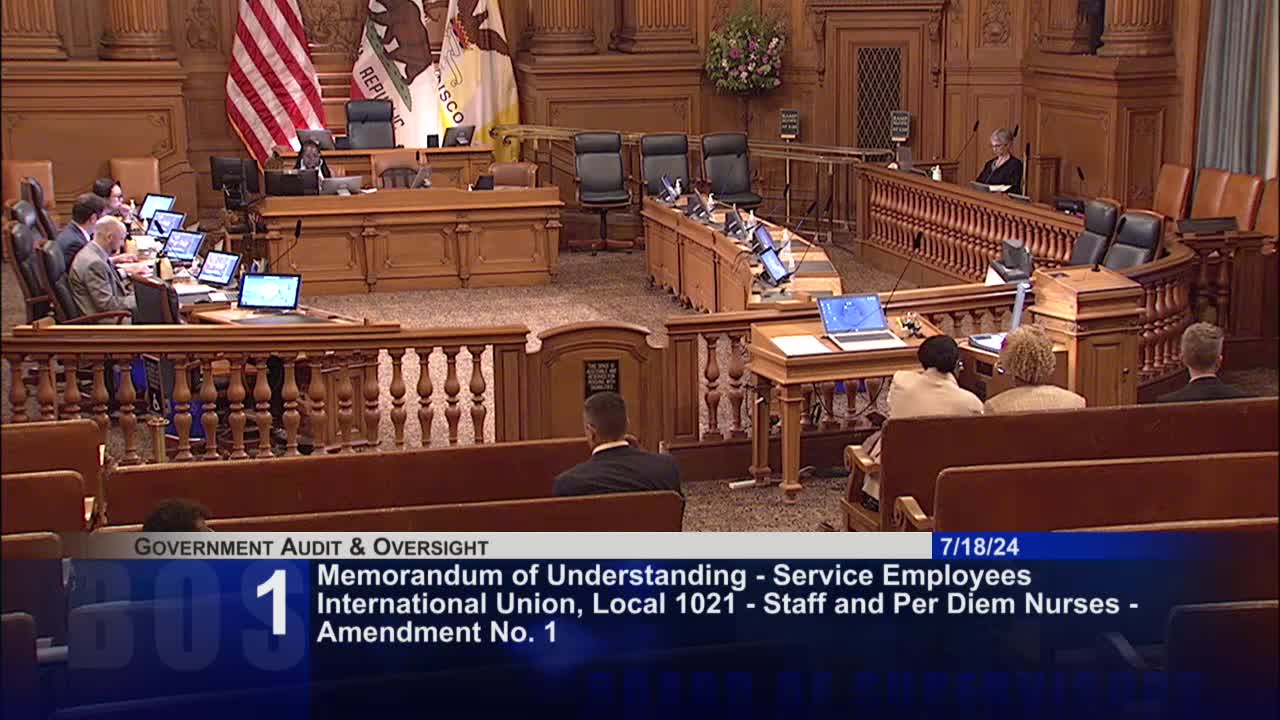
San Francisco housing officials told the Government Audit and Oversight Committee on July 18 that the city will move to reserve its full Faircloth-to-RAD authority and prepare for HUD's rent-augmentation pilot, but supervisors pressed officials for timelines, budget clarity and outreach plans.
Dr. Tanya Lettaju, CEO of the San Francisco Housing Authority, said the authority "has committed to leveraging its entire 3,667 units of Faircloth authority" across new construction and existing properties and will work with the Mayor's Office of Housing and Community Development (MOHCD) to submit placeholder NARS applications to HUD before the Sept. 30, 2024 deadline. She described the Faircloth-to-RAD program as a HUD initiative that combines Faircloth authority with RAD transactions to enable housing authorities to build and convert public housing into deeply affordable rental housing.
MOHCD presenters explained program mechanics and constraints. Baseline RAD rents are low (presenters described them as roughly 35% of area median income, "about $600 to $1,200 a month" depending on unit type), so the pilot rent-augmentation policy allowing vouchers up to 110% of the fair-market rent is a key tool to make projects financially viable. An unnamed MOHCD presenter said the city is "definitely operating under the assumption that that is a final deadline" for Sept. 30 and described NARS submissions as placeholder reservations that can be transferred among project addresses as planning proceeds.
Deputy Lydia Eley, MOHCD, said NARS applications can be "dummy" or placeholder applications that require only high-level operating budgets and an address (actual or theoretical), which preserves optionality for projects not yet fully specified. Housing and MOHCD staff repeatedly cautioned that augmenting RAD rents to the payment standard depends on local Housing Authority reserves and year-to-year budgeting; the authority said current reserves are committed across project-based vouchers and Housing Choice Vouchers (Section 8) and must be balanced to avoid long wait lists.
Supervisors asked why the city had not submitted placeholder reservations sooner; MOHCD said the application and data-entry work is time-consuming and the agency wanted a clear path forward before submitting hundreds of NARS. Supervisors also sought clarity on how Faircloth-to-RAD will interact with other funding streams such as Homekey and possible state bond funds (Prop 1); presenters said those programs often have different timelines or requirements and do not always align on a project-by-project basis.
MOHCD said the immediate plan is twofold: (1) submit NARS reservation applications by the Sept. 30 deadline to reserve the full 3,667-unit Faircloth authority, and (2) move an initial pilot cohort of about 750 units through more detailed HUD engagement (environmental review and design) so staff and partners can learn the compliance steps. The committee agreed to continue the item to the call of the chair for follow-up reporting and oversight. Charlie Shamas of the Council of Community Housing Organizations spoke in public comment urging the city to "go the full distance and leverage these resources for the maximum allowable capacity."