Get Full Government Meeting Transcripts, Videos, & Alerts Forever!
Get email alerts on the Flood Management topic
No spam. Unsubscribe anytime.
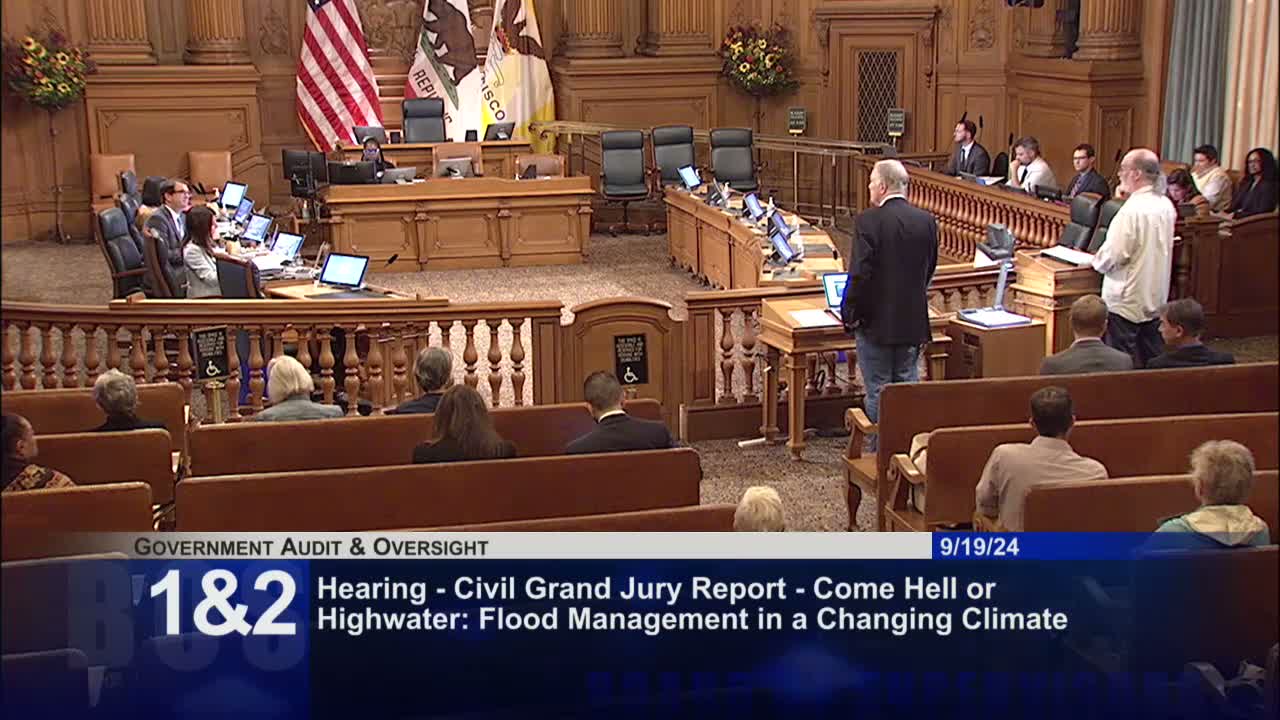
Supervisors hear civil grand jury call for stronger flood governance as city cites ongoing planning work
Summary
The Government Audit & Oversight Committee reviewed the civil grand jury's "Come Hell or High Water" report on flood management. Grand jurors urged clearer financing and coordination; city staff said Climate SF and the 10‑year capital plan provide coordination and funding pathways but acknowledged gaps in public communication and project costing.
The Government Audit and Oversight Committee reviewed the civil grand jury’s “Come Hell or High Water” report on the city’s flood preparedness, with jurors urging stronger governance, clearer financing and more public communication.
Michael Carboy, the civil grand jury foreperson, opened the session by noting the jury’s concern that city respondents had frequently disagreed with the jury’s factual findings and urged the committee “to heed the civil grand jury's findings and recommendations.” Ralph Lane, presenting the jury’s flood report, said the jury could not find public records for some coordinating bodies and warned residents deserve more information about risks.
Lane highlighted potential costs tied to the US Army Corps waterfront study and said city systems need clarification. “The PUC admits that the wastewater system cannot handle what's coming,” he said, stressing that more debt capacity and coordinated funding approaches may be necessary to deliver large adaptation measures.
City staff pushed back on aspects of the jury’s framing while accepting many recommendations in spirit. Brian Strong, Chief Resilience Officer and Director of the Office of Resilience and Capital Planning, said Climate SF, formed in 2019, functions primarily as a coordination platform funded across six departments and that many resilience projects remain the domain of implementation agencies. He said the city uses a Facilities Resource Renewal model to track infrastructure needs and that the 10‑year capital plan is the standard vehicle for bringing projects forward.
On funding, officials pointed to a state general obligation (G.O.) bond on the ballot (referred to in testimony as a $10 billion bond, Prop. 4), federal programs and other financing tools. Adam Barrett of the Port of San Francisco said the draft Army Corps plan had a preliminary cost estimate of about $13.5 billion, with the federal share potentially covering up to 65% of design and construction if Congress authorizes the project.
Supervisors pressed for clearer public reporting and timelines. Vice Chair Katherine Stephanie asked whether Climate SF could produce an annual report so the Board would have a basis for action; Mr. Strong said the office is working with the controller to better identify and tag projects in budget documents but cautioned it will take time.
After public comment from neighborhood residents and scientists urging immediate attention to waterfront impacts, the committee directed the clerk to prepare the board’s response to the superior court and forward the item to the full Board with a positive recommendation. Committee members also continued Item 1 for further analysis on certain responses.
What happens next: The committee forwarded the proposed response to the full Board of Supervisors for formal adoption and asked staff to continue work on project identification, public reporting and the feasibility of annual resilience reporting.