Get Full Government Meeting Transcripts, Videos, & Alerts Forever!
Get email alerts on the Seawall Bond topic
No spam. Unsubscribe anytime.
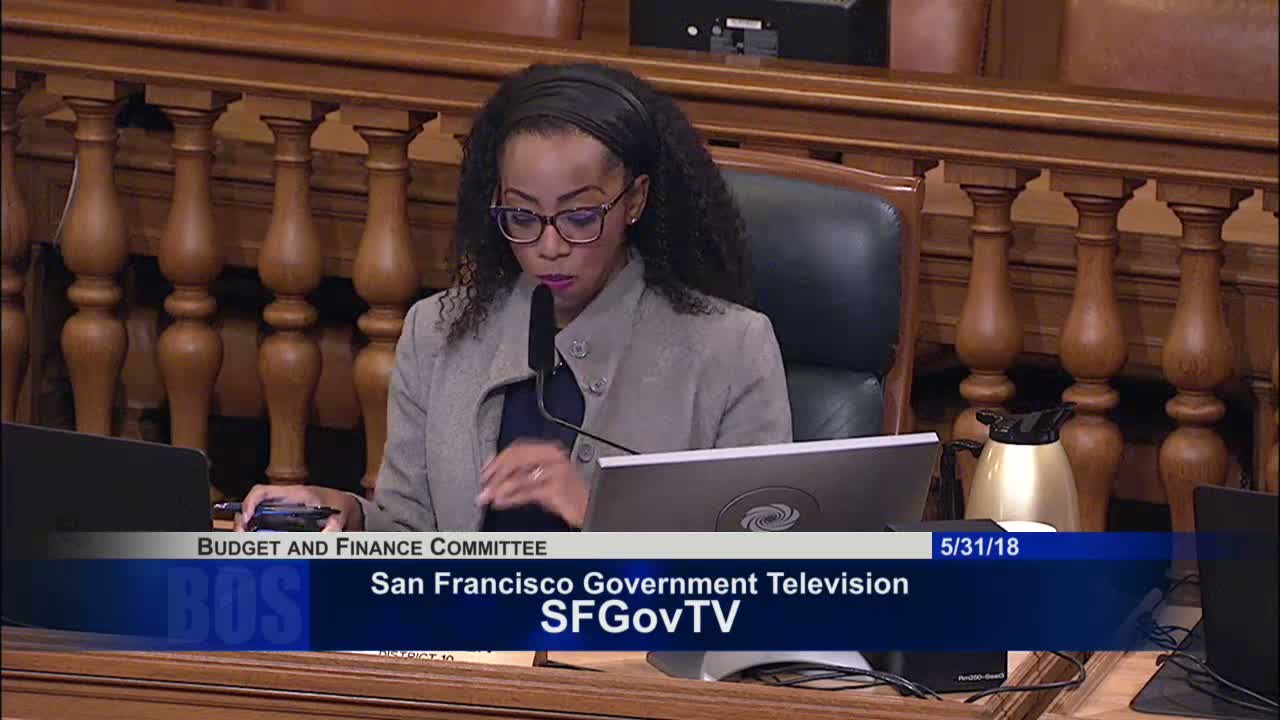
Budget committee backs $425 million Seawall safety bond, sends measure to full Board
Summary
The San Francisco Budget and Finance Committee unanimously recommended that the Board of Supervisors place a $425 million general‑obligation bond for Embarcadero Seawall seismic and flood safety on the Nov. 6, 2018 ballot, while instructing staff to hold a pared‑down ballot question file in committee pending state guidance on geo bond wording.
The Budget and Finance Committee on a unanimous procedural vote recommended that the Board of Supervisors place a $425,000,000 general obligation bond on the Nov. 6, 2018 ballot to fund seismic and flood safety work on the Embarcadero Seawall.
Chair Malia Cohen moved to accept the CEQA amendments to the files, duplicate the ordinance for the ballot question so the committee can amend question language later if necessary, continue the duplicated file to the call of the chair, and forward items 1–3 to the full board with a positive recommendation; the motions were seconded and taken without objection.
City Administrator Naomi Kelly told the committee the Seawall is a largely unseen lifeline that supports regional transportation, utilities and the Embarcadero waterfront and that the 2014 lifelines interdependency study identified it as a top capital priority. "The Seawall is important to so many different assets," Kelly said, urging the committee to keep the project moving.
Port Director Elaine Forbes described the structure as a roughly 3‑mile legacy infrastructure built on reclaimed land between Fisherman's Wharf and Mission Creek and said engineering work shows fill behind the wall can liquefy and push the Seawall bayward in a major quake, threatening roads, Muni tracks, piers and utilities. "The fill behind the Seawall will liquefy, forcing the wall bayward as much as 5 feet," Forbes said, summarizing the seismic risk the bond is intended to address.
Port staff characterized the bond as the primary local funding source for Phase 1 of a multi‑phase program. The port estimated Phase 1 at about $500,000,000 and said the proposed $425,000,000 bond would cover a substantial portion of that package; the port also reported $10,000,000 secured from the U.S. Army Corps of Engineers and an anticipated $55,000,000 in state support contingent on pending legislation (AB 2578).
Stefan Campbell of the Budget Analyst's Office summarized financing options and tax impacts, saying the city is considering issuing three bond series over five years and that principal and interest were currently estimated at about $730,000,000 over the program; he estimated an average property tax impact of about $13 for every $100,000 of assessed value.
Deputy City Attorney John Gibner told the committee that a new state rule requires tax measures to include additional information in ballot language (annual collections, potential tax rates and duration), and that the Legislature is considering whether that rule will apply to geo bonds. Because the rule's status is uncertain, Gibner recommended duplicating the file and keeping a version that contains only the ballot question so the committee can amend wording in July if the state law remains unchanged.
Public comment at the hearing was overwhelmingly supportive of the bond. Speakers included representatives of waterfront neighborhood associations, the Exploratorium, the Chamber of Commerce, transit and labor groups, and public‑safety unions, who cited risks to transportation, public safety, jobs and downtown economic activity. Bruce Agade, chair of the TJPA Citizens Advisory Committee, called $425,000,000 a down payment to address catastrophic risks; Laura Zander, chief financial and operating officer of the Exploratorium, cited USGS regional earthquake probability and urged investment in the Seawall to protect institutions on the waterfront.
Committee members signaled bipartisan interest in moving the measure forward and in adding targeted language. Sunny Angulo (as recorded in the hearing) said Supervisor Peskin's office will work with the Port to refine ordinance language to acknowledge mitigation steps and protection of the Embarcadero Historic District and that Peskin intends to offer amendments at the Board hearing.
Next steps: the committee sent the ordinance and related files to the full Board of Supervisors with a positive recommendation; the clerk recorded that the files will appear on the Board agenda on June 12 and that the duplicate ballot‑question file will remain in committee for possible amendment once the state law status is clear.