Get Full Government Meeting Transcripts, Videos, & Alerts Forever!
Get email alerts on the Department Budgets And Program Risks topic
No spam. Unsubscribe anytime.
Departments outline FY18–19 priorities, warn of IHSS cost shift and CalFresh work requirement exposure
Summary
Public Health, the Human Services Agency, Aging & Adult Services and Early Care & Education presented FY18–19 priorities. HSA flagged an SB 90 IHSS cost‑shift (~$592M statewide; ~$20M SF share this year) and the ABOD waiver that could place about 5,000 San Franciscans at risk of losing CalFresh without 20 hours/week of work activity.
Supervisors received a multi‑department briefing on FY2018–19 budget priorities and program risks from the Departments of Public Health (DPH), Human Services Agency (HSA), Aging & Adult Services (DOS) and the Office of Early Care & Education (OECE).
DPH Director Barbara Garcia outlined a $2.2 billion base budget that relies on $1.4 billion in drawdown revenue (principally Medi‑Cal and Medicare) and emphasized the department’s behavioral‑health portfolio, electronic health record modernization ($383 million over 10 years with a Phase 1 go‑live Aug. 3, 2019), syringe access and disposal efforts, shelter health, medical respite and partnerships with UCSF. Garcia said the department will backfill $4.1 million in HIV prevention, surveillance and other disease control funding where grant or state funds were reduced.
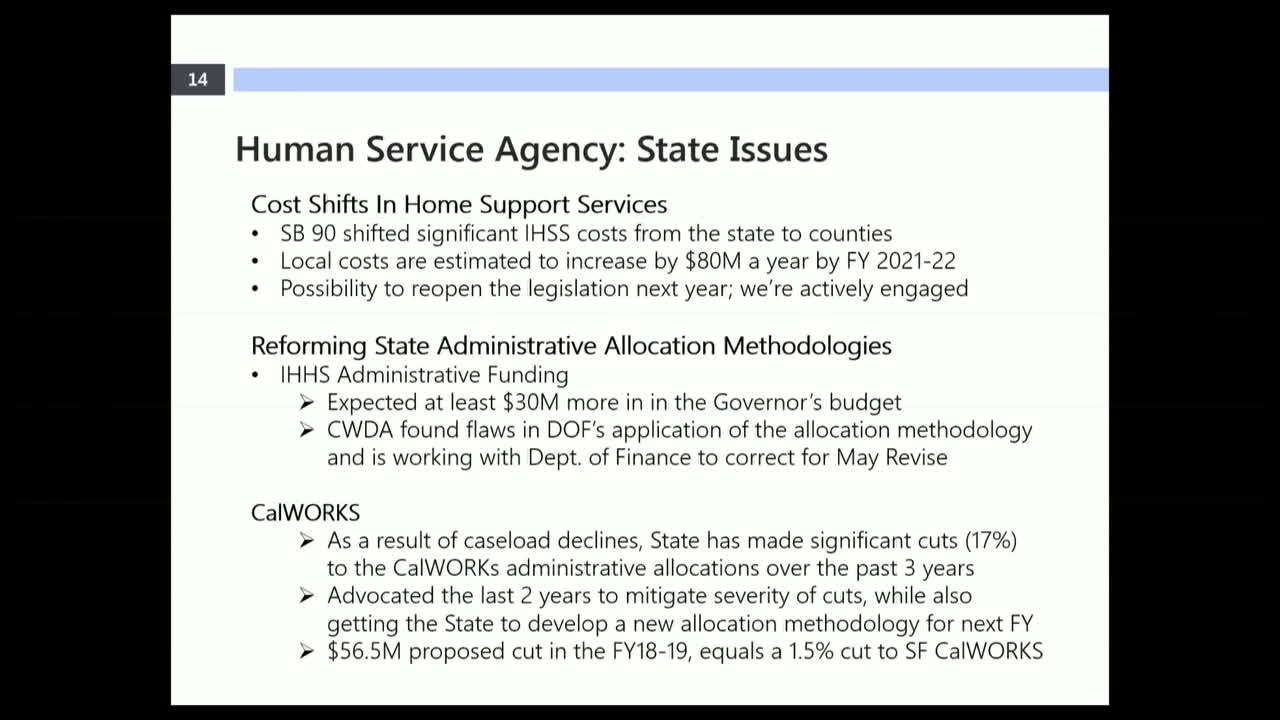
Trent Rohrer, Director of the Human Services Agency, characterized the state’s Senate Bill 90 as a substantial cost shift that moves roughly $592 million of IHSS costs to counties; San Francisco’s share is about $20 million in the current fiscal year and the county faces escalators that will raise the exposure in coming years. Rohrer said the agency is working with county associations and labor partners to reopen the issue under the new state administration and is seeking mitigation in the May revise. He also warned that expiration of an ABOD waiver will require able‑bodied adults 18–49 to do roughly 20 hours a week of work activities to retain CalFresh benefits; HSA estimates roughly 5,000 San Franciscans could be affected (average benefit about $230/month).
Rohrer reviewed HSA reforms and programs — JobsNow and workforce development, CAP (County Adult Assistance Program), CalWORKs housing supports and the 4E waiver that allows federal dollars to be used more flexibly for preventive family services — and highlighted the new benefits linkage manager role to align the agency’s benefits with the Department of Homelessness and Supportive Housing.
Shereen McSpadden (DOS) described IHSS caseloads (~25,000 clients; ~22,400 providers), a new high‑risk self‑neglect and eviction prevention unit (launched May 2017; ~285 clients served with most cases closed in a stable state), and a tiered wage pilot aimed at reducing caregiver turnover. The department flagged capacity gaps for residential care and workforce shortages.
September Jarrett (OECE) described early care and education work — city programs serve 7,500 children through an Early Learning Scholarship and the office is building a digital portal to help parents find and navigate child care options; Jarrett also flagged workforce recruitment and compensation as significant constraints.
Supervisors questioned behavioral health bed capacity, continuity of care between treatment and housing, the city’s approach to conservatorship and placement outside the county, and the effectiveness of workfare vs. paid subsidized employment. Department officials said staffing, housing availability and program capacity — not single‑agency policy — are the principal constraints.