Get Full Government Meeting Transcripts, Videos, & Alerts Forever!
Get email alerts on the Homelessness Budgeting topic
No spam. Unsubscribe anytime.
San Francisco supervisors hear detailed budget evidence as homelessness remains steady despite investments
Summary
At an April 19 Budget & Finance Committee hearing, city departments and providers reviewed homelessness indicators, spending and program priorities. Presenters urged stronger prevention (rapid rehousing, eviction defense), expanded temporary shelter, and deeper behavioral-health supports tied to housing.
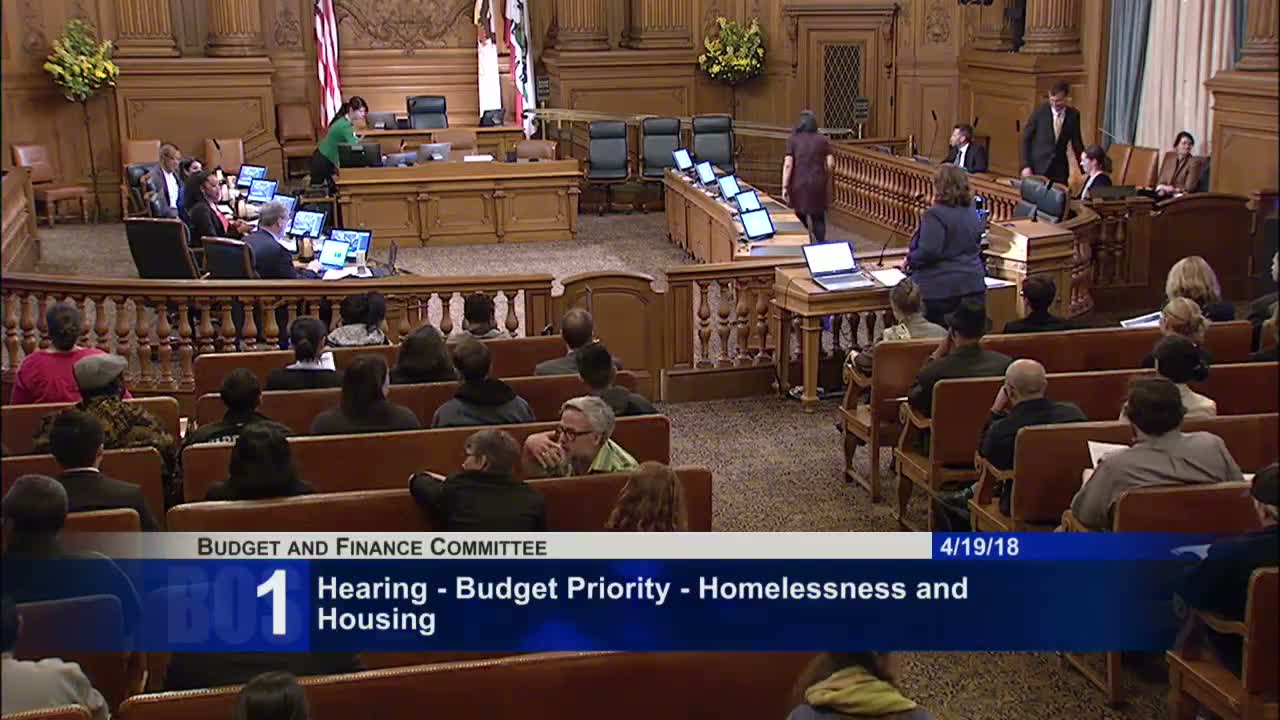
The Board of SupervisorsBudget & Finance Committee on April 19 convened a multi-hour policy hearing to examine past spending and budget priorities for homelessness and behavioral health.
Chair Malia Cohen opened the meeting by asking departments and community partners to focus the discussion on where money is going, what outcomes are expected and which populations should be prioritized. The committee heard detailed presentations from the Controllers Office, the Department of Homelessness and Supportive Housing (HSH), the Department of Public Health (DPH), the Mayors Office of Housing and the Budget Legislative Analyst, followed by a joint budget request from the Homeless Emergency Service Providers Association (HESPA) and extensive public comment.
The Controllers Office said San Franciscos point-in-time methodology is more expansive than HUDs for some measures and that benchmarking across peers is intended to provide apples-to-apples comparisons. The office said work is underway to expand public performance scorecards and to improve data on subpopulations and program targets.
HSH leadership listed the departments strategic goals — reduce chronic and youth homelessness by 50 percent, effectively end family homelessness and reduce large encampments — and described a coordinated-entry and problem-solving approach to prioritize people for the right intervention. HSH staff highlighted a recurring operational challenge: "every week HSH and our partner agencies house or help 50 people exit homelessness," but the department sees about 150 newly homeless people each week, creating a net shortfall.
Departments also described capacity and spending. HSH reported an operating budget of roughly $250 million and said about two-thirds of operating funds go to housing; temporary shelter accounts for about 17 percent, outreach about 8 percent, and healthcare about 3 percent. The Mayors Office of Housing reviewed the citys existing affordable stock and the near-term pipeline of units, and the Budget Legislative Analyst presented a set of policy options ranging from master-leased units and navigation centers to targeted rapid-rehousing expansions.
DPH outlined services for people with serious medical or behavioral-health needs, described the citys Whole Person Care waiver (federal waiver funding used to integrate services) and discussed a state bill (SB 1045) the department and partners are tracking that would affect involuntary treatment and conservatorship pathways for a small subset of people judged gravely disabled.
HESPA, a coalition of frontline nonprofit providers, delivered a consolidated budget request that seeks to maintain existing programs and expand services that providers say prevent new entries into homelessness. Its asks include targeted rental subsidies (for youth, families, seniors and people with disabilities), emergency shelter operations (24-hour access, showers and privacy for families), hotel vouchers, an expansion of housing navigation and outreach, enlarging the pit-stop (staffed bathroom) program, and $2 million in additional funding for full-scope eviction-defense attorneys.
Public commentators, many of them providers and people with lived experience, stressed prevention and rapid exits from homelessness, urged baseline funding for successful pilots such as SHARE (supportive housing assistance readiness), and called for replacement or new shelters in neighborhoods with acute need.
Committee members said the hearing strengthened an emerging set of budget priorities for the board resolution they will file: expand rapid rehousing and front-end prevention, baseline successful subsidy pilots, fund eviction-defense representation, invest in mental-health supports linked to housing, and create a transitional-age-youth (TAY) navigation center. The committee will synthesize testimony into a resolution for the full board and forward it to the mayors office ahead of the mayors budget submission.