Get Full Government Meeting Transcripts, Videos, & Alerts Forever!
Get email alerts on the Federal Budget And Tax Reform topic
No spam. Unsubscribe anytime.
Controller and city health officials flag federal tax and budget changes as risks to San Francisco services
Summary
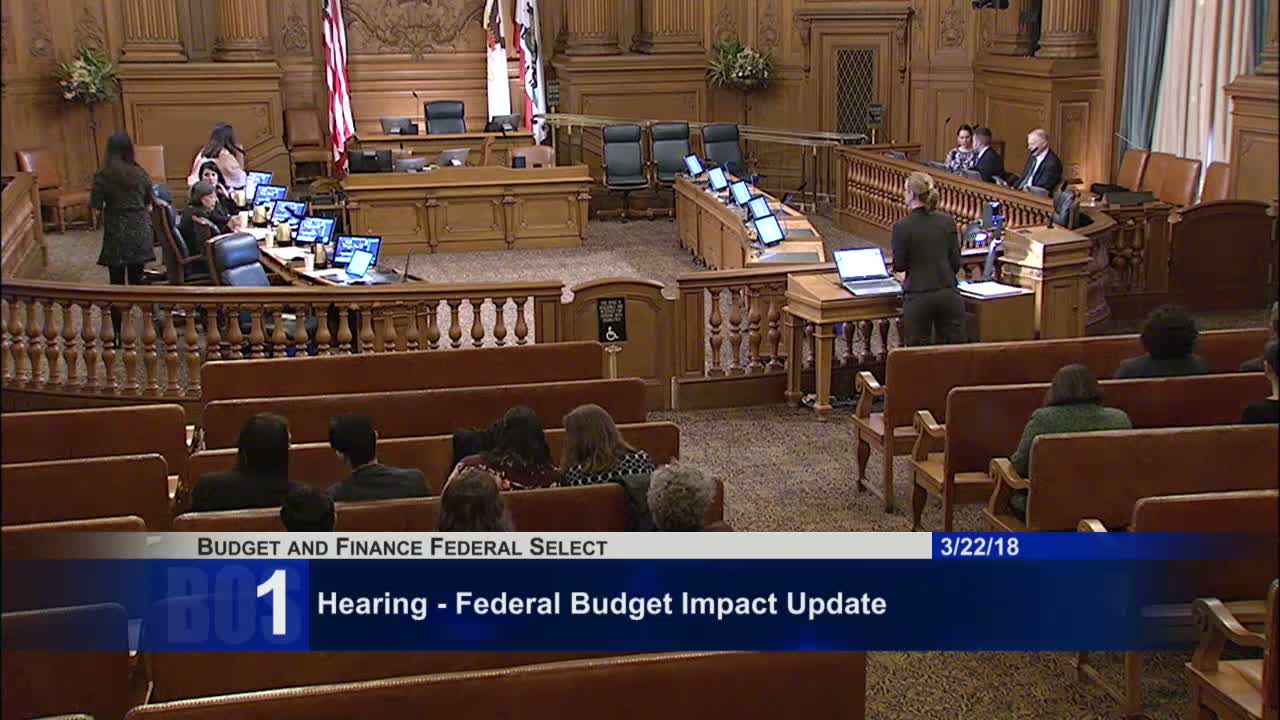
City staff told the Budget & Finance Committee the federal tax overhaul and ongoing federal budget debates could reduce revenues, change household tax burdens, and pose risks to Medicaid/Medi‑Cal and safety‑net programs; the controller and DPH asked the city to track impacts and consider reserves.
City financial staff and department officials told the Budget & Finance Committee that recent federal tax changes and ongoing federal budget negotiations pose material fiscal and service risks for San Francisco.
Michelle of the Controller’s Office and Ted Egan, also of the Controller’s Office, summarized recent federal activity including a February two‑year budget package and the December 2017 tax law. Egan cited Joint Committee on Taxation estimates that the tax changes would add roughly $1.5 trillion to the federal deficit over 10 years and produce distributional changes — reductions in after‑tax income for many lower‑income households and gains for many higher‑income households — and the loss of some federal deductions (notably the cap on state and local tax deductibility at $10,000 and limits to mortgage interest deductibility) that are likely to raise federal taxes for many California households. Egan said the controller’s office will estimate local household and business effects and adjust city forecasts as appropriate.
Greg Wagner, Chief Financial Officer of the Department of Public Health, briefed the committee on health‑sector impacts: the federal deal extended funding for the Children’s Health Insurance Program and community health center support, and included new funding for opioid treatment and mental health. But Wagner cautioned that proposed federal budgets and policy proposals (including Medicaid changes, repeal of the individual mandate and reduced cost‑sharing subsidies) could reduce coverage, raise premiums and ultimately increase demand on city providers and hospitals; he said the department is monitoring proposals and coordinating advocacy.
Michelle warned committee members that Congress had an imminent deadline to pass a spending bill (a possible shutdown if it failed) and that Congress and the administration were negotiating over immigration and border spending that remain sticking points.
Committee members asked about local effects, and the Controller’s Office said it is developing estimates of household and business revenue impacts and will share more detailed analyses with supervisors in upcoming briefings. No formal votes were taken; the committee continued the item to the call of the chair for follow‑up analysis.