Get Full Government Meeting Transcripts, Videos, & Alerts Forever!
Get email alerts on the Budget Options topic
No spam. Unsubscribe anytime.
Budget office lays out one‑time and ongoing options to address street cleanliness
Summary
The Budget & Legislative Analyst summarized performance trends and offered a menu of options—temporary public-service aides, Tenderloin expansion, new sweepers, pit-stop purchases and targeted grants—so the Board can weigh one‑time versus ongoing investments.
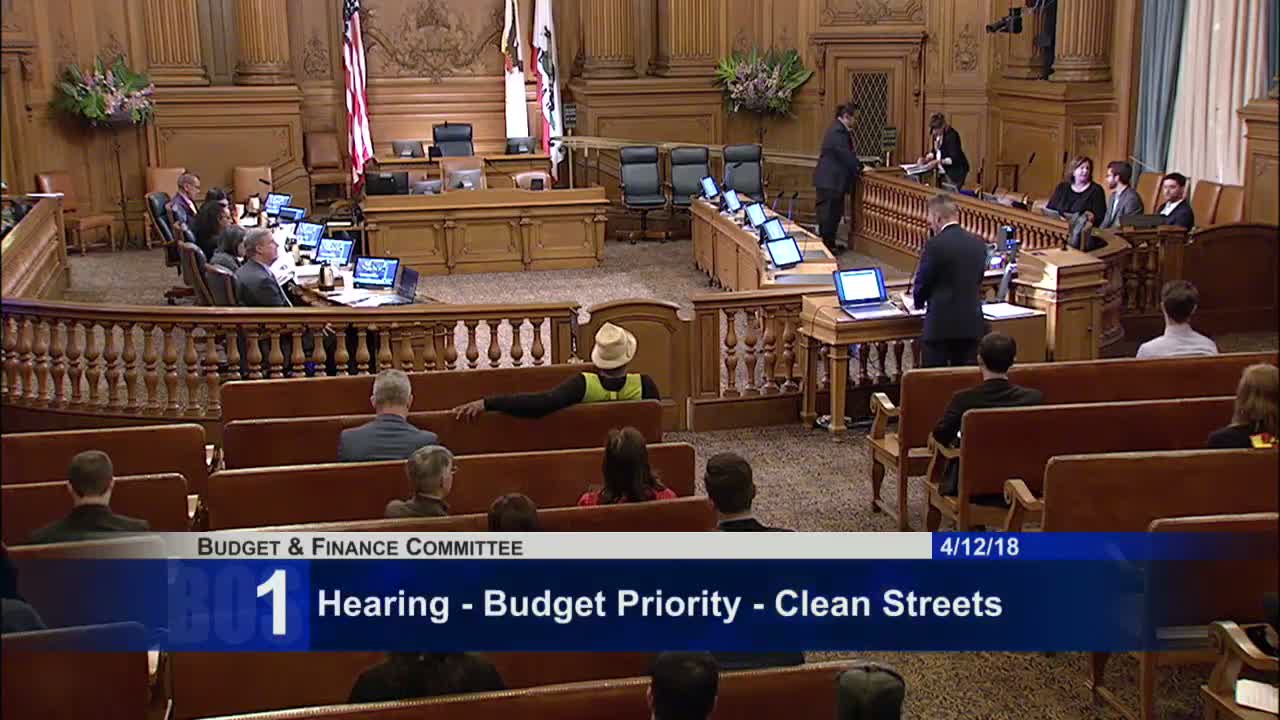
Dan Goncher of the Budget & Legislative Analyst's office presented the BLA's clean-streets priorities report. He told the committee that street and sidewalk cleanliness is a top resident concern and that the Street Environmental Services bureau’s budget has risen about 47% in five years to roughly $65,000,000; general-fund support has also increased substantially.
The BLA recommended a mix of options rather than a single operational expansion. Examples cited included temporary public-service aides (a range of roughly $250,000 for six positions to $1.7 million for 40 positions), expanding the Tenderloin clean program to seven days for about $230,000 per year, purchasing two additional sweepers (estimated $280,000 each), a South of Market targeted cleaning program (~$805,000 for a year), and a grant program to community-based organizations ranging from $10,000 to $500,000. The BLA also noted a cited figure of roughly $189,000 as the approximate first-year purchase-and-staffing cost for one pit-stop configuration and emphasized that some options are one-time while others are ongoing.
Goncher said the BLA recommended a one-time augmentation in part because the bureau’s budget and general-fund investment have grown substantially in recent years and because there are outstanding questions about how performance measures are being calculated. He said the controller’s office and DPW should collaborate to revisit metrics before recommending new permanent positions.
Supervisors asked for additional "menu" choices and for further analysis on how proposed options would affect ongoing operating budgets. Goncher said the options included ranges so the Board could prioritize based on available appropriation and policy preferences.