Get Full Government Meeting Transcripts, Videos, & Alerts Forever!
Get email alerts on the SOGI Data topic
No spam. Unsubscribe anytime.
San Francisco supervisors hear mixed progress on SOGI data collection; departments point to gaps, call for coordinated standard
Summary
City departments told the Board of Supervisors' audit committee that collection of sexual orientation and gender identity (SOGI) data has improved since a 2016 ordinance but remains fragmented across systems; officials urged updated standards, more training and a cross-agency working group to close gaps revealed by the pandemic.
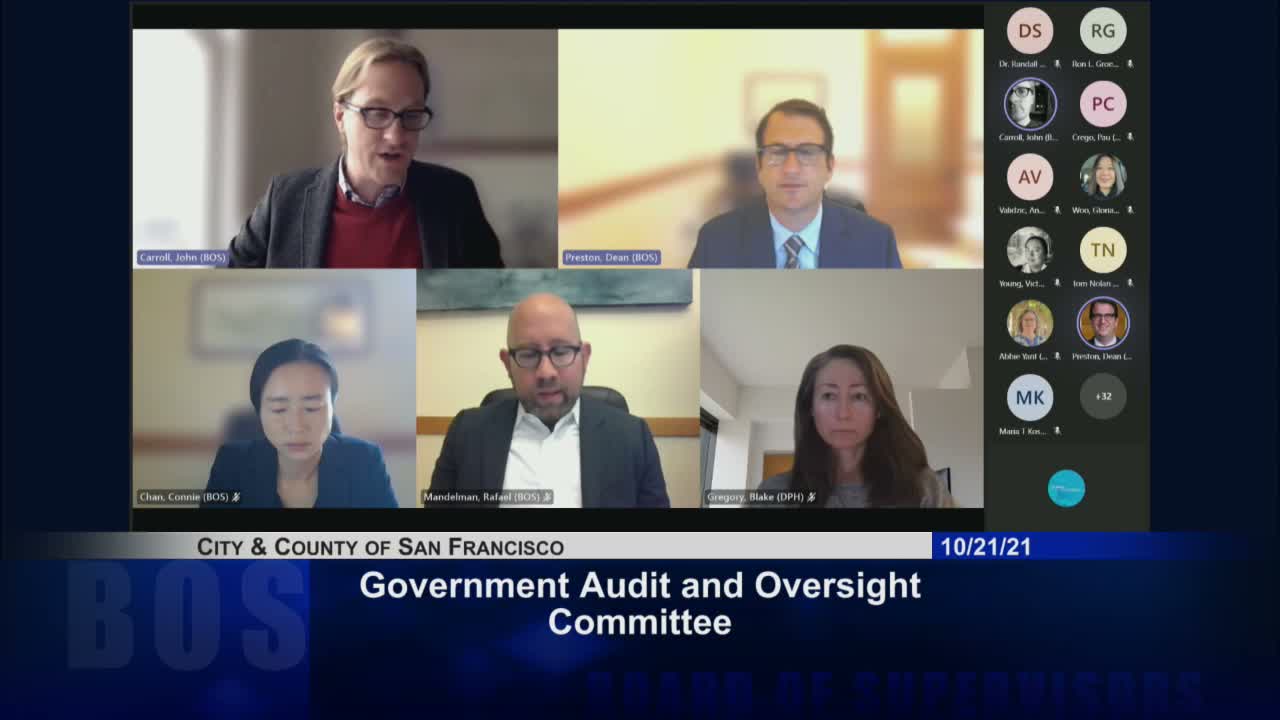
San Francisco's Government Audit and Oversight Committee heard departmental reports Oct. 21 on the city's collection of sexual orientation and gender identity (SOGI) data, with officials saying the city has made measurable progress since a 2016 ordinance but still lacks a unified standard or consistent reporting across agencies.
Pau Crego, acting director of the Office of Transgender Initiatives, told the committee that the local SOGI law (San Francisco Administrative Code, Chapter 104) helped departments begin collecting SOGI information but that data remains decentralized and sometimes incompatible with state and federal categories. "We also have seen that SOGI data is useful for action," Crego said, urging an updated citywide standard, increased implementation capacity and more community input.
Presenters from the Department of Homelessness and Supportive Housing (HSH), Department of Public Health (DPH), the Mayor's Office of Housing and Community Development (MOHCD), the Department of Children, Youth and Their Families (DCYF) and the Human Services Agency (HSA) described both improvements and continuing gaps. HSH reported it consistently served LGBTQ households at about 14
15% of its caseload and that the total number of LGBTQ households served grew substantially since 2018; the department also said roughly 2% of households served identified as transgender and 3% as gender nonconforming and flagged a service gap for trans men. HSH said it invested more than $400,000 in coordinated entry and navigation services for transgender and gender nonconforming youth during FY20-21.
DPH said collection rates vary across clinical settings: Laguna Honda Hospital and behavioral health units performed better than primary and specialty care, which DPH said saw collection rates fall after an electronic health record transition and the move to telehealth. "We had SOGI screening completion rates at about 60% in 2018; it's dropped below 40% in some primary care workflows," Dr. Blake Gregory said, describing new "missed opportunity" reports in the EHR to help managers provide coaching to staff.
MOHCD reported that about 13% of its applicants and program clients identified as LGBTQ in FY19 and FY20, with 1
to 1.4% identifying as transgender or gender nonconforming. DCYF said about one in five transitional-age youth participants in its funded programs identified as LGBTQ. HSA and Disability & Aging Services highlighted large gains in data completeness for specific programs (for example, increases in gender-identity capture for IHSS clients) and outlined community-targeted COVID responses and mental-health pilots for older LGBTQ residents.
Committee members repeatedly raised a concern shared by presenters: that different departments collect slightly different SOGI fields and that state and federal reporting categories do not always match the local standard, making cross-agency analysis difficult. Supervisor Rafael Mandelmann said he supported creating a cross-department working group that would include OTI, DPH, HSA, DHR and community providers to align standards and implementation between annual hearings.
No callers signed up for public comment on the item. At the conclusion of the presentations, the committee voted to "file" the hearing and asked the departments to continue improvements and report back next year; the clerk recorded the roll call as Chan Aye, Mandelmann Aye, Preston Aye (motion passed). The committee also directed staff to consider forming the working group to coordinate SOGI standards and training across departments.
What's next: Supervisors said they expect departments to continue improving data quality and to make progress on cross-agency coordination before the next annual report. The committee will revisit SOGI data collection at a future hearing to review changes to standards, disclosure rates and the availability of COVID-related SOGI indicators.