Get Full Government Meeting Transcripts, Videos, & Alerts Forever!
Get email alerts on the Airport Budget topic
No spam. Unsubscribe anytime.
SFO forecasts higher traffic and new spending as it presents $1B operating budget and $5.7B capital plan
Summary
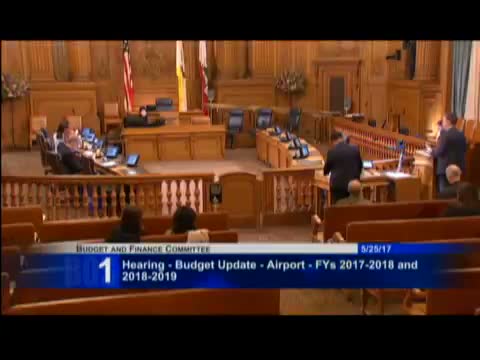
Airport Director Ivar Sattero told the Budget & Finance Committee that San Francisco International Airport is forecasting more than 53.6 million passengers, proposing a just‑over $1 billion operating budget for FY2017–18 (a 3.9% increase) and pressing ahead on a roughly $5.7 billion capital program that includes gate capacity, shoreline protection and noise mitigation.
Ivar Sattero, director of San Francisco International Airport, told the Budget & Finance Committee that SFO’s proposed operating budget for the coming year is just over $1,000,000,000 and reflects a 3.9 percent increase from the prior year driven primarily by staffing (32 additional positions) and higher debt service tied to the airport’s multi‑year capital program.
Sattero said passenger traffic remains a strong driver of the airport’s finances: the airport reached a peak above 51 million passengers in 2015–16 and he forecast more than 53.6 million passengers for 2016–17. The airport, he said, has pursued a major capital investment to match growth and aging infrastructure — citing a capital program he described first as $6,000,000,000 and then corrected during the presentation to $5,700,000,000 — with projects focused on gate capacity, terminal upgrades and amenities.
Why it matters: SFO is an enterprise department that does not rely on the city’s general fund for operations, but the airport does make an annual service payment to the city. For the coming year Sattero said the airport budget sets the annual service payment at $45,600,000 (a stated 4.6 percent increase over the prior year). Continuing capital investment, he said, also supports local business participation and city revenues through concessions and retail programs.
Key details and initiatives
- Revenues and efficiency: Sattero described airport revenues as largely self‑sustaining (airline rates and charges, concessions, parking and rental car fees). He cited a passengers‑per‑employee metric of about 29,400 passengers per employee as a planning target.
- Staffing and operating increases: The 3.9 percent operating increase was tied primarily to 32 additional operating positions (safety and security related and maintenance to support a larger asset base) and increased debt service associated with the capital program.
- Capital program and shoreline protection: The director highlighted a multi‑year capital program and called out $61,000,000 in the current budget for shoreline protection as part of a broader seawall/sea‑level‑rise program he said could reach $400,000,000–$500,000,000 in planned investment over the next 15 years.
- Noise mitigation and technology: Sattero said the airport will invest $10,000,000 in navigation and landing technology intended to allow higher arrival altitudes and closer spacing that can reduce noise exposure on the ground.
- Concessions and duty free: The airport expects significant upside from a new duty‑free lease (Sattero estimated approximately $8,000,000 a year in revenue from the new lease, with roughly $2,000,000 of that flowing to the city through the annual service payment mechanism).
Committee questions and operational notes
- Runway overlay: When asked about runway work that has caused weekend closures, Sattero said the '28 left' overlay project requires two more weekend closures and that staff are accelerating the contractor to complete work by June. He said delays and cancellations have occurred but had not yet produced a measurable impact on revenue streams.
- Security perimeter: In response to a question about a recent perimeter breach, Sattero clarified the breach occurred at San Jose, not SFO, and described recent security upgrades at SFO (perimeter vulnerability assessment, upgraded crash barriers and high‑speed gates, and replacement fencing designed to be difficult to climb).
- Flight paths and noise: Supervisor Jeff Sheehy asked about changes to flight paths and rising noise in southern neighborhoods. Sattero attributed much of the effect to the FAA’s national Metroplex redesign, which narrowed approach corridors and concentrated traffic, and to broader regional traffic changes including Oakland; he pointed to the airport’s community roundtable and regional coordination as the forum for pursuing mitigation and for forwarding community concerns to the FAA.
What happens next: The committee formally moved to file the airport budget hearing. The presentation and the answers to supervisors’ questions were recorded for the committee’s file.
Sources: Presentation and Q&A by Ivar Sattero, Airport Director, to the Budget & Finance Committee (transcript).