Get Full Government Meeting Transcripts, Videos, & Alerts Forever!
Get email alerts on the Efws Expansion topic
No spam. Unsubscribe anytime.
Supervisors press agencies on $1.6 billion plan to expand San Francisco’s earthquake firefighting water system
Summary
San Francisco agencies told the Board of Supervisors’ audit committee they model a post‑quake demand of about 240,000 gallons per minute and estimate roughly $1.6 billion (2021 dollars) to build citywide Emergency Firefighting Water System (EFWS) improvements, while the BLA recommended a long‑term financing plan and multiple revenue options.
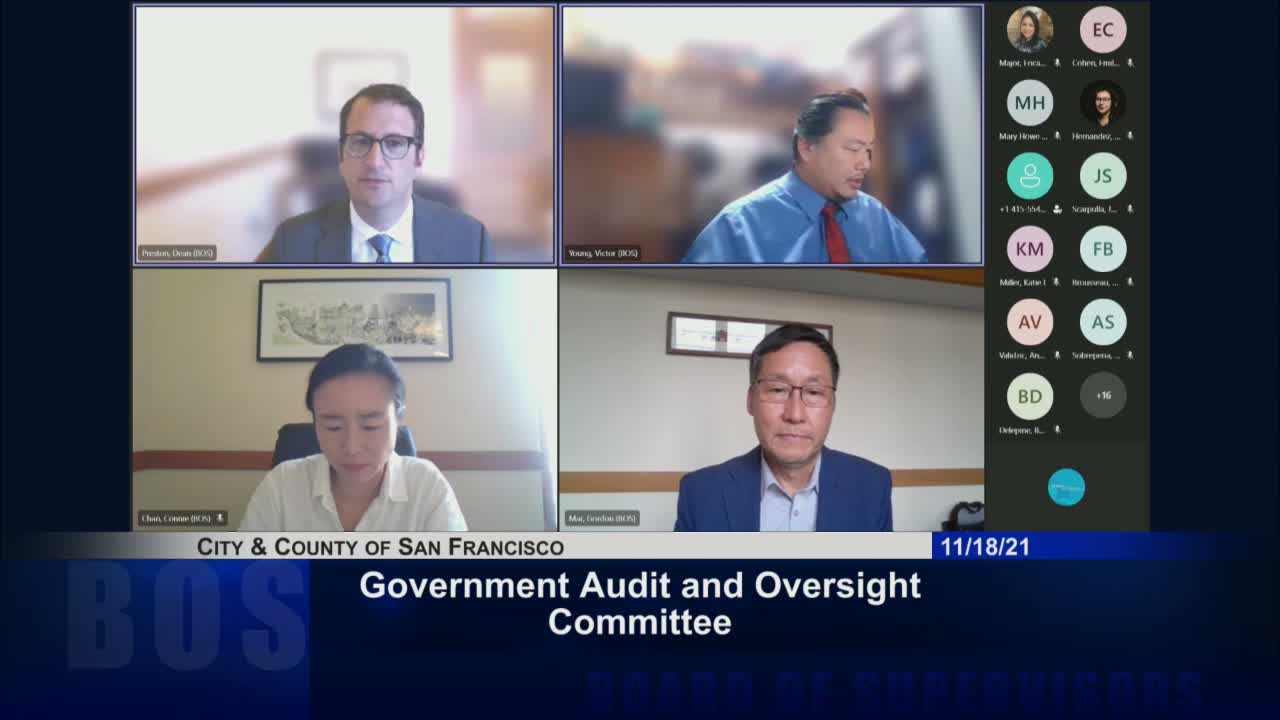
SAN FRANCISCO — The Board of Supervisors’ Government Audit and Oversight Committee heard detailed briefings Nov. 18 on the city’s plan to expand its Emergency Firefighting Water System after a civil grand jury report urged faster action.
John Scarpulla of the San Francisco Public Utilities Commission told the committee his team’s modeling of a 7.9 San Andreas‑fault earthquake indicates the citywide water requirement to fight ignition patterns typical of that scenario is about 240,000 gallons per minute for roughly 25 hours. Scarpulla said that, under current pipeline plans and projected development, the Westside phases 1 and 2 would account for about 37,000 of that total gallons‑per‑minute demand and that connecting Lake Merced would be the fastest way to provide a multi‑week water supply to that area.
The Budget and Legislative Analyst’s Severn Campbell told supervisors the BLA’s supplemental report estimates about $1.6 billion in 2021 dollars to fund the full EFWS expansion over a multi‑decade period and urged the city to prepare a 25‑year financing plan. “Within the existing capital plan there is room to look at additional bonds for EFWS,” Campbell said, adding that general obligation bonds appear the most feasible large‑scale option but that the city should also examine infrastructure financing districts, development agreements and federal sources where appropriate.
Supervisors pressed agency staff on tradeoffs between seawater pump stations and freshwater hookups. Scarpulla said seawater pump stations face complex permitting at the federal and state level, technical challenges (California’s Ocean Plan requires subsurface intakes) and high capital and operating costs — he cited illustrative figures of roughly $68 million for a small 3,000‑gpm pump station and on the order of $180 million to build a much larger Westside seawater plant to cover full Westside demand — and recommended prioritizing connections that produce the most rapid, equitable increase in protection.
Brian Strong of the Office of Resilience and Capital Planning said he did not expect a comprehensive financing plan could be assembled in a month; office staff aim to provide more robust options tied to the next 10‑year capital plan and estimated a realistic work window of several months to the better part of a year to produce detailed bond‑capacity and tradeoff analyses.
Deputy Chief Tom O’Connor of the San Francisco Fire Department told the committee the department supports interim measures such as buying modern host tenders — mobile pumps that transport water from supply sources to fires — and that the department can prepare an acquisition and operational plan if the Board funds the purchases (O’Connor estimated each host tender at roughly $1 million).
Supervisor Gordon Mar moved to continue the EFWS item to the call of the chair so departments could supply detailed materials requested by the committee. The motion passed unanimously.
What’s next: agencies agreed to provide the committee with a consolidated technical plan and a financing outline ahead of the deadline the civil grand jury and the Board previously set; the committee left the item open for follow‑up oversight and detailed budget analysis.