Get Full Government Meeting Transcripts, Videos, & Alerts Forever!
Get email alerts on the Parks And Recreation topic
No spam. Unsubscribe anytime.
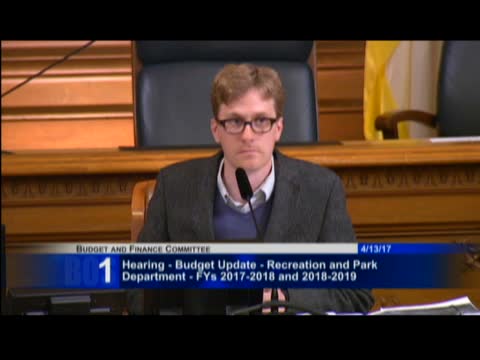
Recreation & Park Department lays out budget priorities, highlights $15M a year for deferred maintenance
Summary
RPD General Manager Philip Ginsberg told the Budget & Finance Committee the department manages about 4,000 acres and a $154 million operating budget, described equity metrics tied to Proposition B and a $15 million annual deferred‑maintenance allocation, and answered supervisors on park activation, needle boxes and procurement delays.
Philip Ginsberg, general manager of the San Francisco Recreation & Park Department, gave the Budget & Finance Committee a broad budget and program briefing, emphasizing the department’s strategic plan, equity metrics and plans to address deferred maintenance.
Ginsberg said RPD oversees nearly 4,000 acres and 222 neighborhood parks and that a statistic he’s “most proud about” is that very nearly 100 percent of San Franciscans live within a 10‑minute walk of a park. He described three core revenue sources for the department: the general fund subsidy, an open space fund funded by 2.5 cents per $100 of property tax, and earned revenue from permits, concessions and parking. On deferred maintenance, he said Proposition B provides a baseline and noted the department is allocating about $15,000,000 per year to chip away at more than a billion dollars of deferred needs.
Ginsberg described how the department is using CalEnviroScreen to create equity zones and to compare access, maintenance and investment across neighborhoods; he reported 0.47 parks per 1,000 residents in equity zones versus 0.22 in non‑equity zones and slightly higher completion rates for maintenance requests in equity zones.
Program and capital highlights included a major renovation of the Golden Gate Park Tennis Center (largely philanthropic), field rehabilitation cycles for synthetic turf, Camp Mather capital, and expanded urban forestry work to address increased tree failures following severe winter weather. Ginsberg also touted workforce pathways: Public Service Trainee and apprenticeship programs that have produced several gardeners and captains, with roughly 100–200 PSTs deployed across park units.
Supervisors pressed on operational issues: whether procurement thresholds are delaying equipment purchases (Ginsberg said a $5,000 threshold creates additional procurement steps that slow staff), how to increase activation of fields like Victoria Manor Draves Park without displacing neighborhood access, and whether needle disposal boxes should be piloted in parks (Ginsberg said the department has not authorized authorized pilot installations and that a pilot would need public‑health and public‑works data to evaluate benefits and risks).
Ginsberg acknowledged high weekend cleanup costs at Dolores Park, describing extra porta‑potties, increased Recology service and overtime that can cost roughly $6,000–$7,000 on busy days. He said the department is experimenting with outreach and volunteer programs such as 'Love Dolores' to improve visitor behavior.
Outcome: After discussion the committee moved to file the RPD update (motion by Supervisor Kim, second by Supervisor Tang), and the item was filed for the record. The committee also advanced separate capital and ICT plans to the full Board with positive recommendations.