Get Full Government Meeting Transcripts, Videos, & Alerts Forever!
Get email alerts on the Childcare Supply And Affordability topic
No spam. Unsubscribe anytime.
OECE lays out strategy to expand spaces, affordability and workforce; $6.4M tied to developer fees for facilities
Summary
September Jarrett, director of the Office of Early Care and Education, described OECE's budget priorities: $80M in subsidies and provider payments, $16.9M for community quality improvement, and a $6.4M facilities line (largely developer fees) intended to create up to ~350 new childcare spaces; she outlined an early learning scholarship sliding fee model to improve affordability across 0–5.
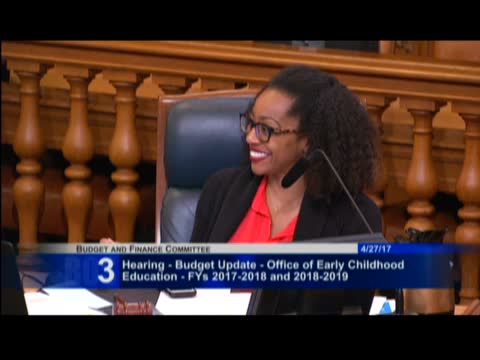
September Jarrett, director of the Office of Early Care and Education, presented OECE's first budget cycle in her role and laid out priorities to address affordability, quality and supply for children 0–5 in San Francisco.
Jarrett said the office stewards a large portfolio of subsidies and provider payments (described as roughly $80 million) and proposes $16.9 million for community quality improvement and capacity building. She said $6.4 million in facilities funding is planned to expand spaces and that this amount is primarily sourced from developer fees rather than general fund dollars. "That's largely the developer fee at this point in time," she said when asked about the $6.4 million line.
To address affordability, Jarrett described an "early learning scholarship" model that operates as a sliding fee—prioritizing lowest‑income families and scaling support up to moderate incomes—while maximizing state and federal draws and using local dollars to close quality gaps. Jarrett said OECE aims to professionalize and support the workforce through degree pathways and partnerships, and to grow private and philanthropic partnerships over time to augment local resources.
Supervisors pressed on prioritization between 0–3 and 3–4 year old strategies; Jarrett said advisory council guidance favored prioritizing infants and toddlers where unmet needs are most acute, while acknowledging tradeoffs if resources are limited. The committee filed the OECE hearing without objection.