Get Full Government Meeting Transcripts, Videos, & Alerts Forever!
Get email alerts on the Public Safety Recruitment topic
No spam. Unsubscribe anytime.
San Francisco hearing highlights racial and gender gaps in first‑responder recruitment, flags testing as barrier
Summary
City fire, police and sheriff leaders described recruitment efforts and pipelines; departments and unions said the National Testing Network and fee requirements have reduced local and underrepresented applicants. The Office of Racial Equity will analyze hiring and testing data and the committee continued the hearing to the call of the chair.
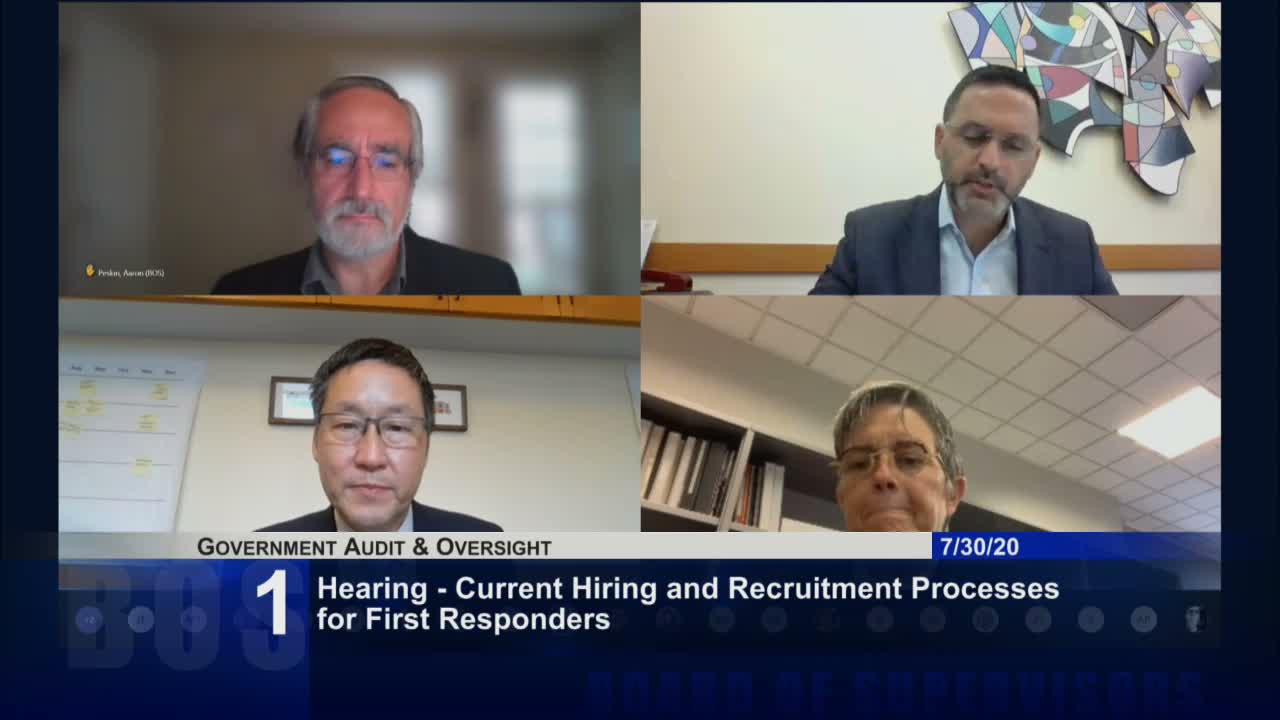
San Francisco — City officials and union leaders on July 30 told the Board of Supervisors' Government Audit and Oversight Committee that recruitment systems for first responders are producing unequal outcomes by race and gender and that testing practices merit reevaluation.
Fire Chief Janine Nicholson said the department’s diversity grew after a 1988 consent decree but that progress has stalled. She criticized the city’s use of the National Testing Network (NTN) and the fee‑based testing structure, saying those changes make it harder for local and low‑income candidates to apply and succeed and describing the resulting losses in African American and female representation. "I'd rather give a local kid a job than someone from Florida," Nicholson said in the hearing.
Police Chief Bill Scott described SFPD’s recruitment work — eight full‑time recruiters plus an 81‑member part‑time recruiter corps and a roughly $250,000 events budget — and said the department has used outreach, college recruiting, free test preparation and mobile testing to broaden the pool. He also noted the mayor has ordered an audit of hiring and testing practices. "This process and this audit will make us better, but it has caused a temporary pause in hiring," Scott told committee members.
Sheriff Paul Miyamoto said his office has a far smaller recruitment staff (one full‑time recruiter/deputy supported by part‑time staff) but uses the sheriff’s day‑to‑day community presence and varied academy partnerships to reach candidates; he reported about 820 deputies on staff and said recent promotions were demographically more diverse.
DHR and testing: Dave Johnson and DHR staff traced the NTN adoption to 2012 and acknowledged disparate pass rates by group. DHR said the city has paused testing while it evaluates instruments to find those that minimize "adverse impact" (statistical group differences) and that the city has granted a small number of fee waivers. "We moved to the national testing network in 02/2012," DHR staff explained while describing data and waiver counts.
Unions, employee groups and community members pressed for local pipelines and paid pathway programs. Local 798 and United Fire Service Women urged funding for a revived, staffed recruitment unit in SFFD and for an EMS‑certificate pipeline modeled on successful programs (EMS Corps) that provide wraparound services, training and mentorship. Multiple callers who graduated EMS Corps testified that the program produced EMTs who went on to firefighting, nursing and other health careers.
Committee action and next steps: Committee members pressed departments for concrete demographic breakdowns and asked the Office of Racial Equity to analyze the data on where diversity is lost in the process (testing, physical ability tests, background intake and promotion) and to recommend changes. The committee voted to continue the hearing to the call of the chair so ORE can submit findings in the coming months and so departments can return with follow‑up details for the budget cycle.
Why it matters: Supervisors framed the hearing as a timely review given the national reckoning on race and the upcoming budget process. Members said they want to ensure first‑responder ranks better reflect the communities they serve and that the city uses testing, outreach and budgeting tools to reduce barriers without sacrificing public‑safety suitability.
What is unclear or pending: DHR has not yet completed its audit, and city departments have not identified a uniform, alternative testing approach that demonstrably reduces adverse impacts while maintaining defensible selection standards. Chiefs and unions both requested clearer, dedicated recruitment budgets and higher classification for recruitment leads; Chief Nicholson said she will seek funding in the department’s budget request, acknowledging severe fiscal constraints.
The committee continued the hearing to the call of the chair and requested the Office of Racial Equity and DHR to return with analysis and recommendations before the next budget cycle.