Get Full Government Meeting Transcripts, Videos, & Alerts Forever!
Get email alerts on the City Budget Five Year Plan topic
No spam. Unsubscribe anytime.
San Francisco Budget Office and Controller Warn of Long‑Term Shortfall Despite Near‑Term Improvement
Summary
The mayor’s budget office and the Controller’s Office told the Budget and Finance Committee that one‑time savings and deferred debt reduced near‑term gaps but structural pressures — rising health and pension costs, voter‑mandated baselines and uncertain state/federal funding — leave larger deficits in years three through five.
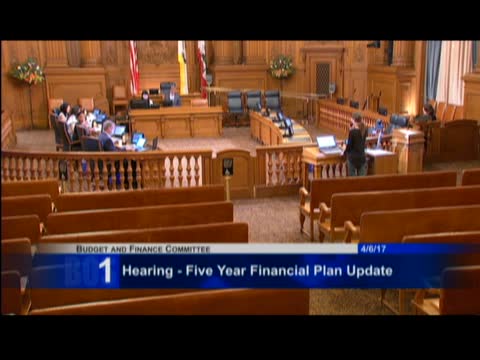
Supervisor Malia Cohen convened the Budget and Finance Committee for a hearing on the city’s updated five‑year financial plan, where the mayor’s budget director and the Controller’s Office outlined a smaller shortfall in the next two budget years but a larger cumulative deficit in the later years of the plan.
Melissa Whitehouse, the mayor’s budget director, said the March update builds on the December draft and will inform the June 1 budget submission. “We put out the five year financial plan in December, the draft,” Whitehouse said, and the update focuses on the deficit projection, drivers, recession scenarios and federal and state funding uncertainty.
At the hearing Whitehouse and Controller’s Office representative Michelle Eller Smyth emphasized two dynamics: near‑term improvements driven by one‑time revenues, midyear savings and deferred debt service, and longer‑term structural pressures. Whitehouse reported projected general fund revenue growth of $541,000,000 and projected expenditure growth of $1,400,000,000 over the plan period, with salaries and benefits (projected to grow by $732,000,000) and reserves cited as major expenditure drivers.
The Controller’s Office said economic and policy constraints are squeezing available revenue. “There are some things that are soaking up that revenue growth,” Michelle Eller Smyth said, pointing to voter‑approved baselines and rapidly growing employee benefit costs. She warned that health and pension costs are increasing several times faster than inflation and noted the city’s economic stabilization reserves are under $400,000,000, likely insufficient to cushion the multi‑year impact of a recession.
Eller Smyth outlined federal and state funding risks. She said the president’s preliminary budget would, if enacted as described in the proposal discussed by staff, eliminate Community Development Block Grant (CDBG) and HOME funding that the city receives — “which would be about $21,000,000 to the city if they come true.” On the state side, she said the governor’s January proposal would eliminate the IHSS maintenance‑of‑effort worth about $43,000,000 next year to San Francisco; counties are negotiating with the governor and the May revise should provide more clarity.
Whitehouse said the mayor’s office is awaiting the Controller’s nine‑month report in early May, which will show current‑year revenue and departmental savings and will be used in budget balancing with the mayor’s office. She said the administration is restricting new FTE requests, prioritizing revenue solutions and efficiency proposals and favoring targeted, mostly one‑time investments in capital and technology to avoid broad service cuts. “We really don’t want this to be a service reduction year,” Whitehouse said.
Supervisors pressed staff on assumptions and tradeoffs. Supervisor Katie Tang asked whether the model assumes no FTE growth; Whitehouse replied that the projection assumes no new unconstrained FTEs beyond currently committed growth and noted that some departments — for example, Public Works to implement the street‑tree program and the new homelessness department to mirror the rebalancing plan — will see planned increases. Supervisor Norman Yi raised the need for additional FTEs for programs such as tree maintenance; Whitehouse acknowledged those operational needs while reiterating the constrained overall FTE posture.
Public speakers urged the board to ensure budget decisions address impacts on African American residents. One commenter said the city has repeatedly failed to dedicate funds for “out‑migration” and demanded specific line items for Black residents; the speaker warned of protests if the budget did not address these concerns.
Procedurally, Supervisor Katie Tang moved to continue the hearing “to the call of the chair.” Supervisor Jane Kim seconded, and the motion passed without objection. The committee adjourned.
The committee asked staff to return with updated revenue and expenditure data in early May and to present the mayor’s balanced budget on June 1. The hearing did not produce any ordinance or budget adoption; it served as an informational update and a scheduling decision to continue the discussion.