Get Full Government Meeting Transcripts, Videos, & Alerts Forever!
Get email alerts on the Capital Investment topic
No spam. Unsubscribe anytime.
Board committee files $35 billion, 10-year capital plan that includes $350 million Seawall bond
Summary
City staff presented a fiscally constrained $35 billion 10-year capital plan that proposes a $350 million general obligation bond to fortify the Seawall, targets a pavement condition index of 70 by 2025, and details pay-as-you-go and bond sequencing to avoid raising property tax rates; the committee filed the hearing.
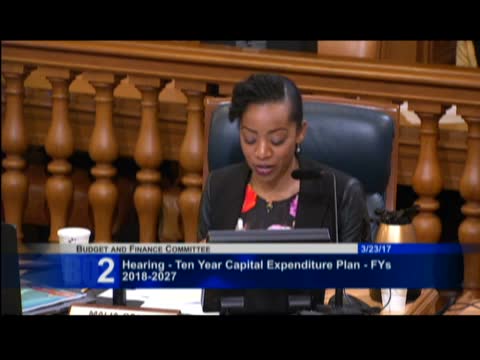
City administrators presented the proposed 10-year capital expenditure plan and the Budget and Finance Committee filed the hearing to allow the plan to return as an action item with further detail.
City Administrator Naomi Kelly said the plan recommends a record-level $35 billion investment over the next decade to fund seismic repairs, transportation, utilities, parks and affordable housing. The plan includes a proposal for a $350 million general obligation bond to begin fortifying the San Francisco Seawall, and a target pavement condition index (PCI) score of 70 by 2025.
Capital planning lead Brial Strong described the plan as “fiscally constrained”: new bonds will be issued only as older ones retire so the ad valorem tax rate does not rise. He broke the $35 billion into roughly $5.2 billion for general fund departments, about $19 billion for enterprise departments (SFO, PUC, MTA), and about $11 billion for external agencies. Strong said the plan relies on the pay-as-you-go program (projected roughly $128M this year and $137M next year) to maintain facilities and right-of-way renewals and that the city is reviewing 152 projects over the decade.
Board members pressed staff about timing and funding risks. Supervisors discussed the failed sales-tax measure that left a roughly $33 million gap affecting street resurfacing and asked whether SFMTA can spend down large transportation bond proceeds (a $500 million transportation bond is planned on a 10‑year cycle). Strong said the capital planning committee and bond oversight committees are monitoring spend-down capacity and that community processes and state grant prospects are ongoing for projects such as Hall of Justice and county jail renewals.
After public comment was closed (none), a supervisor moved to file the hearing; the motion was seconded and accepted without objection. Staff said the plan will return with more project-level detail and any proposed bond measures will be scheduled to avoid increasing the ad valorem tax rate.