Get Full Government Meeting Transcripts, Videos, & Alerts Forever!
Get email alerts on the Affordable Housing topic
No spam. Unsubscribe anytime.
Balboa Park Upper Yard financing moves to Board after community objections to AMI mix
Summary
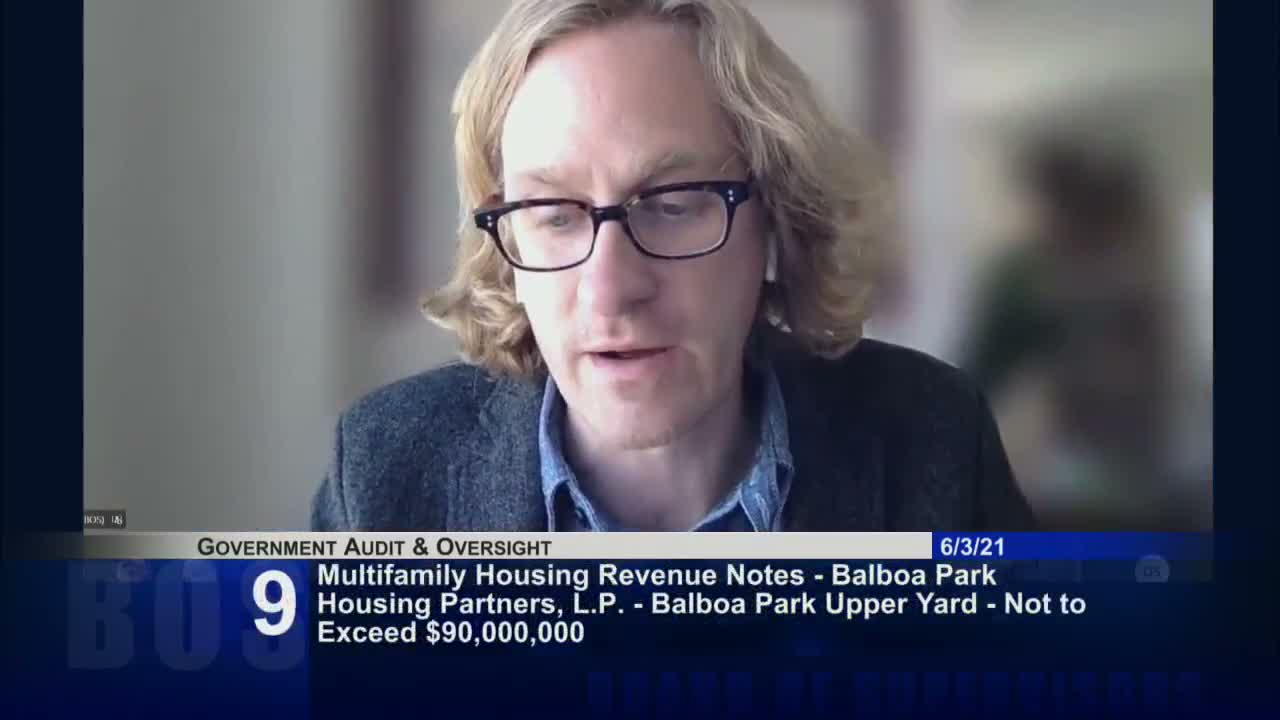
The committee forwarded four linked Balboa Park Upper Yard items (bond authorization, ground lease, a $24.46M gap loan, and state grants totaling about $28.8M for housing and plaza improvements) to the full Board without recommendation after community groups raised concerns about outreach and area median income (AMI) levels.
The Mayor’s Office of Housing and Community Development presented a 100% affordable development proposal for the Balboa Park Upper Yard site at 2340 San Jose Avenue: a 131‑unit building with a mix of deep affordability and moderate‑income units, 39 units reserved for HOPE SF relocatees, and ground‑floor community uses including a YMCA early‑education center and a bike‑repair training shop.
MOHCD described financing that combines tax‑exempt multifamily housing revenue bonds (up to $90 million), a MOHCD gap loan of up to $24,459,458, tax credit equity and permanent debt, plus state Infill Infrastructure Grant (IIG) funds of $3.5 million and a $25.3 million Affordable Housing & Sustainable Communities (ASEC) award that allocates $15M to housing and $10M for transit/bicycle/pedestrian public improvements. Total development cost was estimated at roughly $119 million (~$911,000/unit).
Several community organizations and neighborhood advocates said the project’s public outreach and certain AMI levels did not match early community expectations. Speakers and written correspondence said earlier community planning prioritized deeper affordability in the 30–60% AMI range; some said changes to higher AMI brackets were not adequately communicated. MOHCD and developer Mission Housing said they had extensive outreach going back to 2014 and since 2018, and that federal/state tax‑credit rules and the use of income‑averaging tools made the current AMI mix feasible while preserving overall average affordability under 60% AMI.
Committee members recognized the project’s significant public benefits—including transit‑oriented development, childcare and a new BART plaza—and the need to meet CDLAC closing deadlines for bond authority. To balance the time‑sensitive financing window with community concerns, the committee voted 3‑0 to forward the four items (bond authorization, ground lease and loan, IIG grant acceptance, and ASEC grant acceptance) to the full Board as committee reports without recommendation, and asked MOHCD to meet the concerned community groups before the Board takes up the items.
Why it matters: The packages of tax‑exempt bonds, MOHCD subsidy and state grants enable a 100%‑affordable project on public land adjacent to a major transit hub, with both housing and public‑realm improvements. Community groups say the distribution of unit affordability should better reflect local needs; MOHCD says financing constraints and tax‑credit rules necessitate the current structure.
What’s next: The four items will appear on the Board of Supervisors agenda; MOHCD committed to follow‑up engagement with the community before the Board vote.
Sources: MOHCD presentation, Mission Housing sponsor remarks, community callers and letters to the committee at the June 3, 2021 GAO meeting.