Get Full Government Meeting Transcripts, Videos, & Alerts Forever!
Get email alerts on the Contracting Emergency Policy topic
No spam. Unsubscribe anytime.
Committee reviews mayor’s 35th emergency procurement supplement and reporting changes
Summary
Deputy Controller and the Office of Contract Administration briefed the committee on the mayor’s 35th supplemental emergency order, which permits limited extensions of COVID-era contracts, requires departments to transition back to standard procurements where possible, and modifies reporting from monthly to as-needed/periodic with an August 15 departmental filing requirement.
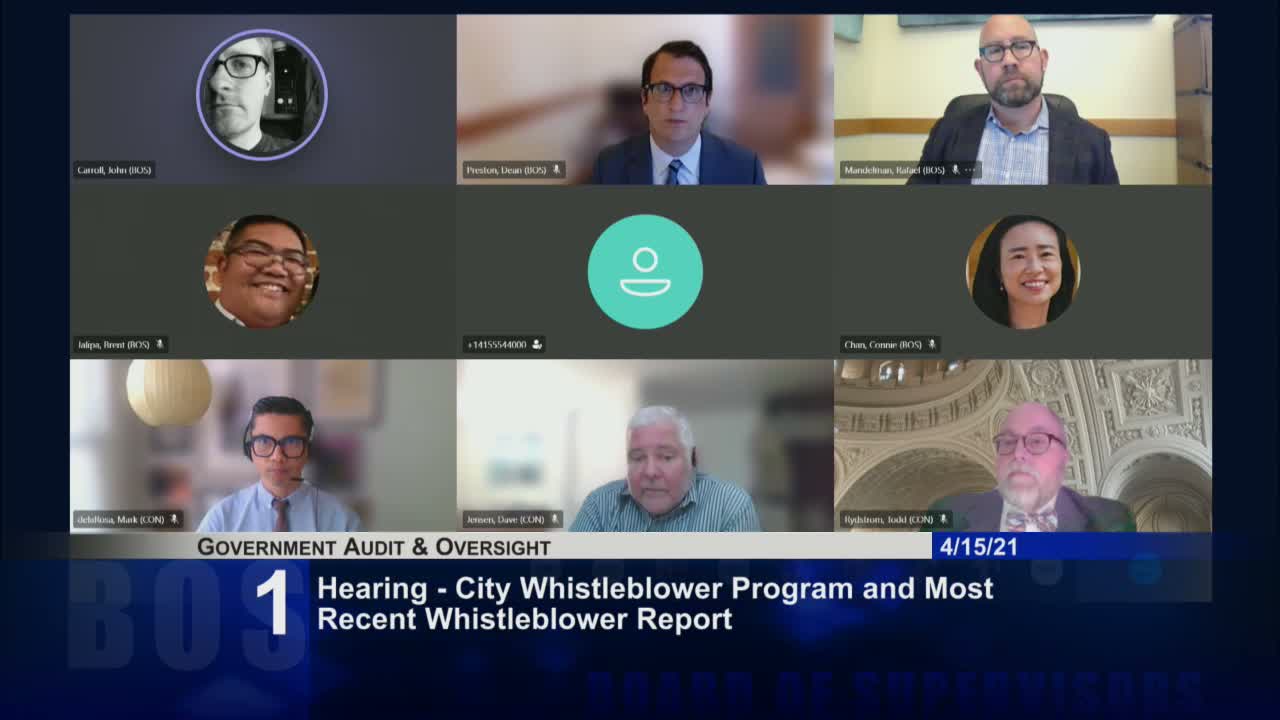
The Government Audit & Oversight Committee on April 15 reviewed the administration’s changes to emergency contracting authority under the so-called 35th supplemental proclamation and asked for clarifications about reporting, procurement practices and safeguards.
Deputy Controller Todd Reedstrom described the administrative context for emergency procurements during the COVID-19 response and compared the 13th supplemental (May 11, 2020) with the 35th supplemental (issued Feb. 19, 2021). He said the 35th allows COVID-related contract amendments executed before Feb. 1, 2021 to be extended up to 12 months and permits select non-COVID contract extensions in six-month increments but no later than June 30, 2022. Reedstrom emphasized that any extensions must be consistent with the city’s approved budget and FEMA reimbursement rules where applicable.
Acting Director Sailaja Corella of the Office of Contract Administration explained that emergency purchasing authority exists under Chapter 21 (section 21.15) and that true exigencies can justify bypassing competitive solicitations. She said the thirteenth supplemental required departments to seek at least three quotes even for emergency purchases; under the 35th the city has moved to a standardized reporting cadence (from monthly to as-requested/periodic) and the controller’s policy memo requires departments to submit a comprehensive list of contracts that used emergency authority by August 15, 2021. Corella said departments should return to conventional procurement practices when feasible and that the Office of Contract Administration will work with departments to obtain quotes or use existing competitively procured suppliers.
Reedstrom provided quantitative context: the 13th supplemental produced a small number of long-form exceptions and short-form purchase orders relative to normal procurement volumes (for example, 15 long-form written contract exceptions and 129 grant contract amendments related to COVID response; typical fiscal-year activity includes roughly 3,300 written contracts and over 90,000 short-form purchase orders). He noted remaining unknowns — FEMA’s reimbursement timeline (currently through Sept. 30), vaccine rollout impacts, and near-term departmental staffing capacity — and said many complex procurements still require six to eight months to complete.
Supervisors asked for continued transparency. Chair Preston noted that the 13th had required monthly submissions to the Board and asked why that requirement was changed; staff said the reporting approach was standardized and that board members and the mayor’s office can request the controller’s automated project listings at any time. Vice Chair Chan asked about equitable application of expedited payments to nonprofit vendors and about debarment checks; staff said the financial system offers dashboard views of supplier inclusion and that debarment lists and federal SAM.gov checks are part of the standard clearance process. The committee voted to recommend the supplemental to the full Board of Supervisors.