Get Full Government Meeting Transcripts, Videos, & Alerts Forever!
Get email alerts on the Homelessness Plan topic
No spam. Unsubscribe anytime.
Supervisors urge new homelessness department to adopt a five‑year strategy as director previews framework
Summary
The Budget & Finance Committee advanced a resolution asking the new Department of Homelessness and Supportive Housing to adopt a five‑year plan. Director Jeff Kositzky previewed a data‑driven strategic framework that centers coordinated entry, a single data system and measurable targets, with a draft planned for February and public release by April 2017.
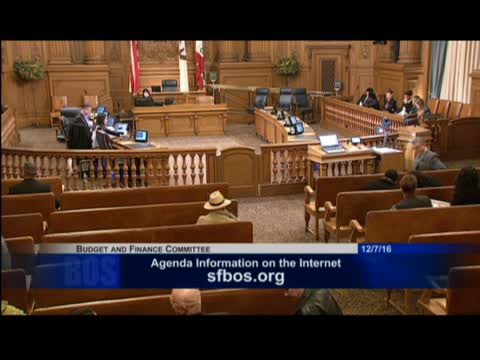
Chair Mark Farrell introduced a resolution urging the Department of Homelessness and Supportive Housing (HSH) to adopt a five‑year plan as the city seeks a more unified approach to rising homelessness. "Our city has a homelessness crisis," Farrell said, citing the 2015 point‑in‑time count of 6,686 people and arguing the city needs a single written strategy and measurable goals.
HSH Director Jeff Kositzky, who the chair invited to present, described the proposal as a strategic framework rather than a fixed plan and said the department is “trying to build the airplane while we’re flying it.” He told the committee the department is roughly 100 days old, has helped reunify more than 500 people through Homeward Bound, placed nearly 600 people in permanent supportive housing, opened a navigation center and has others in development. Kositzky said staff completed data collection and much of a gaps analysis and have held extensive stakeholder outreach, including 16 focus groups with people experiencing homelessness and more than 600 surveys.
The framework centers on a coordinated entry system and a single data platform so providers can share assessments and prioritize people for scarce resources. Kositzky said the model will plug in past performance and assumptions to estimate how many shelter units, rental subsidies and permanent housing the city would need to hit a stated outcome (for example, ending chronic homelessness among veterans by a target date). He declined to put firm numerical goals in the public draft yet, citing data quality concerns, but laid out a timeline: a written draft in February 2017, data analysis completed in March, public report by April 2017, family and veterans system redesign by December 2017, the data system fully operational by October 2018 and full adult/youth redesign in 2018–2019.
Public commenters and service providers generally welcomed the approach but flagged risks. The Coalition on Homelessness and other advocates urged caution about any coordinated‑entry changes that would narrow access to emergency shelter; Jennifer Freedombach of the Coalition warned that “having a system of rationing shelter is hugely problematic” and pressed the city not to replace a wait list with stricter eligibility that leaves families without options. Kositzky responded that the intent of coordinated entry is to reduce time spent waiting for shelter and to expand pathways out of homelessness — for example, through rapid rehousing and targeted diversion — and described case studies where quicker access shortened average length of homelessness from about 14.9 months to under six months.
Committee members praised the data‑driven approach and asked the department to return as the draft solidifies. Supervisor Norman Yee highlighted the need to account for state and federal policy impacts in any local targets. The committee voted to forward the resolution to the full Board with a positive recommendation.
Kositzky and staff were directed to continue stakeholder outreach, complete the data model, and provide the Board with the public draft and timeline. The committee recorded no binding budget allocation at this hearing; it instead requested follow‑up reporting and a public release of the draft plan.
Next steps: HSH expects to share a written draft in February 2017 and a public report by April 2017; committee members asked for regular updates as the department completes the model and stakeholder engagement.