Get Full Government Meeting Transcripts, Videos, & Alerts Forever!
Get email alerts on the Efws topic
No spam. Unsubscribe anytime.
Supervisors hear progress on Emergency Firefighting Water System; two reports due in June
Summary
City departments told the Government Audit and Oversight Committee that neighborhood-level demand mapping and a seawater-pump feasibility study for the Emergency Firefighting Water System (EFWS) will be delivered to the Board by June 30, 2021, while funding for the West Side Phase 1 is drawn from the 2020 earthquake bond and utility revenue bonds.
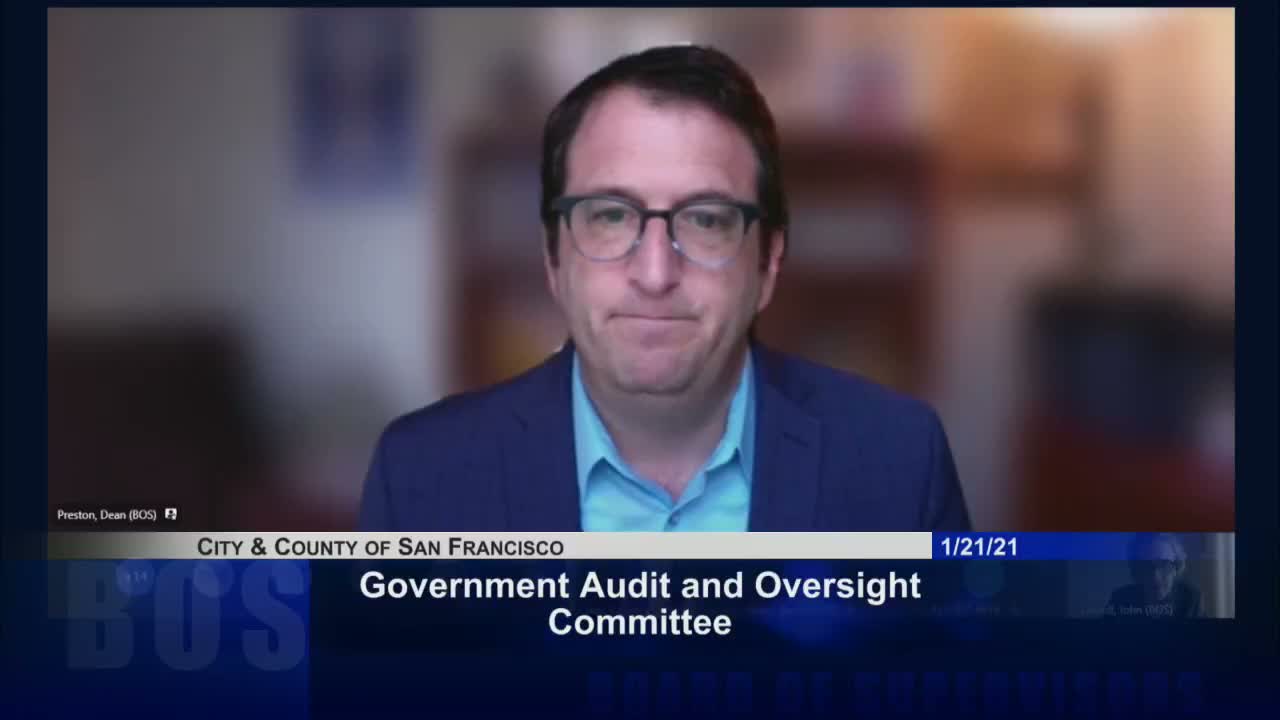
San Francisco supervisors on Jan. 21 heard progress reports from the San Francisco Public Utilities Commission (SFPUC), the Fire Department and the Budget and Legislative Analyst Office on efforts to expand the city’s Emergency Firefighting Water System (EFWS), including neighborhood-by-neighborhood hydraulic modeling and a feasibility study of seawater pump stations. Departments said two reports are due to the Board by June 30, 2021, and a comprehensive citywide EFWS plan is planned for presentation by Dec. 31, 2021.
The EFWS is a high-pressure, post-1906 earthquake–era network fed primarily by the Hetch Hetchy regional system with two seawater pump stations as secondary sources, John Scarpulla of the SFPUC told the committee. Scarpulla said teams have replaced the older 45 Fire Response Areas with 50-acre grid cells for finer analysis, added building-inventory and vegetation inputs, and are running thousands of earthquake-and-weather scenarios to model fire demand for 2020, 2030, 2040 and 2050.
"The more you have of [water] sources, the better," Scarpulla said, arguing Lake Merced and Sunset Reservoir can be used quickly while seawater pump stations would take longer to permit and build. He described earlier bond-funded work (2010 and 2014) to shore up reservoirs and reduce leaks from about 600,000 gallons per day to minimal amounts and said the EFWS had an estimated 47% reliability for median flow after a 7.8-magnitude San Andreas scenario in 2010.
Seawater pump station plans will evaluate permitting and siting constraints — from the California Coastal Commission and National Park Service on ocean-facing sites to the Bay Conservation and Development Commission on the bay side — as well as geological constraints such as bay mud, rocky shoreline, and sea-level rise. Scarpulla noted tradeoffs between open-water intakes and slant wells (environmental impacts, capacity, and suitability by site) and cautioned that permitting “is not easy” and can be time-consuming.
Financing for West Side Phase 1 was outlined by Severn Campbell of the Budget and Legislative Analyst Office. The West Side Phase 1 project’s total cost is estimated at about $198 million, with roughly $143 million proposed from the March 2020 Earthquake Safety and Emergency Response bond and $55 million from water enterprise revenue bonds. The 2020 bond allocated about $153 million overall for EFWS projects; the Board is considering issuance and the appropriation of tranches of that bond.
Campbell also said the grand jury recommended purchasing more "host tenders" — mobile units that carry hose and pumps for last-mile firefighting. Each truck costs about $1 million. The 2019–20 budget originally included funding for five tenders (total $5 million) but mid-year rebalancing reduced available general-fund money by $2 million, leaving $3 million to acquire three tenders; additional purchases would require board approvals or lease-revenue financing.
Deputy Chief Jose Bello of the Fire Department said EFWS activations are uncommon but critical as redundancy. He and the SFPUC staff described limited historic activations of seawater intakes (noting activations in 1984 and during the 1989 earthquake) and said Hetch Hetchy water supplies EFWS most of the time. Bello said outcomes in an unprotected neighborhood would depend on building construction, ignition sources, and access but that existing fire resources can respond to many incidents; still, some West and southern areas have coverage gaps.
Public commenters raised concerns. Eileen Bogan of the Coalition for San Francisco Neighborhoods urged the Board to remove language that would allocate potable drinking water for firefighting, arguing the bond language should instead refer only to the "Emergency Firefighting Water System." She added that only the north basin of Sunset Reservoir has been seismically retrofitted and said the south basin remains a concern. Francisco de Costa criticized SFPUC’s past infrastructure work and warned that pipe failures could limit system performance in a major event.
Following department presentations and public comment, Supervisor Rafael Mandelmann moved to continue the hearing to the call of the chair; the panel voted to continue the hearing (Preston, Chan and Mandelmann recorded as ayes). The committee also convened a closed session to consider litigation items (agenda items 2–9) and, upon returning, reported it had unanimously recommended those items to the Board of Supervisors for consideration at the Feb. 2, 2021 board meeting and voted not to disclose closed-session discussions.
What’s next: SFPUC and partners will complete two reports by June 30, 2021 (a neighborhood fire-demand analysis and a seawater pump-station feasibility study) and then present a finalized, comprehensive EFWS plan to the Board by the end of 2021.