Get Full Government Meeting Transcripts, Videos, & Alerts Forever!
Get email alerts on the Treasure Island Financing topic
No spam. Unsubscribe anytime.
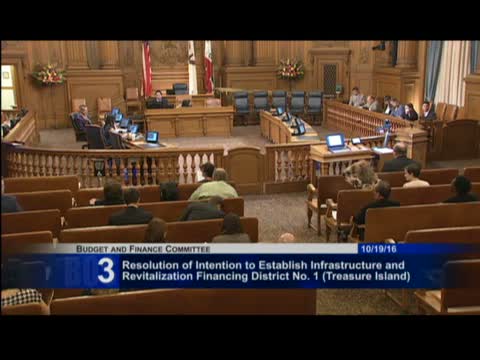
Supervisors advance Treasure Island financing measures to form IRFD and CFD
Summary
The committee advanced multiple resolutions to begin forming an Infrastructure and Revitalization Financing District (IRFD) and Community Facilities District (CFD) for Treasure Island and Yerba Buena Island. Staff laid out tax-increment mechanics, projected long-term revenues, and acknowledged an affordable-housing funding gap.
The Budget & Finance Committee on Oct. 19 advanced a package of resolutions that begin the formal process to form an Infrastructure and Revitalization Financing District and Community Facilities District for Treasure Island and Yerba Buena Island.
Director Beck of the Treasure Island Development Authority outlined the development program, describing plans for roughly 8,000 new homes (with a minimum 25 percent affordable requirement and an option to increase to 2,173 affordable units, or roughly 27 percent). Beck said demolition and early infrastructure work have begun and that parcel transfers from the Navy will continue through 2020–21. The financing plan calls for public and private improvements to be reimbursed from the IRFD and CFD.
Beck described the IRFD’s revenue mechanics: after a base year, a share of the ad valorem property tax increment would be pledged to the IRFD (the presentation cited that roughly 56.69 percent of the city’s share could be pledged to the district, with an additional 8 percent subordinated to financing to provide coverage for debt). The CFD would levy a supplemental special tax assessed to property owners to repay public-infrastructure and maintenance obligations, including long-term funding for parks and a capital reserve for sea-level-rise adaptations.
Budget analyst Harvey Rose summarized the financial analysis in the committee packet: over a 43-year term the infrastructure financing plan estimates about $1,080,836,000 in net available increment and $152,499,000 of conditional city increment for the IRFD; the packet also shows projected cumulative surpluses to the city’s general fund of approximately $328,700,000 over 52 years and an estimated annual general-fund surplus on build-out of roughly $6.8 million per year. Rose recommended approval of the resolutions.
Supervisors probed rate-setting and timing. Director Beck said CFD rates are set in the Rate and Method of Apportionment and vary by parcel type; she estimated typical CFD assessments could amount to about 0.5–0.6 percent of assessed value on top of the 1 percent base property tax (equating to about 1.5–1.6 percent in some illustrative examples). Supervisors also pressed Beck on a funding gap for affordable housing driven by rising construction costs; Beck said staff are evaluating local resources and state grant opportunities and plan to exercise the option to increase affordable-unit counts.
Sherry Williams of the Treasure Island Homeless Development Initiative urged support, saying the financing measures are critical to generating project funds necessary to build affordable housing and workforce-training opportunities on the island. The committee passed items 3–7 with a positive recommendation to the full board without objection; a public hearing is anticipated before the full board on Dec. 6.