Get Full Government Meeting Transcripts, Videos, & Alerts Forever!
Get email alerts on the Workforce Equity topic
No spam. Unsubscribe anytime.
Supervisors hear progress reports from city agencies on racial disparities in hiring, discipline and retention
Summary
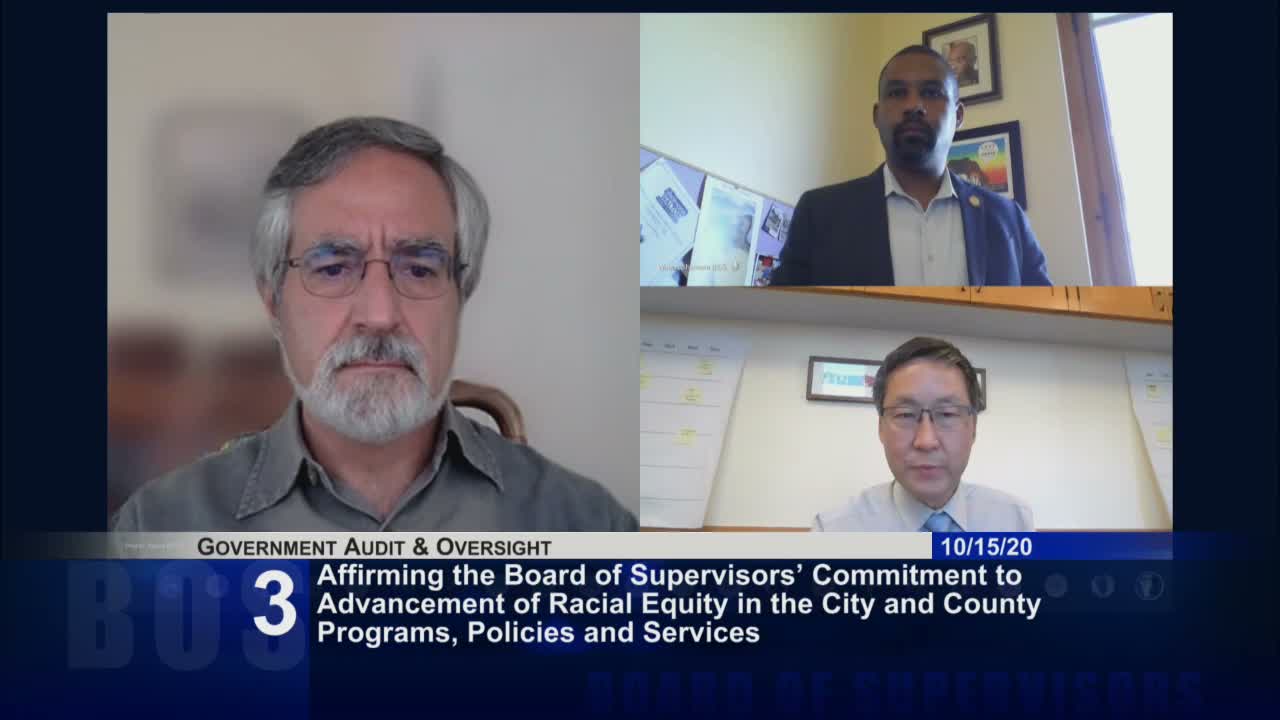
At an Oct. 15, 2020 Government Audit & Oversight hearing, Human Rights Commission, Office of Racial Equity and department heads (DHR, DPH, PUC, SFMTA, SFO, Public Works, HSA) described data and action plans to address anti‑Black outcomes in the city workforce, including discipline reviews, recruitment pipelines and training; DHR pledged a supplemental discipline review within 30 days and agencies committed equity plans due Dec. 31, 2020.
The Government Audit & Oversight Committee on Oct. 15 held a virtual hearing on citywide racial inequities in hiring, discipline and promotion, where department leaders laid out data, timelines and proposed reforms.
Supervisor Shimon Walton, who called the hearing, framed it as a continuation of work dating to 2017 and asked city agencies to answer six community‑driven demands, including an EEO audit, a utilization report and an out‑migration study. Walton told the committee the aim was to "move forward with bold change" to address systemic anti‑Black racism in city employment.
Cheryl Davis, director of the Human Rights Commission, summarized the task force process that produced six demands from labor and community partners and described ongoing HRC efforts: convenings with community organizations and labor, stakeholder meetings and collaboration with the Office of Racial Equity (ORE). Davis said HRC and ORE are working on recruitment pipelines, training and reporting to implement the mayoral directives and the stakeholders’ requests.
Director Shakir Simley of the Office of Racial Equity urged a systems approach, saying the city must target "institutional" practices that produce racialized outcomes. Simley described ORE's citywide workforce priorities and said department racial equity plans are due Dec. 31, 2020.
Acting DHR Director Carol Eisen, in her first week on the job, reported concrete steps and gaps in the personnel system. Eisen said DHR has rolled out one‑day implicit bias training to roughly a third of the workforce, integrated bias material into supervisory training and created a fairness‑in‑hiring requirement for interview panels. She highlighted a discipline checklist distributed citywide and reported that DHR's data show 457 corrective actions taken against permanent civil‑service employees (DHR presentation slide). Eisen said DHR will develop a supplemental review of proposed discipline and expects to present a reporting and review plan to departments within the next 30 days.
Several large departments described their equity initiatives and data. The Department of Public Health said it has an Office of Health Equity and equity councils at major sites; DPH estimated roughly 11% of its staff identify as Black and said it is hiring a workforce equity manager and will release a racial equity action plan in December. Public Utilities Commission GM Harlan Kelly outlined apprenticeship and pipeline programs and said the PUC workforce is roughly 9% Black with about 6% in management. SFMTA Director Jeff Tumlin showed discipline dashboards focused on transit operators — the agency reported that, in some measures, Black men and Black women are disciplined at higher rates than their share of operators and that the agency is pursuing training, mediation and an ombudsperson. SFO reported reductions in certain disciplinary disparities after supervisory training and said it will finalize an airport racial equity plan by year end.
Multiple department heads acknowledged limits on citywide authority and the need for partnerships with labor, civil service commissions and educational institutions to change pipelines into professional occupations. Several presenters cited gaps in historical data, the need to modernize hiring platforms, and constraints imposed by law on race‑conscious hiring approaches.
Public commenters and union representatives told the committee the reforms discussed do not go far enough. Dozens of callers — many representing the Black Employee Alliance, SEIU Local 21 and IFPTE Local 21 — urged an independent, external investigation of the city's Equal Employment Opportunity (EEO) processes and the Department of Human Resources. Callers demanded reopening past EEO cases they said were mishandled, transparent reinvestigation thresholds, a citywide inspector general or outside investigator with authority to audit hiring, promotions, discipline and settlements, and remedies including reinstatement where appropriate.
After public comment, Supervisor Walton moved to continue the hearing to the call of the chair to allow further work; the committee approved that motion. The committee also voted to recommend the Board‑level resolution affirming a commitment to advancing racial equity to the full Board of Supervisors.
What comes next: DHR said it will circulate the detailed timeline on its supplemental discipline review and provide departmental breakdowns requested during the hearing. ORE and departments reiterated target dates in late 2020 for racial equity plans; the Board requested additional hearings to examine restructuring of the EEO office and to consider outside oversight options.
This hearing documented both data and political pressure: agency leaders described programs and timelines, while workers and unions called for independent oversight and reopening of complaints. The committee left the record open for further analysis and scheduled follow‑up work to translate the hearing's recommendations into enforceable changes.