Get Full Government Meeting Transcripts, Videos, & Alerts Forever!
Get email alerts on the Worker Protections topic
No spam. Unsubscribe anytime.
Committee adopts amendments to emergency SAFER Act, forwards anti-retaliation ordinance to full Board
Summary
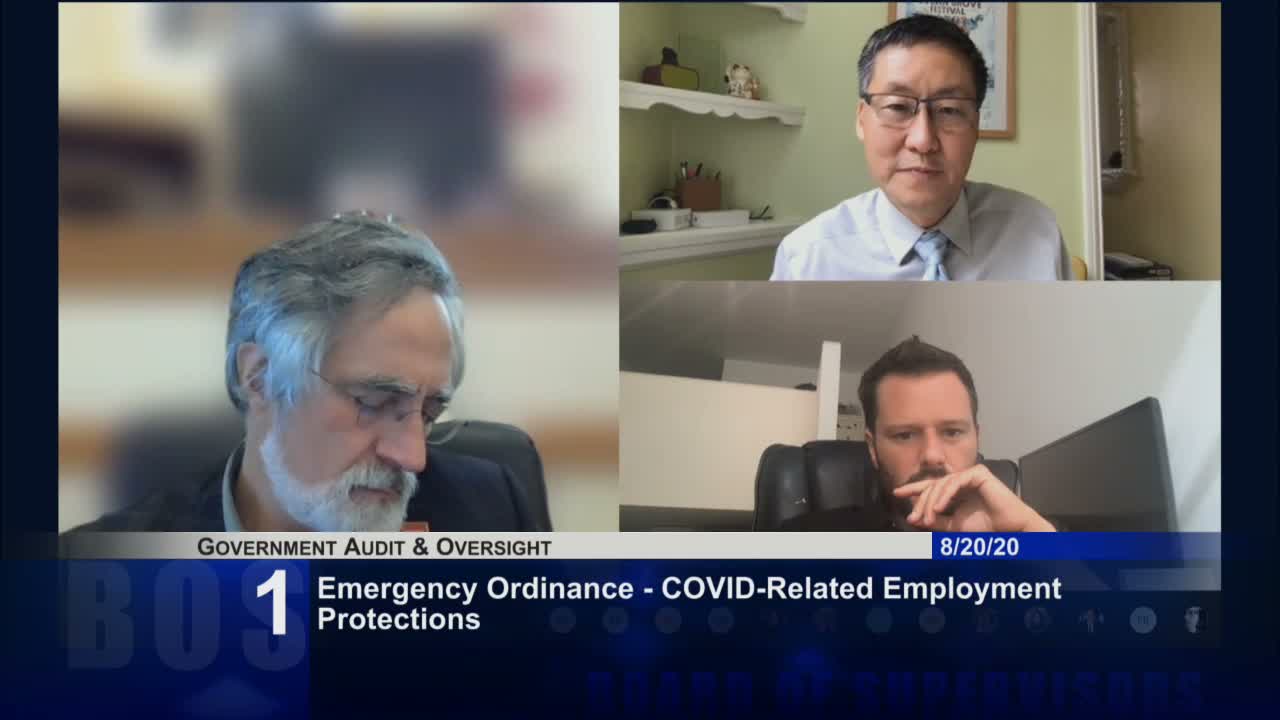
The Government Audit and Oversight Committee unanimously adopted four amendments to the SAFER Act, a San Francisco emergency ordinance that would prohibit adverse employment actions against workers who test positive for COVID-19 or must quarantine, and forwarded the ordinance to the Board with a positive recommendation.
The Government Audit and Oversight Committee on Aug. 24 adopted amendments to an emergency ordinance called the SAFER Act and voted to forward the measure to the full Board of Supervisors with a positive recommendation.
Paul Monque, legislative aide to Supervisor Hilary Ronan, told the committee the SAFER Act "will expand employment protections for workers who are unable to work because they test positive for COVID-19 or must quarantine," and said the ordinance complements income supports launched by the office and community partners. The ordinance would make it unlawful for an employer to fire, demote, suspend, discipline or otherwise discriminate against a worker who cannot work due to a positive test or required quarantine.
The committee approved four amendments Monque described: 1) a clearer definition of an independent contractor covered by the ordinance, setting a threshold of at least 16 hours worked; 2) language allowing employers to rebut a presumption of unlawful adverse action by showing an independent basis (such as performance or misconduct); 3) a clarification that employers may request a general basis for an absence but may not require medical documentation substantiating COVID status; and 4) a provision empowering the Office of Labor Standards Enforcement (OLSE) to provide immediate interim relief while investigations are pending.
Chair Supervisor Gordon Marr said the 16-hour threshold is "a low barrier to qualifying for these protections" while providing administrative clarity for OLSE. Monque told the committee workers who believe a positive diagnosis could result in job loss have avoided testing, undermining public-health efforts.
Two public commenters who identified themselves as gig workers urged explicit coverage and stronger enforcement for on-demand delivery workers. "All workers, including gig workers, must be protected during this pandemic," one caller, Tyler, said, arguing the city should make protections unambiguous. John Wong, another courier, said he and others had heard of deactivations after a positive test.
Supervisor Matt Haney, who asked to be added as a cosponsor, said the amendments and OLSE enforcement mechanisms are critical to protecting frontline and low-wage workers. The committee adopted the amendments on a 3–0 roll call (Peskin, Haney, Marr) and then voted to forward the amended emergency ordinance to the Board of Supervisors with a positive recommendation.
The ordinance establishes OLSE authority to investigate complaints and order remedies including reinstatement, payment of lost wages and civil penalties. Monque said violations could result in financial penalties for employers. The committee recorded no mailed or written public comments for this item during the live comment period.
The Board of Supervisors will consider the measure at a forthcoming meeting; the committee forwarded the item as a committee report with a positive recommendation, and staff said any enforcement questions should be directed to OLSE.